Stock Analysis · Healthpeak Properties Inc (DOC)
Overview
Healthpeak Properties Inc is a real estate investment trust, or REIT, focused on healthcare properties. Instead of operating hospitals or medical businesses itself, it owns buildings and earns rent from tenants that use those properties for healthcare-related activities. After its combination with Physicians Realty Trust, the company became more concentrated in outpatient medical buildings while still maintaining exposure to life science laboratories and senior housing.
Its revenue mainly comes from rental income and resident fees tied to three property groups. Based on the company’s latest annual reporting, the business mix is approximately:
- Outpatient medical: about 50% of total property operating income. This includes medical office and outpatient care buildings located near hospitals and health systems.
- Lab: about 30%. These are research and development properties leased to biotech, pharmaceutical, and life science tenants, mainly in major innovation clusters.
- Continuing Care Retirement Communities and other senior housing: about 20%. This includes housing and care-oriented communities for older adults.
This mix matters because it gives Healthpeak exposure to different healthcare demand drivers: doctor visits, scientific research activity, and aging demographics. It also reduces dependence on any one tenant category, although outpatient medical is now clearly the largest piece of the company.
The business has expanded its total revenue meaningfully over the past several years, but profitability has been more uneven. Revenue has climbed from under $2.0 billion in 2021 to above $2.8 billion in 2025, while net income has been much more volatile as interest costs, asset activity, and portfolio changes moved around.
The long-term pattern shows stronger revenue and gross profit, but a weaker conversion into bottom-line earnings in recent years. Rising interest expense has taken a larger share of operating income, which is an important point for a property company that depends heavily on financing.
Key Figures
| Metric | Value | Sector ⓘ |
|---|---|---|
| Date | Nov 06, 2026 | |
| Context | ||
| Sector | Real Estate | |
| Industry | REIT - Healthcare Facilities | |
| Market Cap ⓘ | $14.26B | |
| Beta ⓘ | 0.98 | |
Value (Cheapness) | ||
| P/E Ratio ⓘ | 37.26 | 18.32 |
| P/B Ratio ⓘ | 2.82 | 0.88 |
| FCF Yield ⓘ | 2.33% | 7.19% |
| Dividend Yield ⓘ | 6.05% | 4.45% |
| EBIT / EV ⓘ | 2.88% | 3.71% |
| PEG ⓘ | 4.32 | |
Growth (Business expansion) | ||
| Revenue Growth ⓘ | 16.30% | 5.70% |
| RPS Growth (5Y CAGR) ⓘ | 3.63% | 5.92% |
| EPS Growth (5Y CAGR) ⓘ | 39.37% | -5.19% |
| BVPS Growth (5Y CAGR) ⓘ | -5.53% | 0.39% |
| Margin Growth (5Y Trend) ⓘ | -0.38% | -0.69% |
| FCF Growth (5Y CAGR) ⓘ | 12.01% | 5.71% |
| DPS Growth (5Y CAGR) ⓘ | 0.30% | 5.01% |
Quality (Business durability) | ||
| ROIC (Latest) ⓘ | 3.71% | 5.14% |
| ROE (Latest) ⓘ | 6.68% | 7.53% |
| ROA (Latest) ⓘ | 1.82% | 3.19% |
| ROIC (5Y Median) ⓘ | 3.59% | 4.22% |
| ROE (5Y Median) ⓘ | 5.16% | 6.04% |
| ROA (5Y Median) ⓘ | 1.94% | 2.45% |
| Net Debt / EBIT (Latest) ⓘ | 13.77 | 7.47 |
| Net Debt / EBIT (5Y Median) ⓘ | 16.08 | 8.40 |
| Net Debt / EBITDA (Latest) ⓘ | 5.20 | 5.16 |
| Net Debt / Assets ⓘ | 40.86% | 37.17% |
| EBITDA / Interest ⓘ | 5.12 | 4.21 |
| Operating Margin (Latest) ⓘ | 21.70% | 34.79% |
| Operating Margin (5Y Median) ⓘ | 20.50% | 37.49% |
| Debt to Equity (Latest) ⓘ | 122.94% | 87.65% |
| Profit Margin (Latest) ⓘ | 12.32% | 20.06% |
| Free Cash Flow (Latest) ⓘ | $332.53M | |
Momentum (Price trend) | ||
| 3Y Return ⓘ | +43.93% | +35.62% |
| 12M Return (excl. last month) ⓘ | +5.52% | +1.92% |
| 6M Return ⓘ | +6.33% | -1.04% |
| Price vs. 200-Day MA ⓘ | +7.30% | +0.62% |
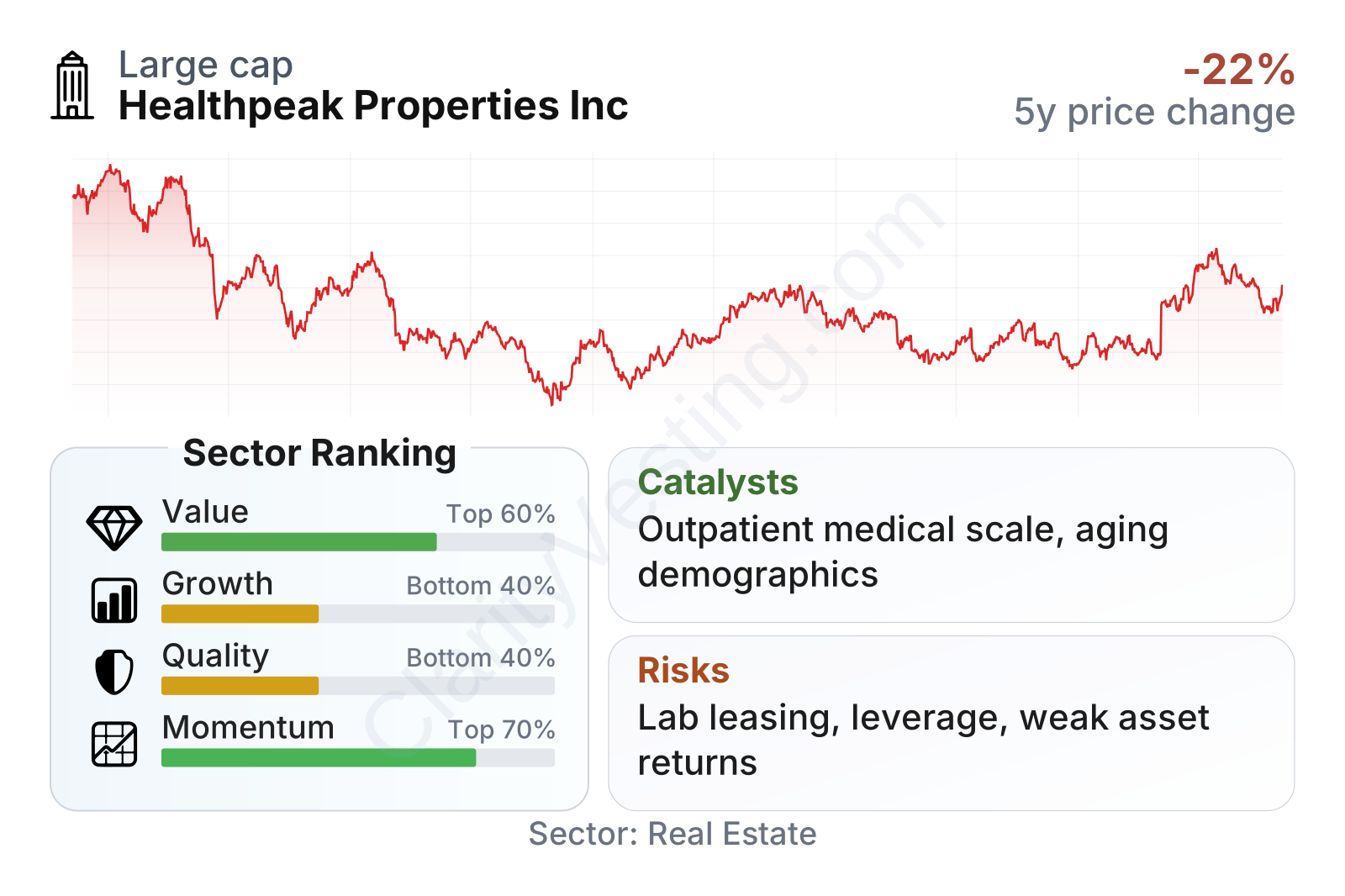
Healthpeak is a large healthcare REIT with a stock that has recovered well from its 2023 lows and has recently outperformed much of the broader real estate sector. The table suggests a mixed profile: market momentum is relatively solid, near-term revenue growth is strong, but quality and long-term growth measures remain less impressive than many sector peers. Valuation also appears demanding, especially on earnings, book value, and cash flow-based measures.
The dividend yield is above the sector median, which is often one of the first things people notice with REITs. However, the company’s free cash flow yield is lower than the sector median, so the higher income profile comes with a valuation that already reflects a meaningful amount of optimism.
Growth
Healthpeak operates in a part of real estate that benefits from durable structural demand. The largest support is demographics: the U.S. population is aging, which tends to increase demand for physician visits, outpatient procedures, chronic disease management, and senior living services. At the same time, life science research remains important for drug development and medical innovation, supporting demand for specialized lab space in leading research markets.
The company’s strategy is fairly easy to understand. It has been building scale in outpatient medical properties, where tenant demand is usually tied to recurring healthcare usage rather than discretionary spending. This segment can be more defensive than some other forms of commercial real estate because medical visits do not stop simply because the economy slows. The Physicians Realty Trust merger strengthened that positioning and increased Healthpeak’s presence in on-campus or affiliated medical office locations.
Revenue per share has trended upward over the last five years, but the slope has been modest rather than steep. That suggests the company is growing, though not at a pace that clearly separates it from the sector over a full cycle. Recent year-over-year growth has been much stronger than the sector median, so the key question is whether that improvement proves durable after the portfolio reshaping effects fade.
Another growth angle is development and redevelopment. In healthcare real estate, well-located projects near major hospital systems or research clusters can create value over time because replacement costs are high and zoning can be restrictive. Healthpeak also benefits from relationships with health systems, universities, and life science tenants in established markets, which can help maintain occupancy and pricing power if demand remains healthy.
The dividend per share has been broadly stable, with only limited growth over the period. That stability can signal resilience in recurring rent collection, but it also shows that most of the company’s investment case is tied to portfolio quality and operating execution rather than fast-growing shareholder distributions.
Recent company updates have continued to emphasize leasing activity, balance sheet management, and integration benefits from the enlarged outpatient platform. In practical terms, the most important opportunity is not a single headline event but the possibility that Healthpeak can turn its larger, more focused portfolio into steadier occupancy, better rent spreads, and lower financing pressure over time.
Risks
This article is for informational purposes only and does not constitute financial advice. Some content is AI-generated. See Disclaimer