Stock Analysis · Danieli & C Officine Meccaniche SpA (DNIYY)
Overview
Danieli & C Officine Meccaniche is an Italian industrial engineering group that designs and builds equipment, plants, and digital systems used to produce steel and other metals. In simple terms, it sells the machinery that steelmakers need to melt scrap, cast metal, roll it into finished products, and automate the whole process. The group is also active in making specialty steels directly through its Acciaierie Bertoli Safau, or ABS, division.
That means Danieli combines two businesses under one umbrella: a plant-making business and a steelmaking business. The engineering side is the larger and more strategic activity because it provides technology, project management, installation, modernization, and increasingly software and automation. The steel side gives the group direct exposure to metal prices and end-market cycles, but it also helps Danieli test and showcase its own production technologies in a real operating environment.
Based on the company’s annual reporting structure, the main revenue sources are approximately:
- Plant making and industrial systems: about 75% to 85%. This includes steelmaking equipment, rolling mills, continuous casting lines, environmental systems, digital automation, and after-sales services, upgrades, and spare parts.
- Steel production (ABS): about 15% to 25%. This includes specialty steels and related long products manufactured and sold by the group.
Within the plant engineering business, a meaningful share comes from projects tied to electric arc furnaces, continuous casting, rolling, energy efficiency, and lower-emission steel production. Exact product-level percentages are not consistently disclosed in a way that supports a precise split, but the company’s positioning clearly centers on steel plant technology.
Recent revenue has remained around the low single-digit billions of euros, with operating income and net income staying positive through the cycle. The business mix is important for long-term analysis: the engineering segment typically offers better strategic value and customer stickiness, while the steel segment adds cyclicality.
The income structure shows a business with large project revenue, solid gross profit generation, and moderate final profitability. Over the last few reported years, sales increased from roughly €3.5 billion to around €4.2 billion, while net income stayed in the low hundreds of millions. That points to growth with margins that remain respectable but not exceptionally wide, which is normal for heavy industrial engineering.
Key Figures
| Metric | Value | Sector ⓘ |
|---|---|---|
| Date | Oct 17, 2026 | |
| Context | ||
| Sector | Industrials | |
| Industry | Specialty Industrial Machinery | |
| Market Cap ⓘ | $3.69B | |
| Beta ⓘ | 1.24 | |
Value (Cheapness) | ||
| P/E Ratio ⓘ | 11.59 | 22.10 |
| P/B Ratio ⓘ | 1.02 | 1.97 |
| FCF Yield ⓘ | 22.56% | 6.38% |
| Dividend Yield ⓘ | 1.02% | 1.94% |
| EBIT / EV ⓘ | 22.44% | 4.79% |
| PEG ⓘ | N/A | |
Growth (Business expansion) | ||
| Revenue Growth ⓘ | -4.80% | 9.30% |
| RPS Growth (5Y CAGR) ⓘ | 0.27% | 7.81% |
| EPS Growth (5Y CAGR) ⓘ | 21.07% | -13.06% |
| BVPS Growth (5Y CAGR) ⓘ | 5.00% | 6.14% |
| Margin Growth (5Y Trend) ⓘ | -2.84% | 0.88% |
| FCF Growth (5Y CAGR) ⓘ | 32.74% | 11.01% |
| DPS Growth (5Y CAGR) ⓘ | 18.91% | 9.48% |
Quality (Business durability) | ||
| ROIC (Latest) ⓘ | N/A | 10.84% |
| ROA (Latest) ⓘ | 3.56% | 5.41% |
| ROIC (5Y Median) ⓘ | 8.70% | 9.38% |
| ROA (5Y Median) ⓘ | 3.43% | 4.95% |
| Net Debt / EBIT (Latest) ⓘ | -7.00 | 2.08 |
| Net Debt / EBIT (5Y Median) ⓘ | -4.66 | 2.27 |
| Net Debt / EBITDA (Latest) ⓘ | -3.56 | 1.39 |
| Net Debt / Assets ⓘ | -22.90% | 19.28% |
| EBITDA / Interest ⓘ | N/A | 9.58 |
| Operating Margin (Latest) ⓘ | 6.00% | 10.50% |
| Operating Margin (5Y Median) ⓘ | 7.22% | 10.29% |
| Debt to Equity (Latest) ⓘ | 29.41% | 65.48% |
| Profit Margin (Latest) ⓘ | 6.01% | 6.67% |
| Free Cash Flow (Latest) ⓘ | $832.81M | |
Momentum (Price trend) | ||
| 3Y Return ⓘ | +77.94% | +61.68% |
| 12M Return (excl. last month) ⓘ | +10.88% | +12.58% |
| 6M Return ⓘ | 0.00% | 0.00% |
| Price vs. 200-Day MA ⓘ | 0.00% | +0.02% |
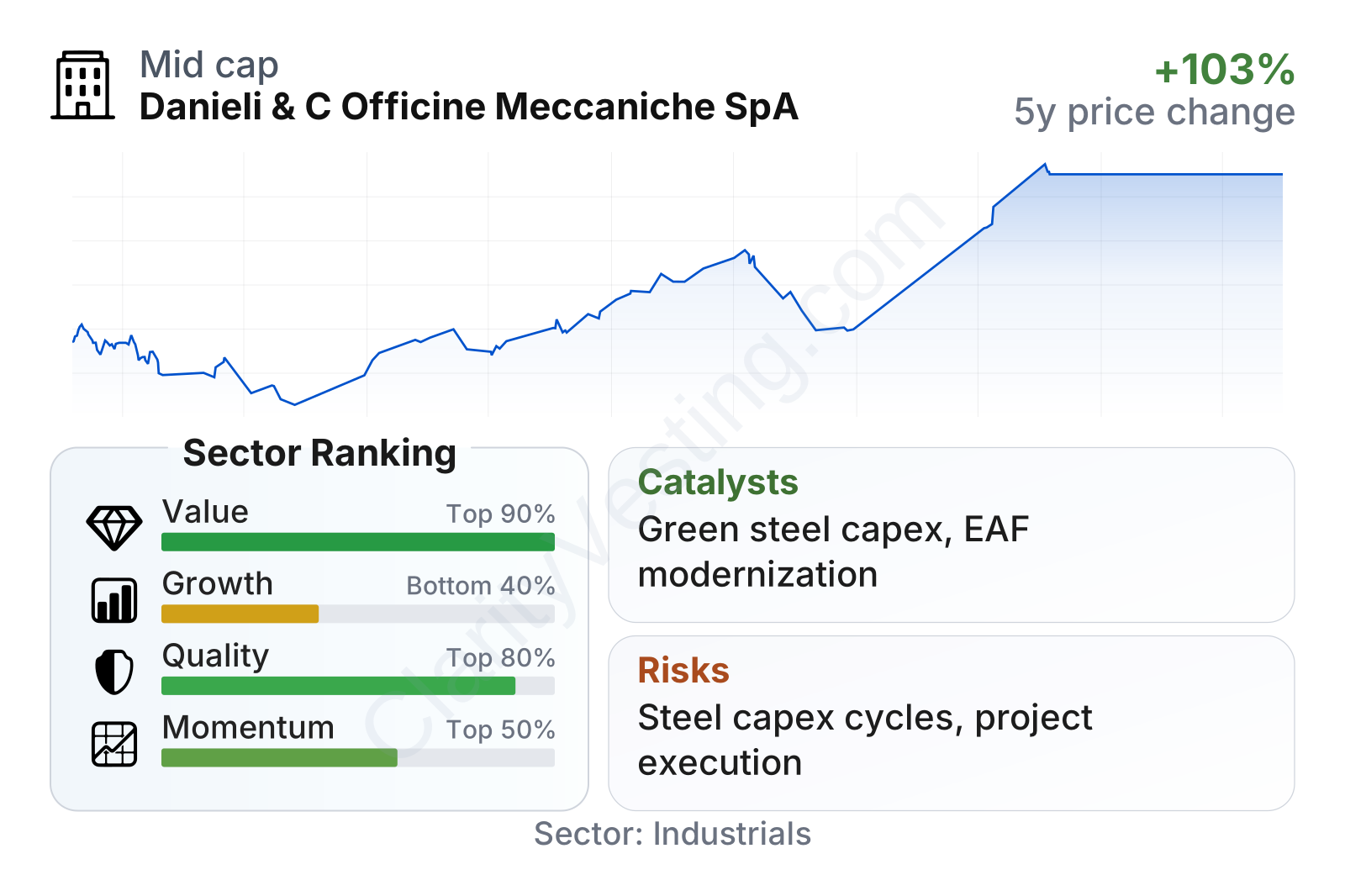
Danieli stands out most on valuation and cash generation. Its earnings multiple and book multiple sit well below sector norms, while free cash flow yield and EBIT relative to enterprise value are unusually strong. Growth metrics are mixed in the short term, with recent year-over-year revenue pressure, but the longer five-year record is much stronger, especially for earnings and free cash flow. Quality is more balanced: leverage looks conservative, but margins and returns on assets remain somewhat below the sector median. In market performance, the long-term share return has been solid, though recent momentum has been less impressive.
The company is mid-sized rather than a giant in global industrials, and its beta slightly above 1 suggests the stock can move somewhat more than the broader market. The most striking financial characteristic is balance-sheet strength: Danieli appears to operate with net cash rather than heavy net debt, which matters in a cyclical capital-equipment business.
Growth
Danieli operates in a sector with a credible long-term growth angle, even though it remains cyclical. Steel demand itself does not usually grow at technology-sector rates, but the installed base of steel plants needs continuous modernization. The biggest industry theme is the shift toward more efficient and lower-emission production, especially scrap-based steelmaking, electric arc furnaces, energy recovery, process automation, and digital control systems. Danieli is directly exposed to all of these trends.
Its strategy makes industrial sense. Steel producers around the world are under pressure to lower energy use, reduce emissions, improve yield, and automate operations. Replacing or upgrading legacy blast furnace infrastructure with newer electric and hybrid technologies is a multi-year investment cycle, and Danieli is one of the companies capable of delivering complete plants rather than only individual machines. That integrated capability can make it relevant for large, complex projects.
Another growth support is the service and modernization angle. Even when customers delay entirely new plants, they may still spend on revamps, efficiency upgrades, spare parts, automation, and maintenance. That can soften the cycle compared with relying only on brand-new projects.
Cash generation is a notable point. The latest trailing free cash flow is very strong relative to the company’s size, and the longer-term trend has improved sharply. In capital goods, strong cash flow matters because accounting earnings can be affected by project timing, working capital swings, and milestone payments. Danieli’s recent profile suggests that project execution and cash conversion have been favorable.
As for near-term catalysts, the company has continued to emphasize technology for green steel, digital plant control, and high-efficiency electric steelmaking in its public materials. Europe’s decarbonization agenda, steelmakers’ need to modernize old capacity, and demand for recycling-based production all create a real commercial opportunity. Danieli also benefits from having an operating steel subsidiary, which gives credibility when marketing industrial solutions built around productivity and efficiency.
Risks
This article is for informational purposes only and does not constitute financial advice. Some content is AI-generated. See Disclaimer


