Stock Analysis · Damora Therapeutics Inc (DMRA)
Overview
Damora Therapeutics Inc is a biotechnology company in the healthcare sector. Like many small and mid-sized biotech businesses, it appears to be focused on developing drug candidates rather than selling approved medicines at scale today. That matters for long-term analysis because the company’s value depends much more on clinical progress, regulatory milestones, and future commercialization potential than on current product sales.
At this stage, revenue is effectively absent. Recent annual results show no meaningful operating revenue, which places Damora in the pre-commercial or very early commercial category. In practical terms, the business is still being funded mainly by investor capital and balance-sheet resources while it spends heavily on research and development.
The company’s economic profile is therefore simple today:
- Product revenue: approximately 0%. There is no meaningful recurring sales base visible in recent annual results.
- Collaboration, licensing, or milestone revenue: approximately 0% in the latest annual view available from the financial profile shown here.
- Other revenue: negligible.
The clearest operating pattern is not revenue diversification but expense concentration. Research and development has historically been the largest use of cash, with general and administrative costs a distant second. In 2025, research and development represented roughly 95% of operating expenses, showing that the company’s resources were directed overwhelmingly toward pipeline development rather than commercial infrastructure.
The financial flow highlights a classic biotech setup: no meaningful revenue, persistent operating losses, and a cost base dominated by pipeline spending. Expenses had been reduced through 2024, then rose sharply in 2025 as development activity accelerated again, which suggests a company entering a more capital-intensive phase.
Key Figures
| Metric | Value | Sector ⓘ |
|---|---|---|
| Date | Oct 17, 2026 | |
| Context | ||
| Sector | Healthcare | |
| Industry | Biotechnology | |
| Market Cap ⓘ | $1.14B | |
| Beta ⓘ | 1.44 | |
Value (Cheapness) | ||
| P/E Ratio ⓘ | N/A | 24.79 |
| P/B Ratio ⓘ | 2.22 | 3.08 |
| FCF Yield ⓘ | -3.91% | 3.15% |
| Dividend Yield ⓘ | N/A | 1.94% |
| EBIT / EV ⓘ | -18.74% | 0.57% |
| PEG ⓘ | N/A | |
Growth (Business expansion) | ||
| Revenue Growth ⓘ | N/A | 7.45% |
| RPS Growth (5Y CAGR) ⓘ | N/A | 8.61% |
| EPS Growth (5Y CAGR) ⓘ | -64.90% | -17.81% |
| BVPS Growth (5Y CAGR) ⓘ | 11.04% | 3.72% |
| Margin Growth (5Y Trend) ⓘ | N/A | -0.62% |
| FCF Growth (5Y CAGR) ⓘ | -40.18% | 1.04% |
| DPS Growth (5Y CAGR) ⓘ | N/A | 6.77% |
Quality (Business durability) | ||
| ROIC (Latest) ⓘ | -139.54% | 3.24% |
| ROA (Latest) ⓘ | -94.82% | 3.01% |
| ROIC (5Y Median) ⓘ | N/A | 4.60% |
| ROA (5Y Median) ⓘ | -68.84% | 1.89% |
| Net Debt / EBIT (Latest) ⓘ | N/A | 1.34 |
| Net Debt / EBIT (5Y Median) ⓘ | N/A | 1.84 |
| Net Debt / EBITDA (Latest) ⓘ | N/A | 1.00 |
| Net Debt / Assets ⓘ | -99.43% | 5.45% |
| EBITDA / Interest ⓘ | N/A | 9.64 |
| Operating Margin (Latest) ⓘ | N/A | 9.27% |
| Operating Margin (5Y Median) ⓘ | N/A | 7.38% |
| Debt to Equity (Latest) ⓘ | N/A | 28.58% |
| Profit Margin (Latest) ⓘ | N/A | 3.59% |
| Free Cash Flow (Latest) ⓘ | -$44.52M | |
Momentum (Price trend) | ||
| 3Y Return ⓘ | +10.89% | +42.80% |
| 12M Return (excl. last month) ⓘ | +774.56% | +18.50% |
| 6M Return ⓘ | -29.58% | +7.57% |
| Price vs. 200-Day MA ⓘ | -27.11% | +5.12% |
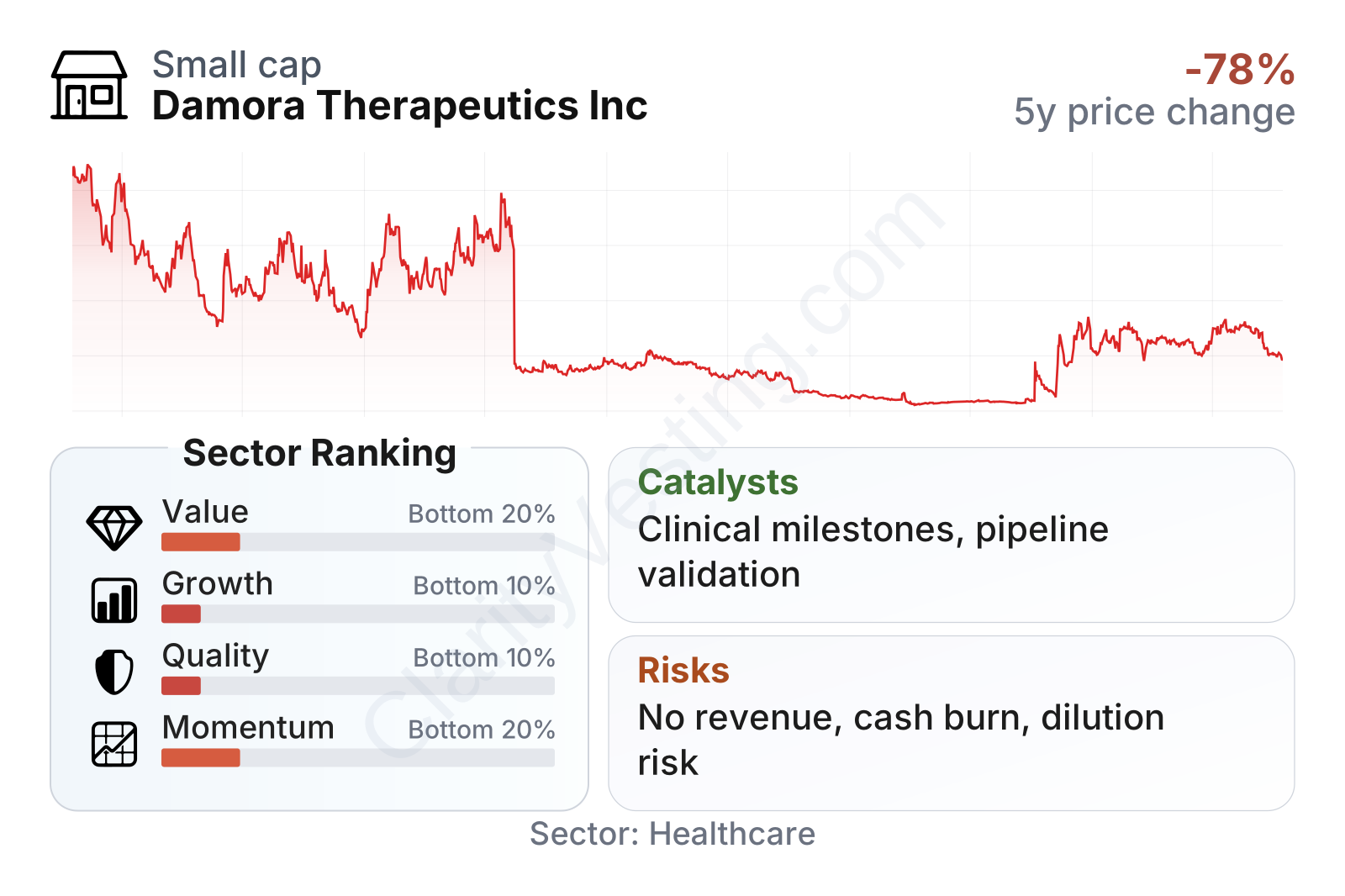
Damora is a small-cap biotech with above-average share-price volatility, reflected in a beta around 1.5. The stock chart shows a steep decline from 2021 into 2025 followed by a very strong rebound into 2026, which is typical of clinical-stage biotech names where sentiment can change quickly around trial expectations and financing conditions.
The metrics table points to a company that ranks weakly on traditional fundamentals versus the broader healthcare sector. Value factors sit in the lower end of the sector because earnings are negative and free cash flow is still negative. Quality and growth scores are also in the bottom decile, mainly because profitability is deeply negative and revenue growth is not yet established.
At the same time, the balance sheet is less stressed than many unprofitable biotech peers. Debt use is extremely low, and the company has at times held net cash rather than net debt. That does not remove funding risk, but it does mean Damora is not currently leaning on heavy leverage to finance operations.
Growth
Damora operates in biotechnology, a sector that can create very large long-term value when a company advances promising therapies into late-stage trials and eventually into regulatory approval. This is a structurally attractive area because medical innovation remains a major priority across oncology, rare disease, autoimmune conditions, and other high-need categories. The trade-off is that sector growth does not automatically translate into company growth; each business still has to prove its science.
Damora’s strategic logic appears straightforward: keep spending centered on research, preserve a relatively clean balance sheet, and aim to create value through pipeline milestones rather than near-term sales. For a development-stage company, that approach makes sense. If a lead asset shows convincing clinical data, the company could unlock several paths to growth, including partnership income, licensing, or eventual product revenue.
One encouraging point is that Damora reduced cash burn meaningfully through 2024 before burn worsened again in the latest trailing period. That pattern can mean management had previously tightened spending and then chose to step back up investment as programs advanced. Whether that renewed spending creates value will depend on clinical execution.
Free cash flow remains negative, but the trend is more nuanced than a simple straight deterioration. Burn improved materially from 2022 to 2025 before turning weaker again in the most recent trailing period. For a biotech company, that is often linked to trial timing rather than a normal operating cycle, so future updates on study progress matter more than one quarter in isolation.
The strongest potential catalyst is any clinical or regulatory event that validates the underlying platform or lead program. In this type of company, a favorable data release can reshape valuation far more quickly than ordinary revenue growth would in a mature business. The sharp stock recovery over the last year suggests the market has already started to price in improved expectations, which makes upcoming milestones especially important.
Risks
This article is for informational purposes only and does not constitute financial advice. Some content is AI-generated. See Disclaimer


