Stock Analysis · Domino's Pizza Group plc (DMPZF)
Overview
Domino's Pizza Group plc is the master franchisee for the Domino’s brand in the United Kingdom and Ireland. Rather than operating as a broad restaurant chain with many formats, it is focused mainly on pizza delivery and takeaway, supported by digital ordering, local store operations, supply chain services, and brand marketing. Its role in the system is broader than just collecting franchise fees: it also runs the dough manufacturing and food distribution network that supplies franchised stores, while operating a smaller number of corporate stores directly.
This matters for long-term analysis because the business combines elements of a franchise company and a food distributor. Franchise systems often benefit from brand recognition and recurring fee income, while supply operations can add scale and control over product quality, although they also expose the company to food, labor, and logistics costs.
Based on recent annual reporting, the main sources of revenue are approximately:
- Supply chain sales to franchisees and stores: about 85% to 90%. This includes dough, food ingredients, packaging, and other items distributed through the group’s central network.
- Corporate store revenue: about 5% to 10%. This comes from stores operated directly by the company rather than by franchise partners.
- Franchise-related income and other revenue: about 3% to 7%. This generally includes royalties, fees, and other system-related income.
The revenue mix shows that Domino’s Pizza Group is driven mostly by the health of its store network and order volumes moving through its supply chain. Over recent years, revenue has stayed in a fairly stable range but profitability has been more uneven, with operating profit rising strongly in 2024 before easing again in 2025 as interest costs and net income came under pressure.
The business flow highlights a useful pattern: sales have grown from the 2021 level to a higher level in 2025, but profit conversion has been less consistent. Operating income improved materially in 2024, then softened in 2025, while interest expense has trended upward over the same period. That suggests the core model remains productive, but financing costs and margin discipline matter a lot for shareholder returns.
Key Figures
| Metric | Value | Sector ⓘ |
|---|---|---|
| Date | Oct 03, 2026 | |
| Context | ||
| Sector | Consumer Cyclical | |
| Industry | Restaurants | |
| Market Cap ⓘ | $1.01B | |
| Beta ⓘ | 1.22 | |
Value (Cheapness) | ||
| P/E Ratio ⓘ | 13.25 | 17.04 |
| P/B Ratio ⓘ | N/A | 1.61 |
| FCF Yield ⓘ | 16.22% | 9.02% |
| Dividend Yield ⓘ | 4.30% | 2.75% |
| EBIT / EV ⓘ | N/A | 6.69% |
| PEG ⓘ | N/A | |
Growth (Business expansion) | ||
| Revenue Growth ⓘ | 6.70% | 5.60% |
| RPS Growth (5Y CAGR) ⓘ | 9.65% | 9.04% |
| EPS Growth (5Y CAGR) ⓘ | -18.36% | -17.44% |
| BVPS Growth (5Y CAGR) ⓘ | N/A | 5.73% |
| Margin Growth (5Y Trend) ⓘ | -3.92% | -0.26% |
| FCF Growth (5Y CAGR) ⓘ | -8.61% | 4.91% |
| DPS Growth (5Y CAGR) ⓘ | -2.15% | 10.48% |
Quality (Business durability) | ||
| ROIC (Latest) ⓘ | 268.91% | 12.38% |
| ROA (Latest) ⓘ | 22.85% | 5.54% |
| ROIC (5Y Median) ⓘ | 44.64% | 10.63% |
| ROA (5Y Median) ⓘ | 15.65% | 5.44% |
| Net Debt / EBIT (Latest) ⓘ | 2.10 | 2.16 |
| Net Debt / EBIT (5Y Median) ⓘ | 4.33 | 2.31 |
| Net Debt / EBITDA (Latest) ⓘ | 1.73 | 1.52 |
| Net Debt / Assets ⓘ | 88.59% | 21.74% |
| EBITDA / Interest ⓘ | 6.94 | 9.06 |
| Operating Margin (Latest) ⓘ | 18.24% | 9.12% |
| Operating Margin (5Y Median) ⓘ | 17.02% | 9.56% |
| Debt to Equity (Latest) ⓘ | -656.99% | 76.18% |
| Profit Margin (Latest) ⓘ | 8.40% | 5.30% |
| Free Cash Flow (Latest) ⓘ | $163.82M | |
Momentum (Price trend) | ||
| 3Y Return ⓘ | -36.48% | +11.77% |
| 12M Return (excl. last month) ⓘ | +2.95% | +0.61% |
| 6M Return ⓘ | +20.48% | +1.32% |
| Price vs. 200-Day MA ⓘ | -22.45% | -3.47% |
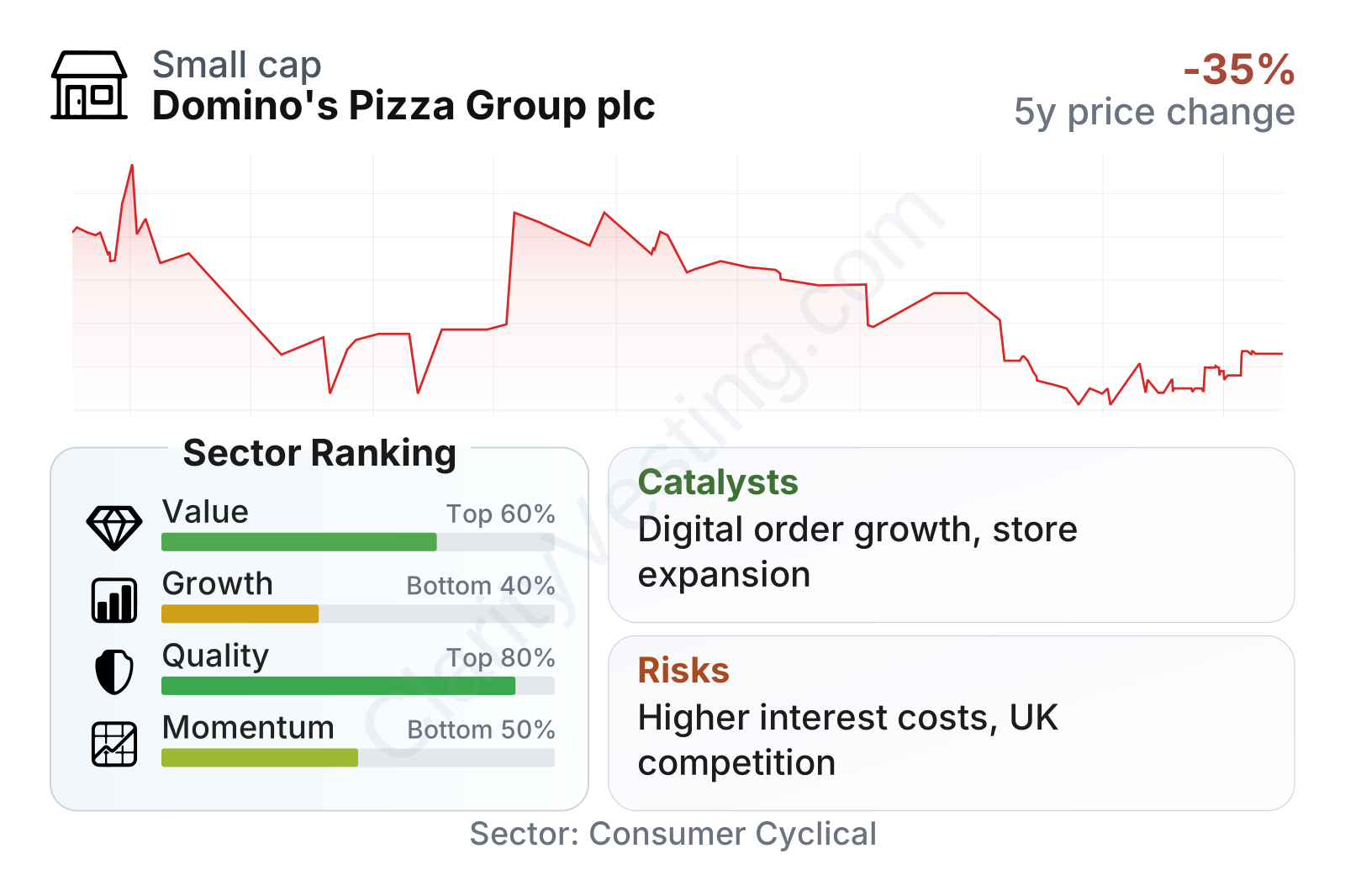
Domino’s Pizza Group is a mid-sized listed restaurant business with a market value of around $1.0 billion and share-price volatility somewhat above the broader market. The overall profile is mixed but understandable. On valuation, it screens cheaper than much of the sector, with a P/E ratio around 13 versus a sector median near 17, and its free cash flow yield and dividend yield are both above typical peer levels. On quality, margins and returns on assets are comfortably ahead of many restaurant peers, reflecting the economics of a branded franchise-and-supply model. The weaker area is growth consistency: revenue has still grown, but earnings, free cash flow, and dividend progression over five years have been less impressive than the stronger quality metrics might suggest.
Growth
The company operates in a part of the restaurant market that still has structural support. Pizza delivery and takeaway remain tied to convenience, digital ordering, value-focused meals, and at-home consumption. Those trends are not new, but they continue to matter, especially when households become more selective about discretionary spending. Domino’s is also well positioned within that behavior because its brand is built around fast delivery, local coverage, and a highly digital customer journey.
Its strategy for future expansion is sensible in principle. The company can grow through a combination of like-for-like order recovery, new store openings, better delivery efficiency, stronger app usage, and higher average ticket values from product mix and promotions. A franchise-based network also means expansion does not always require the same level of capital as a fully company-owned restaurant model.
Recent growth indicators point to modest rather than explosive expansion. Revenue growth is running slightly above the sector median on the latest year-over-year measure, and the five-year revenue-per-share trend is also a little stronger than the peer midpoint. That said, the longer earnings trend has been weaker, which suggests that sales growth alone has not consistently translated into stronger bottom-line performance.
One meaningful catalyst is the company’s ability to increase order density through digital channels. In delivery businesses, more orders through the same local store base can improve economics because fixed costs are spread more efficiently. Another catalyst is network optimization: if franchise relations remain constructive and store development continues in underserved areas, the system can still add scale. The UK and Ireland pizza category is mature, but Domino’s brand awareness, delivery infrastructure, and national marketing reach still create room for incremental gains rather than a simple saturation case.
Recent company updates have also emphasized operational initiatives such as menu innovation, customer value campaigns, and further improvement in technology and service. Those are not dramatic one-off opportunities, but in this industry small execution gains can compound over time, particularly when paired with a recognized consumer brand.
Risks
This article is for informational purposes only and does not constitute financial advice. Some content is AI-generated. See Disclaimer