Stock Analysis · d'Amico International Shipping S.A (DMCOF)
Overview
d’Amico International Shipping S.A. is a tanker company focused on transporting refined petroleum products by sea. In simple terms, it operates ships that move cargoes such as gasoline, diesel, jet fuel, and naphtha between regions. The company is part of the product tanker market rather than the crude oil tanker market, which matters because refined-product shipping follows different trade flows, customer needs, and rate cycles.
The fleet is centered on medium-range tankers, a segment commonly used for moving clean petroleum products on regional and intercontinental routes. The business model is fairly straightforward: the company earns revenue by chartering its vessels to oil majors, trading houses, and other shipping customers. Results depend heavily on freight rates, vessel utilization, operating costs, and financing costs.
Based on company reporting, revenue is overwhelmingly generated by shipping services rather than by multiple unrelated business lines. A practical breakdown is:
- Voyage and time-charter shipping revenue: about 95% to 100% — income from transporting refined petroleum products and from chartering vessels to customers.
- Other maritime-related revenue: about 0% to 5% — mainly smaller ancillary items such as technical or commercial adjustments, if any, rather than a separate major operating segment.
Geographically, the company serves global trade routes instead of depending on a single domestic market, which can help diversify customer exposure. At the same time, that also means earnings are tied to worldwide product demand, refinery dislocations, fleet supply, and disruptions in trade patterns.
What stands out in the business profile is the sharp improvement since 2022. Revenue and profitability rose strongly as tanker markets tightened, and the company turned that favorable environment into higher margins, lower interest burden, and stronger cash generation. More recently, revenue has come down from the 2023 peak, but profitability has remained at levels that are still robust by industry standards.
The long-term pattern here is notable: revenue surged in 2022 and 2023, operating profit expanded much faster than sales, and interest expense steadily fell through 2025. Even with lower 2025 revenue than the prior two years, earnings remained well above pre-upcycle levels, suggesting the balance sheet and cost structure improved meaningfully during the strong part of the cycle.
Key Figures
| Metric | Value | Sector ⓘ |
|---|---|---|
| Date | Oct 17, 2026 | |
| Context | ||
| Sector | Industrials | |
| Industry | Marine Shipping | |
| Market Cap ⓘ | $1.21B | |
| Beta ⓘ | 0.55 | |
Value (Cheapness) | ||
| P/E Ratio ⓘ | 9.34 | 22.10 |
| P/B Ratio ⓘ | 1.48 | 1.97 |
| FCF Yield ⓘ | 10.80% | 6.38% |
| Dividend Yield ⓘ | 3.97% | 1.94% |
| EBIT / EV ⓘ | 13.86% | 4.79% |
| PEG ⓘ | N/A | |
Growth (Business expansion) | ||
| Revenue Growth ⓘ | 19.80% | 9.30% |
| RPS Growth (5Y CAGR) ⓘ | 9.93% | 7.81% |
| EPS Growth (5Y CAGR) ⓘ | N/A | -13.06% |
| BVPS Growth (5Y CAGR) ⓘ | 24.24% | 6.14% |
| Margin Growth (5Y Trend) ⓘ | 31.68% | 0.88% |
| FCF Growth (5Y CAGR) ⓘ | 38.67% | 11.01% |
| DPS Growth (5Y CAGR) ⓘ | 7.18% | 9.48% |
Quality (Business durability) | ||
| ROIC (Latest) ⓘ | 11.66% | 10.84% |
| ROA (Latest) ⓘ | 12.23% | 5.41% |
| ROIC (5Y Median) ⓘ | 18.12% | 9.38% |
| ROA (5Y Median) ⓘ | 13.55% | 4.95% |
| Net Debt / EBIT (Latest) ⓘ | N/A | 2.08 |
| Net Debt / EBIT (5Y Median) ⓘ | 0.60 | 2.27 |
| Net Debt / EBITDA (Latest) ⓘ | N/A | 1.39 |
| Net Debt / Assets ⓘ | N/A | 19.28% |
| EBITDA / Interest ⓘ | 14.30 | 9.58 |
| Operating Margin (Latest) ⓘ | 39.65% | 10.50% |
| Operating Margin (5Y Median) ⓘ | 34.96% | 10.29% |
| Debt to Equity (Latest) ⓘ | N/A | 65.48% |
| Profit Margin (Latest) ⓘ | 35.98% | 6.67% |
| Free Cash Flow (Latest) ⓘ | $130.99M | |
Momentum (Price trend) | ||
| 3Y Return ⓘ | +179.07% | +61.68% |
| 12M Return (excl. last month) ⓘ | +94.33% | +12.58% |
| 6M Return ⓘ | +15.95% | 0.00% |
| Price vs. 200-Day MA ⓘ | +18.21% | +0.02% |
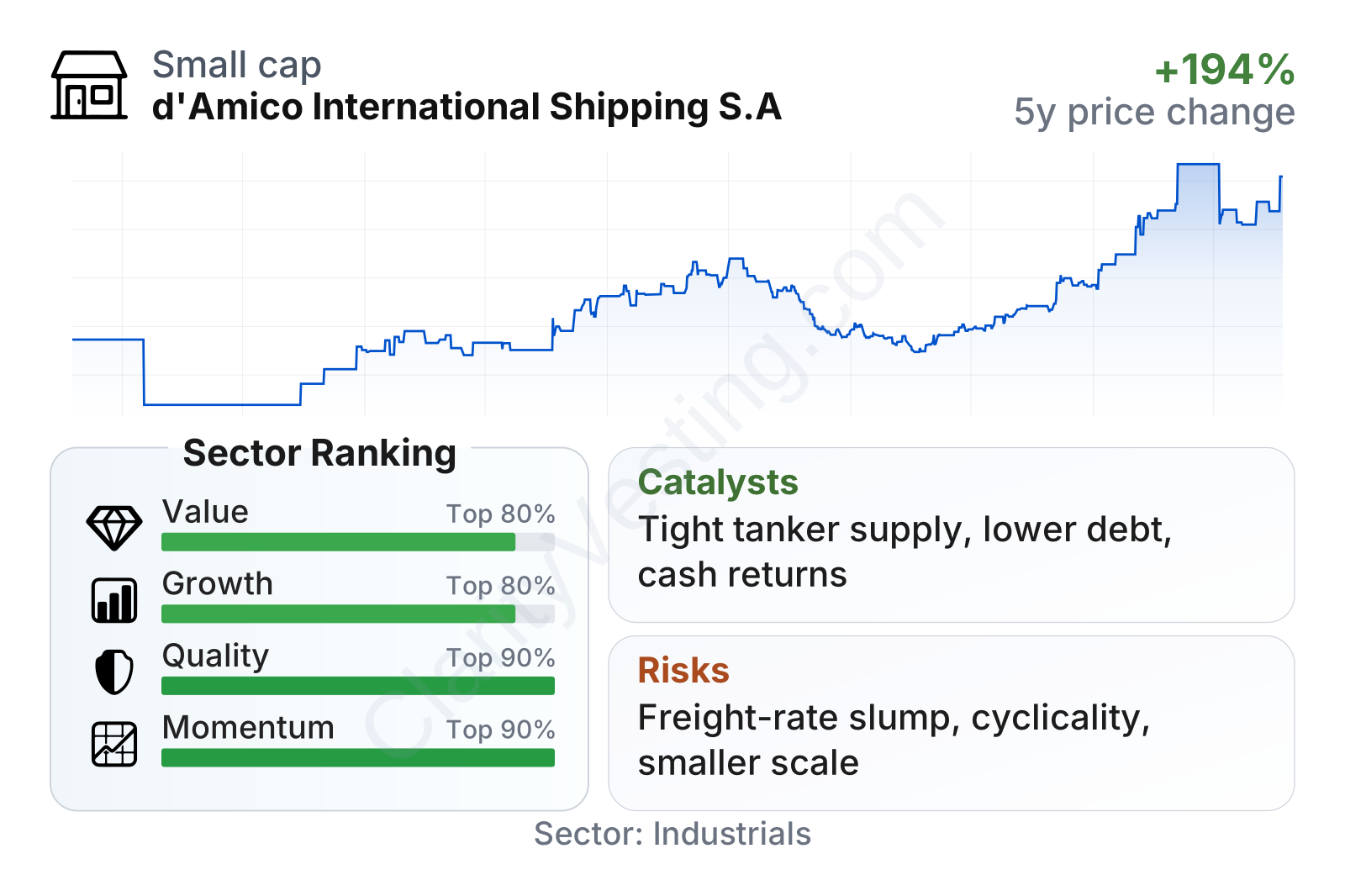
The company is now a mid-sized shipping name with a market value around $1.2 billion and a beta below 1, which indicates lower share-price sensitivity than many cyclical industrial stocks. Across value, growth, quality, and momentum, it ranks well versus much of the broader sector. Valuation multiples remain below sector norms, while profitability, cash flow generation, and capital efficiency are all stronger than typical peers. The combination is unusual: the market is recognizing the earnings recovery, but the stock still screens as inexpensive relative to many industrial companies.
The share-price history also shows how cyclical the name can be. After a deep drop in 2022, the stock recovered strongly through 2023, 2024, and into 2026. That recovery matches the company’s operational turnaround and stronger tanker market backdrop.
Growth
The product tanker market is not a traditional high-growth industry, but it can benefit from powerful structural shifts. In recent years, refinery closures in some regions, new refining capacity in others, and changing fuel trade routes have increased average shipping distances. That matters because longer routes absorb more vessel capacity and can support freight rates even without a dramatic rise in total fuel consumption. In that sense, d’Amico operates in a sector where logistics dislocation can be just as important as pure volume growth.
The company’s strategy fits that backdrop well. Its concentration in product tankers gives it direct exposure to the part of the market that has benefited from changing global refinery geography and rerouted oil-product trade. The focus on a relatively specialized fleet is more coherent than trying to spread capital across many shipping categories with different cycles.
Revenue growth has been volatile, which is normal in shipping. The company moved from a small decline in 2021 to a very strong surge in 2022, followed by continued expansion in 2023 before normalization later on. Even after that moderation, the broader five-year picture remains favorable, with revenue per share growing faster than the sector median. This suggests the recent period was not just a temporary accounting effect but a real step-up in operating scale and earnings power.
Cash generation is another important part of the growth case. Free cash flow improved sharply during the tanker upcycle and remains one of the company’s strongest metrics versus peers. That gives management more flexibility to reduce debt, support dividends, renew the fleet, or pursue selective expansion without relying as heavily on external financing. In shipping, that flexibility matters because companies often need to navigate long stretches of weaker freight markets.
A meaningful catalyst is the company’s improved financial base after the strong market years. Lower leverage and better interest coverage can amplify future upside if freight rates stay healthy, because more of the operating profit can reach net income and cash flow. Another supportive element is industry supply: product tanker fleet growth has generally been constrained by limited shipyard capacity, high newbuild prices, and competition from other vessel categories for slots. If vessel supply remains disciplined, the market can stay tighter for longer than many cyclical investors expect.
Recent company communications have also emphasized continued shareholder distributions and active balance-sheet management, which signals confidence in cash generation. That does not remove cyclicality, but it suggests management is operating from a stronger position than it did a few years ago.
Risks
This article is for informational purposes only and does not constitute financial advice. Some content is AI-generated. See Disclaimer


