Stock Analysis · Del Monte Corporation (DMC)
Overview
Del Monte Corporation is a Philippine food and beverage company best known for packaged pineapple products, mixed fruit, tomato-based products, and beverages. Its business is tied to branded consumer staples, which means it sells everyday grocery items that tend to have recurring demand even when the economy slows. The company also has a meaningful export and industrial business, supplying ingredients and packaged products to overseas markets and commercial customers.
Based on its recent annual disclosures, revenue is primarily generated from packaged food and beverage sales under the Del Monte brand and related labels, with the Philippines remaining a core market and exports adding an important second leg. The mix can vary by year, but the business is generally concentrated in the following areas:
- Packaged fruit and vegetables: a major revenue source, including canned pineapple, tropical fruit, fruit cocktails, and vegetables sold in retail channels.
- Beverages and culinary products: a large contributor, including juice drinks, pineapple juice, tomato sauce, spaghetti sauce, ketchup, and other cooking condiments.
- Export and industrial sales: a meaningful but smaller contributor, including ingredients, fresh pineapple, and products sold to international distributors or food-service and industrial customers.
At a high level, Del Monte operates a large-volume, low-margin business. Its revenue base has stayed around the low-$4 billion range in recent years, while profitability has moved up and down much more sharply. One notable improvement is that gross profit has trended upward over the last few years even though revenue has been relatively flat, suggesting better pricing, mix, or cost control than earlier in the period. However, the path from gross profit to net income remains uneven, which is central to the long-term investment case.
The operating picture shows a business with stable sales but fluctuating earnings. Revenue has been broadly steady from 2021 through 2025, while gross profit improved from roughly $292 million to about $399 million over that span. The challenge is that net income has been much less consistent, including a loss in 2023 before recovering in 2024 and remaining positive in 2025.
Key Figures
| Metric | Value | Sector ⓘ |
|---|---|---|
| Date | Oct 17, 2026 | |
| Context | ||
| Sector | Consumer Defensive | |
| Industry | Farm Products | |
| Market Cap ⓘ | $1.42B | |
| Beta ⓘ | 0.24 | |
Value (Cheapness) | ||
| P/E Ratio ⓘ | 43.01 | 17.88 |
| P/B Ratio ⓘ | 0.73 | 1.29 |
| FCF Yield ⓘ | 7.40% | 12.39% |
| Dividend Yield ⓘ | 4.07% | 2.85% |
| EBIT / EV ⓘ | 3.98% | 6.43% |
| PEG ⓘ | 2.35 | |
Growth (Business expansion) | ||
| Revenue Growth ⓘ | 3.10% | 4.10% |
| RPS Growth (5Y CAGR) ⓘ | 0.21% | 6.18% |
| EPS Growth (5Y CAGR) ⓘ | -8.73% | -13.59% |
| BVPS Growth (5Y CAGR) ⓘ | 2.42% | 3.20% |
| Margin Growth (5Y Trend) ⓘ | 1.15% | -0.15% |
| FCF Growth (5Y CAGR) ⓘ | 57.33% | 4.10% |
| DPS Growth (5Y CAGR) ⓘ | 24.46% | 6.79% |
Quality (Business durability) | ||
| ROIC (Latest) ⓘ | N/A | 12.34% |
| ROA (Latest) ⓘ | 1.05% | 6.30% |
| ROIC (5Y Median) ⓘ | N/A | 10.49% |
| ROA (5Y Median) ⓘ | 2.88% | 5.44% |
| Net Debt / EBIT (Latest) ⓘ | 7.01 | 1.96 |
| Net Debt / EBIT (5Y Median) ⓘ | 5.24 | 2.35 |
| Net Debt / EBITDA (Latest) ⓘ | 3.68 | 1.38 |
| Net Debt / Assets ⓘ | 16.53% | 21.51% |
| EBITDA / Interest ⓘ | 11.59 | 9.46 |
| Operating Margin (Latest) ⓘ | 1.85% | 8.87% |
| Operating Margin (5Y Median) ⓘ | 3.12% | 9.53% |
| Debt to Equity (Latest) ⓘ | 29.65% | 72.35% |
| Profit Margin (Latest) ⓘ | 0.79% | 5.40% |
| Free Cash Flow (Latest) ⓘ | $105.10M | |
Momentum (Price trend) | ||
| 3Y Return ⓘ | +34.36% | +20.92% |
| 12M Return (excl. last month) ⓘ | -8.94% | +2.13% |
| 6M Return ⓘ | -25.72% | +1.26% |
| Price vs. 200-Day MA ⓘ | -10.72% | +1.39% |
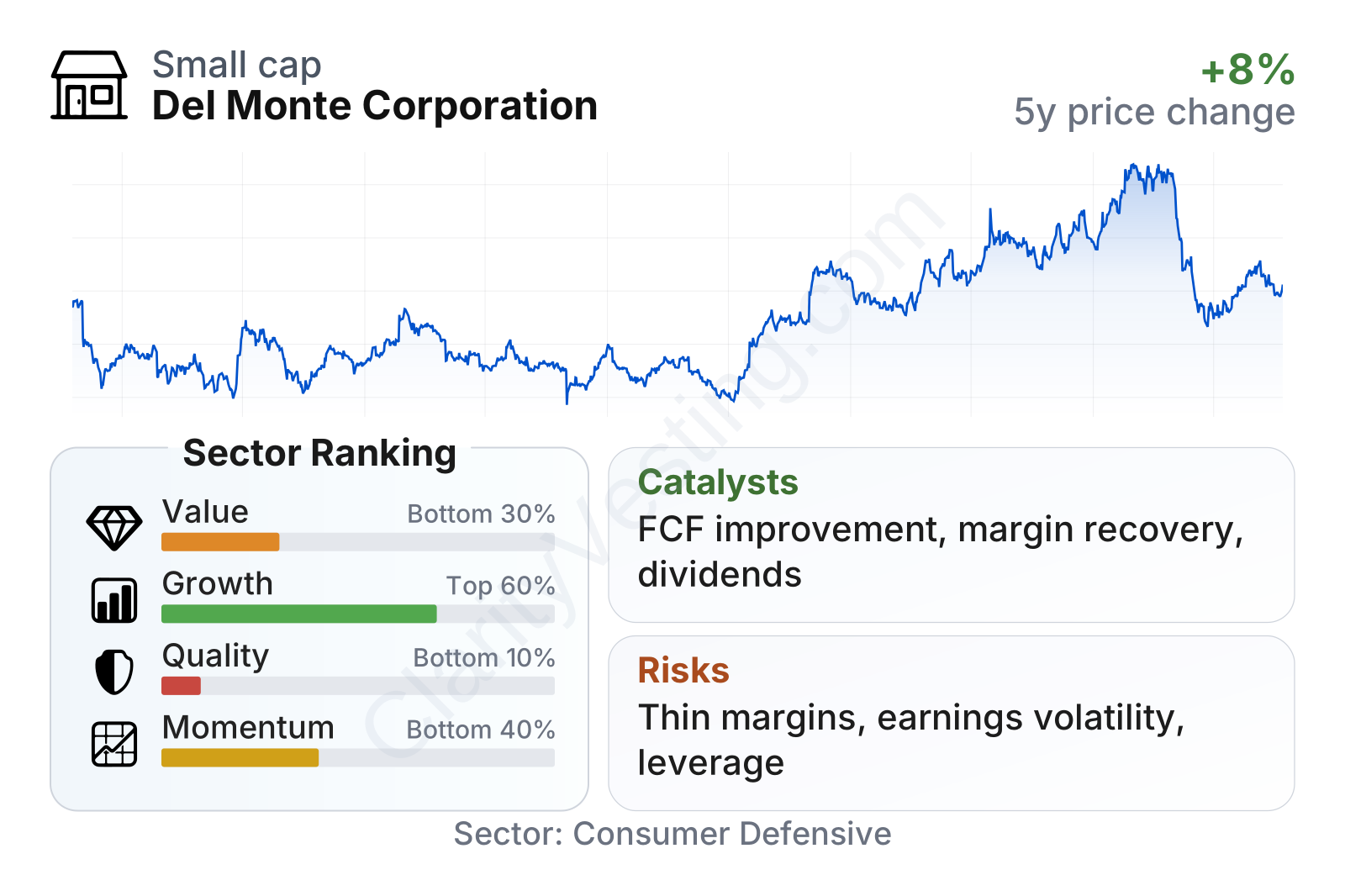
Del Monte is a mid-sized consumer staples company with a relatively low beta of 0.24, meaning its stock has historically moved less than the broader market. The factor profile is mixed. Growth metrics are around the middle of the sector, helped by strong free cash flow and dividend growth over five years. Quality metrics are weak versus peers, mainly because returns on assets and profit margins are low. Value metrics also screen poorly at the moment because the earnings multiple is well above the sector median, even though the price-to-book ratio remains below the sector median.
The share price had a strong multi-year rise before a sharp pullback in 2026. That drop matters because it suggests the market has become more cautious about earnings durability rather than the company’s size or brand presence. The stock’s longer-term performance has still been positive over three years, but recent momentum has weakened considerably.
Growth
Del Monte operates in a sector that is usually more defensive than fast-growing. Packaged food does not typically deliver explosive expansion, but it can produce steady demand, repeat purchases, and room for margin improvement through pricing, brand strength, and better product mix. For Del Monte, the long-term opportunity is less about entering a brand-new market and more about improving the earnings power of an existing food franchise across core categories such as fruit, beverages, and culinary products.
Recent sales growth has been inconsistent. After a better period in 2022, revenue growth turned negative through much of 2023 and parts of 2024, then improved again in late 2025 and mid-2026. The latest year-over-year revenue growth is close to 3%, which is positive but still slightly below the sector median. This points to a business that can grow, but not in a smooth or highly predictable way.
A more encouraging signal is cash generation. Free cash flow has risen sharply over the past several years and recently reached roughly $175 million on a trailing basis. That is one of the strongest aspects of the company’s profile. Stronger cash generation can support debt reduction, dividends, and reinvestment in brands, production, and distribution. The company’s five-year free cash flow growth rate is far above the sector median, which helps offset concerns created by weaker accounting profitability.
Strategically, Del Monte’s growth case makes sense if management can keep improving margins in branded products while maintaining export demand and supply reliability. In packaged food, even modest sales growth can translate into much better earnings when cost discipline improves. A visible catalyst is the company’s ability to convert stable revenue into more consistent operating profit, especially after the major rebound seen in 2024. Continued progress in that direction would matter more than headline sales growth alone.
Risks
This article is for informational purposes only and does not constitute financial advice. Some content is AI-generated. See Disclaimer


