Stock Analysis · Digital Realty Trust Inc (DLR)
Overview
Digital Realty Trust is a real estate investment trust, or REIT, focused on data centers. In simple terms, it owns, develops, and operates specialized buildings where companies place servers, networking equipment, and cloud infrastructure. These facilities are designed to provide secure space, constant power, cooling, and high-speed connectivity. Customers include large cloud providers, network carriers, enterprises, and technology-driven businesses that need reliable digital infrastructure.
The company makes money mainly by leasing data center space and providing related services. Based on its recent annual reporting structure, revenue is concentrated in a few major categories:
- Rental and other services revenue: about 97% to 98%. This is the core business and includes leasing colocation space, larger wholesale capacity, powered base building offerings, and interconnection-related services tied to data center use.
- Fee income and other revenue: about 2% to 3%. This includes smaller non-rental items such as management-related or ancillary service income.
Geographically, Digital Realty is diversified across North America, Europe, Latin America, Asia, and Africa, which matters because large customers increasingly want data center capacity in multiple regions. The business model is relatively straightforward: invest heavily upfront to build or acquire facilities, sign long-term customer contracts, expand utilization over time, and use the recurring cash flow to support operations, development, and dividends.
Over the last several years, revenue has continued to rise, but profitability has moved around more than top-line growth, reflecting acquisition integration, financing costs, development spending, and asset sales. That mix is common in large infrastructure-heavy REITs, but it means headline earnings can look uneven even while the underlying platform grows.
The business has become meaningfully larger since 2021, with revenue climbing from roughly $4.4 billion to more than $6.1 billion by 2025. Operating income and net income have been more volatile, which shows that scale has improved, but cost control and capital intensity still matter a lot.
Key Figures
| Metric | Value | Sector ⓘ |
|---|---|---|
| Date | Oct 24, 2026 | |
| Context | ||
| Sector | Real Estate | |
| Industry | REIT - Specialty | |
| Market Cap ⓘ | $66.59B | |
| Beta ⓘ | 1.01 | |
Value (Cheapness) | ||
| P/E Ratio ⓘ | 85.59 | 17.85 |
| P/B Ratio ⓘ | 2.25 | 0.87 |
| FCF Yield ⓘ | 2.05% | 7.30% |
| Dividend Yield ⓘ | 2.78% | 4.83% |
| EBIT / EV ⓘ | 1.64% | 3.78% |
| PEG ⓘ | 11.72 | |
Growth (Business expansion) | ||
| Revenue Growth ⓘ | 29.90% | 5.35% |
| RPS Growth (5Y CAGR) ⓘ | 2.69% | 6.02% |
| EPS Growth (5Y CAGR) ⓘ | 31.80% | -10.65% |
| BVPS Growth (5Y CAGR) ⓘ | 0.18% | 0.43% |
| Margin Growth (5Y Trend) ⓘ | -20.05% | -0.69% |
| FCF Growth (5Y CAGR) ⓘ | 9.11% | 5.40% |
| DPS Growth (5Y CAGR) ⓘ | 0.24% | 5.07% |
Quality (Business durability) | ||
| ROIC (Latest) ⓘ | N/A | 5.69% |
| ROE (Latest) ⓘ | 3.21% | 7.37% |
| ROA (Latest) ⓘ | 1.55% | 2.85% |
| ROIC (5Y Median) ⓘ | 3.92% | 4.26% |
| ROE (5Y Median) ⓘ | 5.22% | 6.04% |
| ROA (5Y Median) ⓘ | 2.22% | 2.45% |
| Net Debt / EBIT (Latest) ⓘ | 11.60 | 7.55 |
| Net Debt / EBIT (5Y Median) ⓘ | 12.25 | 8.26 |
| Net Debt / EBITDA (Latest) ⓘ | 4.81 | 5.26 |
| Net Debt / Assets ⓘ | 30.06% | 37.45% |
| EBITDA / Interest ⓘ | 7.41 | 4.11 |
| Operating Margin (Latest) ⓘ | 20.63% | 33.86% |
| Operating Margin (5Y Median) ⓘ | 26.72% | 37.49% |
| Debt to Equity (Latest) ⓘ | 66.54% | 88.76% |
| Profit Margin (Latest) ⓘ | 11.83% | 18.94% |
| Free Cash Flow (Latest) ⓘ | $1.37B | |
Momentum (Price trend) | ||
| 3Y Return ⓘ | +59.35% | +36.33% |
| 12M Return (excl. last month) ⓘ | +9.32% | +4.32% |
| 6M Return ⓘ | -13.74% | -1.74% |
| Price vs. 200-Day MA ⓘ | -5.41% | -1.42% |
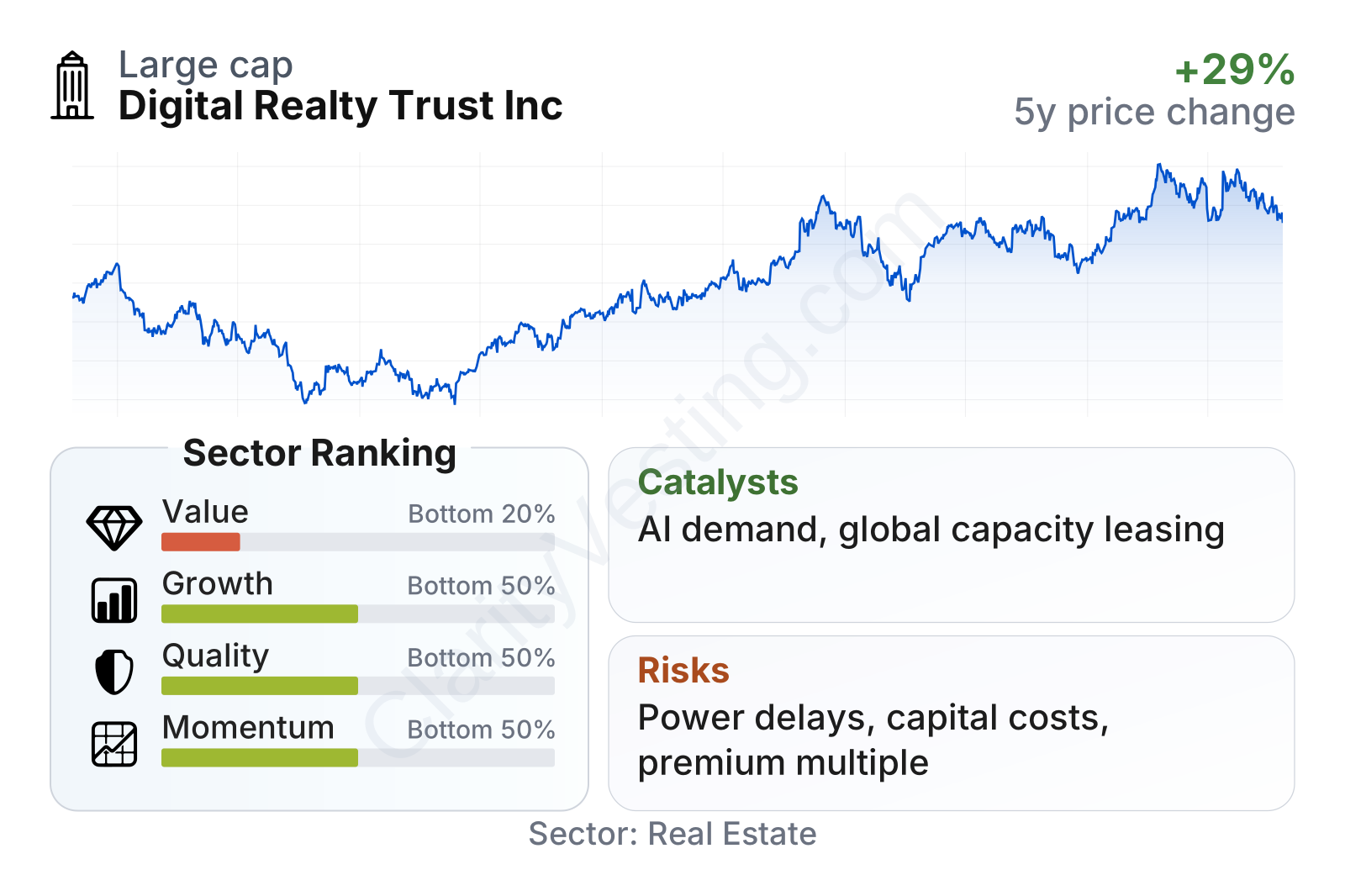
Digital Realty is one of the largest listed data center REITs, with a market value in the tens of billions of dollars and a stock price profile that has recovered strongly from the 2022 downturn. The metrics show a mixed picture. Growth has been helped by strong recent revenue expansion, and share-price momentum has been better than much of the real estate sector. At the same time, valuation multiples sit well above sector medians, while profitability and returns on assets and equity remain less impressive than many peers. In short, the market is giving the company credit for its strategic position and demand outlook more than for current efficiency.
Growth
Digital Realty operates in a part of real estate that benefits from long-term digital demand rather than traditional office or retail cycles. Data traffic keeps rising, cloud computing remains a structural growth market, and artificial intelligence is adding another layer of demand because AI workloads need dense computing power, strong connectivity, and reliable power availability. Those trends support the need for more data center capacity globally.
The company’s strategy broadly fits that backdrop. It combines global scale, land and development pipelines, customer relationships with major cloud platforms, and a connected-campus model that makes its sites more useful as customers expand. This is important because large tenants often prefer operators that can serve several markets under one relationship instead of negotiating with many local providers.
Revenue per share has been positive over time, although not in a straight line. The pattern suggests that expansion is real, but new equity issuance, development cycles, and portfolio changes can dilute some of the benefit on a per-share basis. That is a key point for long-term analysis: growth in total revenue is valuable, but growth per share is what matters most for shareholders.
The dividend per share has been very stable, which is consistent with a mature infrastructure REIT. Stability can be a positive sign for income durability, but it also shows that dividend growth has been minimal recently. For a company tied to powerful secular demand, the bigger growth case currently rests on development returns, leasing activity, and cash-flow expansion more than on fast dividend increases.
A major catalyst is AI-related demand for data center capacity. Digital Realty has highlighted customer demand tied to cloud and AI deployments, and the broader industry is dealing with tight supply in several important markets. Another useful tailwind is the company’s global footprint, which helps it capture multinational demand. Recent company updates have also emphasized development activity, capacity leasing, and joint-venture structures that can help fund expansion without relying entirely on the balance sheet.
Risks
This article is for informational purposes only and does not constitute financial advice. Some content is AI-generated. See Disclaimer


