Stock Analysis · Delek Logistics Partners LP (DKL)
Overview
Delek Logistics Partners LP is a midstream energy partnership. In simple terms, it owns and operates the infrastructure that helps move, store, gather, transport, and market crude oil, refined products, and water. Its assets include pipelines, terminals, storage tanks, trucking, rail-related logistics, crude gathering systems, and water disposal and recycling facilities. A large part of its network supports Delek US Holdings, but the partnership also serves third parties in areas such as the Permian Basin, the Delaware Basin, the Midland Basin, East Texas, and the Gulf Coast.
The business is designed to generate fee-based cash flow from energy infrastructure rather than relying only on oil prices. That makes it different from an oil producer. The company generally earns money when volumes move through its systems, when customers pay for storage or transportation capacity, and when marketing activities capture margins on crude and refined product movements.
Based on the company’s reporting structure and recent filings, the main revenue sources are approximately the following:
- Gathering and processing: about 35% to 45% of revenue. This includes crude oil and intermediate stream gathering, transportation, and related logistics services.
- Wholesale marketing and terminalling: about 25% to 35% of revenue. This includes crude oil and refined products marketing, terminaling, storage, and product handling activities.
- Storage and transportation: about 15% to 25% of revenue. This mainly covers pipeline transportation and tank storage fees tied to refined products and crude oil.
- Water services: about 10% to 20% of revenue. This includes produced water gathering, disposal, recycling, and fresh water supply tied to upstream drilling activity.
Those percentages can shift meaningfully by quarter because marketing revenue can be volatile and because acquisitions and dropdown transactions have changed the portfolio over time. Still, the broad picture is clear: Delek Logistics is an infrastructure-heavy cash flow business with an added marketing component.
Over the last several years, revenue has fluctuated around the $0.9 billion to $1.0 billion range, while operating income has generally improved. The most notable pressure point has been interest expense, which has climbed materially as the business has carried more debt. That helps explain why operating performance can look stronger than the final profit available after financing costs.
Key Figures
| Metric | Value | Sector ⓘ |
|---|---|---|
| Date | Oct 03, 2026 | |
| Context | ||
| Sector | Energy | |
| Industry | Oil & Gas Refining & Marketing | |
| Market Cap ⓘ | $3.07B | |
| Beta ⓘ | 0.41 | |
Value (Cheapness) | ||
| P/E Ratio ⓘ | 18.54 | 14.47 |
| P/B Ratio ⓘ | N/A | 1.70 |
| FCF Yield ⓘ | 4.17% | 8.66% |
| Dividend Yield ⓘ | 8.41% | 3.77% |
| EBIT / EV ⓘ | 5.76% | 7.46% |
| PEG ⓘ | 0.77 | |
Growth (Business expansion) | ||
| Revenue Growth ⓘ | 56.20% | 27.35% |
| RPS Growth (5Y CAGR) ⓘ | 4.08% | 6.75% |
| EPS Growth (5Y CAGR) ⓘ | -16.76% | -15.45% |
| BVPS Growth (5Y CAGR) ⓘ | N/A | 5.85% |
| Margin Growth (5Y Trend) ⓘ | 4.45% | 0.75% |
| FCF Growth (5Y CAGR) ⓘ | N/A | 3.62% |
| DPS Growth (5Y CAGR) ⓘ | 4.55% | 16.85% |
Quality (Business durability) | ||
| ROIC (Latest) ⓘ | 12.64% | 11.33% |
| ROA (Latest) ⓘ | 5.49% | 6.03% |
| ROIC (5Y Median) ⓘ | 17.34% | 10.16% |
| ROA (5Y Median) ⓘ | 7.75% | 5.34% |
| Net Debt / EBIT (Latest) ⓘ | 7.47 | 1.62 |
| Net Debt / EBIT (5Y Median) ⓘ | 6.40 | 1.91 |
| Net Debt / EBITDA (Latest) ⓘ | 5.19 | 1.06 |
| Net Debt / Assets ⓘ | 83.40% | 17.29% |
| EBITDA / Interest ⓘ | 2.11 | 9.64 |
| Operating Margin (Latest) ⓘ | 26.74% | 16.32% |
| Operating Margin (5Y Median) ⓘ | 30.70% | 19.53% |
| Debt to Equity (Latest) ⓘ | -3474.91% | 54.41% |
| Profit Margin (Latest) ⓘ | 12.85% | 8.79% |
| Free Cash Flow (Latest) ⓘ | $128.27M | |
Momentum (Price trend) | ||
| 3Y Return ⓘ | +71.06% | +62.93% |
| 12M Return (excl. last month) ⓘ | +38.01% | +44.83% |
| 6M Return ⓘ | +11.32% | -1.62% |
| Price vs. 200-Day MA ⓘ | +4.85% | +5.18% |
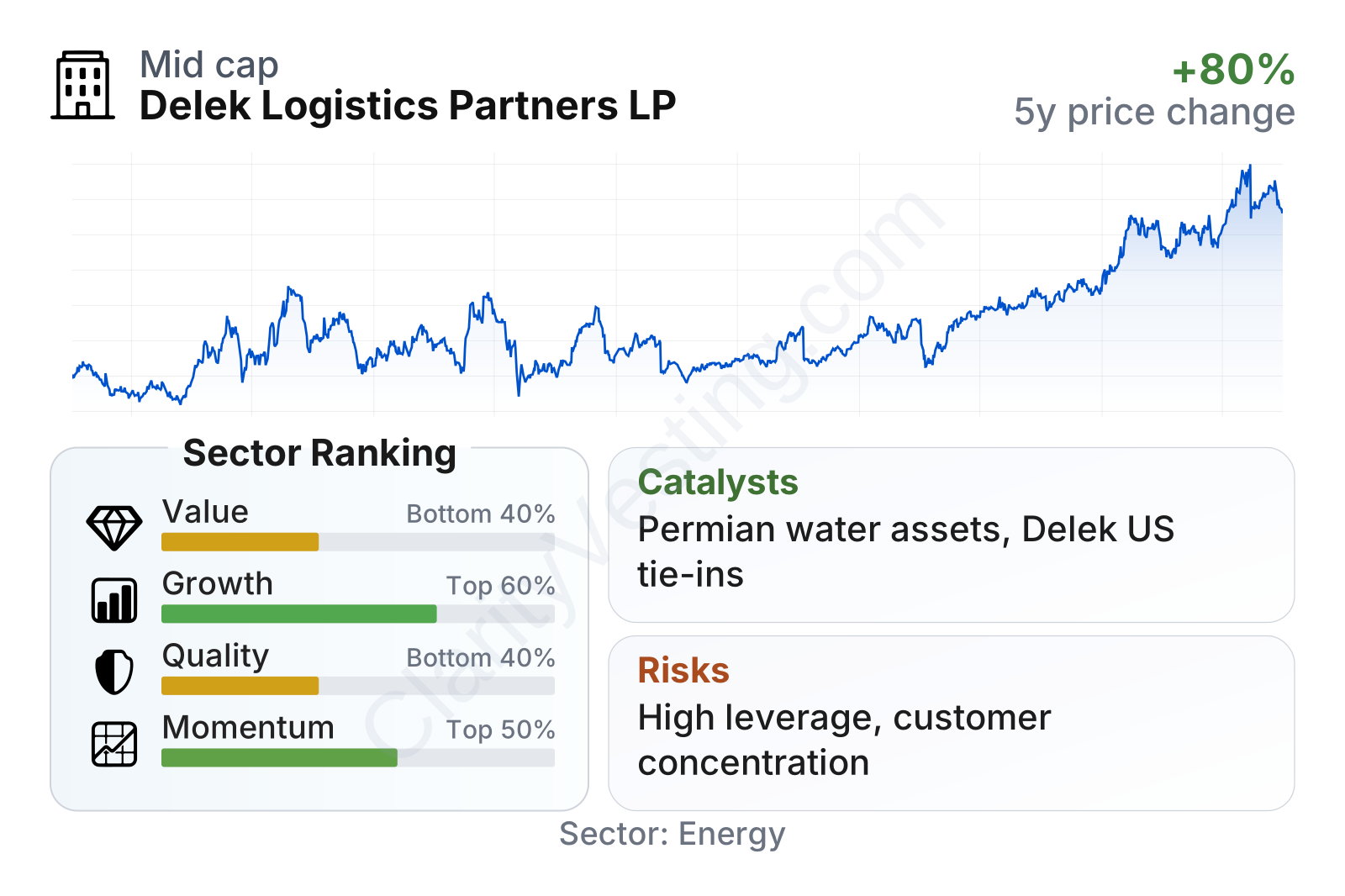
Delek Logistics is a small-to-mid-sized energy infrastructure company with a relatively low beta, meaning its share price has historically moved less than the broader market. The factor profile is mixed. Growth ranks around the middle of the sector, helped by a recent revenue rebound and improving operating margin trends. Quality and value rank weaker, mainly because leverage is much heavier than the sector norm and free cash flow yield is lower than many peers. Profitability itself is not weak: margins and long-term returns on invested capital are solid for the sector, but the balance sheet limits the overall quality profile.
The share price trend has been strong over the last few years, moving from the high $20s in late 2021 to above $50 by mid-2026. At the same time, the distribution yield has compressed from the low-teens area to around 9%, largely because the unit price rose. That usually signals that the market is assigning a higher value to the partnership than it did a few years ago.
Growth
Delek Logistics operates in a part of the energy industry that is more durable than many people assume. Midstream systems remain necessary as long as the U.S. continues producing and refining oil and related products. In particular, the Permian Basin remains one of the most important producing regions in North America, and water handling needs tend to rise along with drilling activity. That gives the company exposure to a segment with ongoing infrastructure demand rather than purely commodity-driven expansion.
The strategy also has a logical growth path. Management has built the partnership through a combination of organic projects, acquisitions, and commercial ties to Delek US. The core idea is straightforward: own assets that are difficult to replace, connect them to active production and refining regions, and increase cash flow through higher volumes, broader service offerings, and occasional asset additions.
Recent revenue growth has been uneven, which is normal for a business that includes a marketing component, but the latest year-over-year reading shows a strong rebound and sits well above the sector median. That suggests the company is currently benefiting from a better operating backdrop, added contributions from assets, or both. It is encouraging, although investors following the name over the long term should remember that top-line growth can be noisy in this industry.
Free cash flow has also been volatile. It dropped sharply at times and then recovered, which reflects the capital-intensive nature of the business and the timing of working capital changes, projects, and transactions. Even so, the latest trailing free cash flow remains positive and comfortably above the weakest points of the past few years. For a partnership that pays a large cash distribution, sustained positive free cash flow is an important piece of the long-term picture.
A meaningful catalyst is the company’s position in crude logistics and water infrastructure tied to active shale regions. Water services in particular can become more valuable as producers look for efficient disposal and recycling solutions. Another catalyst is the partnership model itself: if Delek US or outside counterparties continue to use the system more heavily, Delek Logistics can grow without needing to reinvent its business.
Recent company communications have continued to emphasize logistics optimization, Permian-related assets, and the support of refinery-connected infrastructure. That does not guarantee fast growth, but it does point to a pipeline of practical expansion opportunities rather than a purely theoretical growth plan.
Risks
This article is for informational purposes only and does not constitute financial advice. Some content is AI-generated. See Disclaimer