Stock Analysis · Delek Drilling (DKDRF)
Overview
Delek Drilling, now known in its core operations as NewMed Energy, is an upstream natural gas company focused on finding, developing, and producing offshore gas resources in the Eastern Mediterranean. Its most important assets are interests in major Israeli gas fields, especially Leviathan and Tamar, which supply natural gas to Israel’s domestic market and to neighboring export markets. In practical terms, the business earns money by owning stakes in gas reservoirs and receiving its share of production sold under long-term contracts.
The company’s revenue base is concentrated in a small number of very large assets, which makes the business relatively easy to understand but also less diversified than a broad international energy producer. Based on its reported asset mix and operating profile, revenue is primarily linked to these sources:
- Leviathan reservoir: approximately 60% to 70% of economic value and the main growth engine. This field supplies Israeli customers and export markets including Egypt and Jordan under long-term agreements.
- Tamar reservoir: approximately 25% to 35%. Tamar is a mature producing gas field that remains a major source of steady cash generation.
- Other assets and exploration interests: generally 0% to 10%. This includes smaller licenses, development options, and early-stage regional opportunities.
The financial profile has been shaped by very high operating margins, which is common for successful gas fields once infrastructure is in place. Over the last several years, revenue stayed around the $1.0 billion to $1.1 billion range, while operating income remained unusually strong for the sector. Interest expense has also moved lower over time, which suggests debt servicing has become more manageable even though leverage is still meaningful for the business.
The multi-year picture shows a business with strong profitability at the field level: costs have remained well below revenue, administrative expenses are small relative to sales, and financing costs have eased from earlier peaks. The main recent change is that 2025 revenue and profit softened versus 2024, reminding readers that even a high-margin gas producer can experience earnings swings from pricing, contract timing, and export volumes.
Key Figures
| Metric | Value | Sector ⓘ |
|---|---|---|
| Date | Oct 03, 2026 | |
| Context | ||
| Sector | Energy | |
| Industry | Oil & Gas E&P | |
| Market Cap ⓘ | $5.99B | |
| Beta ⓘ | 0.40 | |
Value (Cheapness) | ||
| P/E Ratio ⓘ | 22.18 | 14.47 |
| P/B Ratio ⓘ | 3.32 | 1.70 |
| FCF Yield ⓘ | 0.94% | 8.66% |
| Dividend Yield ⓘ | 4.17% | 3.77% |
| EBIT / EV ⓘ | 6.07% | 7.46% |
| PEG ⓘ | N/A | |
Growth (Business expansion) | ||
| Revenue Growth ⓘ | 52.50% | 27.35% |
| RPS Growth (5Y CAGR) ⓘ | 3.50% | 6.75% |
| EPS Growth (5Y CAGR) ⓘ | N/A | -15.45% |
| BVPS Growth (5Y CAGR) ⓘ | 19.15% | 5.85% |
| Margin Growth (5Y Trend) ⓘ | -1.15% | 0.75% |
| FCF Growth (5Y CAGR) ⓘ | -9.69% | 3.62% |
| DPS Growth (5Y CAGR) ⓘ | 24.41% | 16.85% |
Quality (Business durability) | ||
| ROIC (Latest) ⓘ | 11.03% | 11.33% |
| ROA (Latest) ⓘ | 6.58% | 6.03% |
| ROIC (5Y Median) ⓘ | 16.09% | 10.16% |
| ROA (5Y Median) ⓘ | 11.14% | 5.34% |
| Net Debt / EBIT (Latest) ⓘ | 3.18 | 1.62 |
| Net Debt / EBIT (5Y Median) ⓘ | 2.56 | 1.91 |
| Net Debt / EBITDA (Latest) ⓘ | 2.05 | 1.06 |
| Net Debt / Assets ⓘ | 37.25% | 17.29% |
| EBITDA / Interest ⓘ | 8.26 | 9.64 |
| Operating Margin (Latest) ⓘ | 47.91% | 16.32% |
| Operating Margin (5Y Median) ⓘ | 59.61% | 19.53% |
| Debt to Equity (Latest) ⓘ | N/A | 54.41% |
| Profit Margin (Latest) ⓘ | 31.05% | 8.79% |
| Free Cash Flow (Latest) ⓘ | $56.40M | |
Momentum (Price trend) | ||
| 3Y Return ⓘ | +115.93% | +62.93% |
| 12M Return (excl. last month) ⓘ | +17.25% | +44.83% |
| 6M Return ⓘ | -1.00% | -1.62% |
| Price vs. 200-Day MA ⓘ | +19.17% | +5.18% |
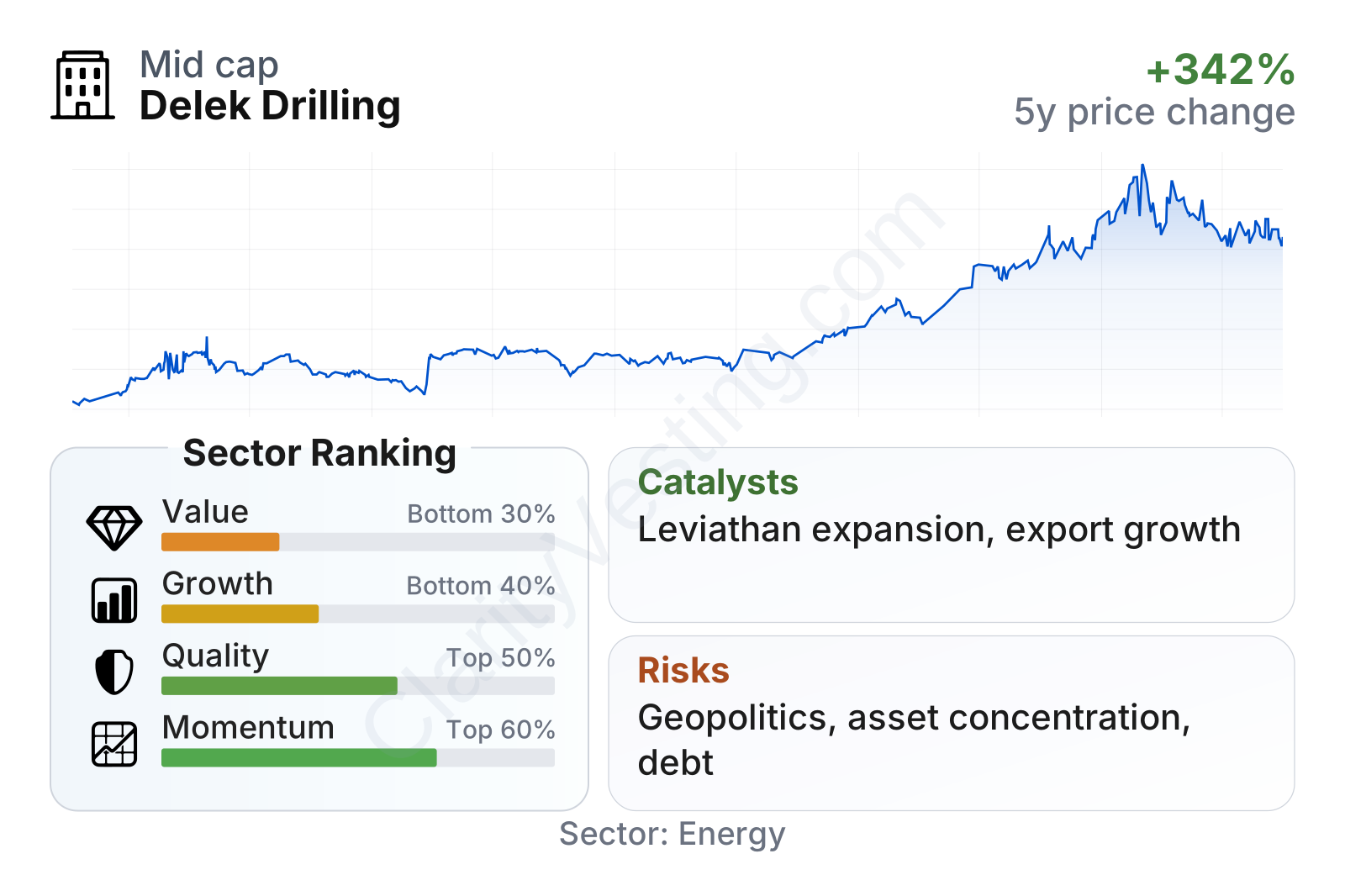
Delek Drilling sits in the mid-sized range within the energy space and has shown low share-price volatility, with a beta well below 1. Over three years, the stock performance has been strong in absolute terms, although shorter-term trading has been less consistent. The valuation profile looks less attractive than much of the sector: earnings and book-value multiples are above industry medians, while free cash flow yield is notably lower.
On business quality, the picture is stronger. Profitability metrics are well above many peers, with operating margin near 48% and profit margin around 31%, both far ahead of typical upstream companies. Return on assets is also slightly above the sector median, and five-year profitability levels have been particularly strong. The trade-off is leverage: net debt relative to EBIT and EBITDA is clearly above sector norms, so the balance sheet remains an important point to monitor even though interest coverage is still solid.
Growth metrics are mixed rather than uniformly strong. Recent year-over-year revenue growth has been high, but the longer five-year trend is more modest, and free cash flow growth over that same period has been negative. Dividend growth has been strong, which supports the income profile, but it does not fully offset the fact that current valuation already reflects a meaningful amount of business quality.
Growth
The company operates in a part of the energy market that still has a clear long-term role. Natural gas remains important as a power-generation fuel, as a lower-emission substitute for coal and oil in some markets, and as a strategic energy security resource for countries that want regional supply. In the Eastern Mediterranean, this role is especially important because local demand growth and cross-border trade have turned offshore gas into both an economic and geopolitical asset.
Its strategy broadly makes sense for future expansion. Rather than trying to become a global producer, the company has focused on maximizing value from a limited number of large, low-cost regional resources. That includes increasing production capacity at Leviathan, preserving long-life output from Tamar, and expanding export routes where infrastructure and politics allow. If those projects move forward as planned, growth does not depend only on higher commodity prices; it can also come from higher delivered volumes.
One of the clearest catalysts is additional development at Leviathan. Capacity expansion can materially increase the amount of gas available for domestic sales and exports. Another important opportunity is stronger regional integration, especially through Egypt’s liquefied natural gas system and pipeline links with neighboring markets. Those connections matter because they can widen the company’s customer base beyond Israel and improve field utilization.
Recent company communications and public disclosures have continued to emphasize reserve development, export demand, and infrastructure progress as central themes. For a business like this, major upside usually comes from project execution and contract expansion rather than from rapid quarterly changes. That creates a slower but more visible growth path than many exploration-focused energy names.
Risks
This article is for informational purposes only and does not constitute financial advice. Some content is AI-generated. See Disclaimer