Stock Analysis · Delek US Energy Inc (DK)
Overview
Delek US Energy is a downstream energy company centered on refining crude oil into fuels and other petroleum products, then moving and selling those products through logistics assets and wholesale channels. In simple terms, it buys crude oil, processes it in refineries, and earns money from turning that crude into gasoline, diesel, jet fuel, asphalt, lubricants, and other products used by businesses and consumers. The company also owns midstream infrastructure through Delek Logistics Partners, including pipelines, storage, terminals, and gathering assets that support its refining network.
Its operations are concentrated in the U.S., with refining facilities and related infrastructure positioned mainly in the Gulf Coast and inland markets. That gives the company exposure to fuel demand, crude oil price differentials, and transportation advantages when its network is running efficiently.
Based on company disclosures, revenue is dominated by refining and related product sales, while logistics and other activities contribute a much smaller share of consolidated sales but can carry strategic importance because they support operations and can provide steadier fee-based earnings.
- Refining: approximately 90% to 95% of revenue. This includes sales of gasoline, diesel, jet fuel, asphalt, and other refined products produced at company refineries.
- Logistics: approximately 3% to 8% of revenue. This includes pipeline transportation, storage, terminalling, wholesale marketing support, and other midstream services, largely tied to Delek’s own refining system and third-party customers.
- Retail, renewable, and other activities: generally a small residual share of revenue. This can include convenience retail exposure in certain periods, renewable-related activity, and corporate or intersegment items depending on the reporting structure.
What matters most for long-term analysis is that Delek is not a pure oil producer. Its results depend less on simply extracting crude and more on refining margins, asset utilization, maintenance discipline, and how well it integrates logistics with refining. That makes the business highly cyclical, but also means improvements in operations can have an outsized impact on profits and cash flow.
The long-term financial pattern has been uneven. Revenue peaked during the favorable 2022 refining environment, then fell sharply in 2023 and 2024 before stabilizing and beginning to recover. Profitability swung from losses to profits and back again, which reflects how sensitive the business is to industry conditions. One encouraging point is that after a very weak 2024, operating performance improved in 2025, although interest costs remained heavy and limited how much of that recovery reached net income.
Key Figures
| Metric | Value | Sector ⓘ |
|---|---|---|
| Date | Oct 17, 2026 | |
| Context | ||
| Sector | Energy | |
| Industry | Oil & Gas Refining & Marketing | |
| Market Cap ⓘ | $4.94B | |
| Beta ⓘ | 0.60 | |
Value (Cheapness) | ||
| P/E Ratio ⓘ | 20.97 | 15.44 |
| P/B Ratio ⓘ | 26.46 | 1.73 |
| FCF Yield ⓘ | 13.85% | 8.20% |
| Dividend Yield ⓘ | 1.32% | 3.59% |
| EBIT / EV ⓘ | 8.64% | 7.46% |
| PEG ⓘ | 0.38 | |
Growth (Business expansion) | ||
| Revenue Growth ⓘ | 47.80% | 26.90% |
| RPS Growth (5Y CAGR) ⓘ | 5.25% | 6.90% |
| EPS Growth (5Y CAGR) ⓘ | -1.48% | -15.73% |
| BVPS Growth (5Y CAGR) ⓘ | -55.15% | 6.07% |
| Margin Growth (5Y Trend) ⓘ | 3.59% | 0.58% |
| FCF Growth (5Y CAGR) ⓘ | -37.93% | 1.86% |
| DPS Growth (5Y CAGR) ⓘ | 105.95% | 16.79% |
Quality (Business durability) | ||
| ROIC (Latest) ⓘ | 15.82% | 11.40% |
| ROA (Latest) ⓘ | 3.07% | 6.06% |
| ROIC (5Y Median) ⓘ | 7.57% | 10.30% |
| ROA (5Y Median) ⓘ | -0.34% | 5.42% |
| Net Debt / EBIT (Latest) ⓘ | 4.31 | 1.64 |
| Net Debt / EBIT (5Y Median) ⓘ | 6.13 | 1.83 |
| Net Debt / EBITDA (Latest) ⓘ | 2.55 | 1.08 |
| Net Debt / Assets ⓘ | 34.78% | 17.29% |
| EBITDA / Interest ⓘ | 3.05 | 9.64 |
| Operating Margin (Latest) ⓘ | 5.05% | 16.27% |
| Operating Margin (5Y Median) ⓘ | 1.85% | 20.39% |
| Debt to Equity (Latest) ⓘ | 770.10% | 54.76% |
| Profit Margin (Latest) ⓘ | 1.86% | 8.82% |
| Free Cash Flow (Latest) ⓘ | $684.90M | |
Momentum (Price trend) | ||
| 3Y Return ⓘ | +244.72% | +67.38% |
| 12M Return (excl. last month) ⓘ | +172.89% | +49.19% |
| 6M Return ⓘ | +102.55% | +7.07% |
| Price vs. 200-Day MA ⓘ | +57.78% | +9.56% |
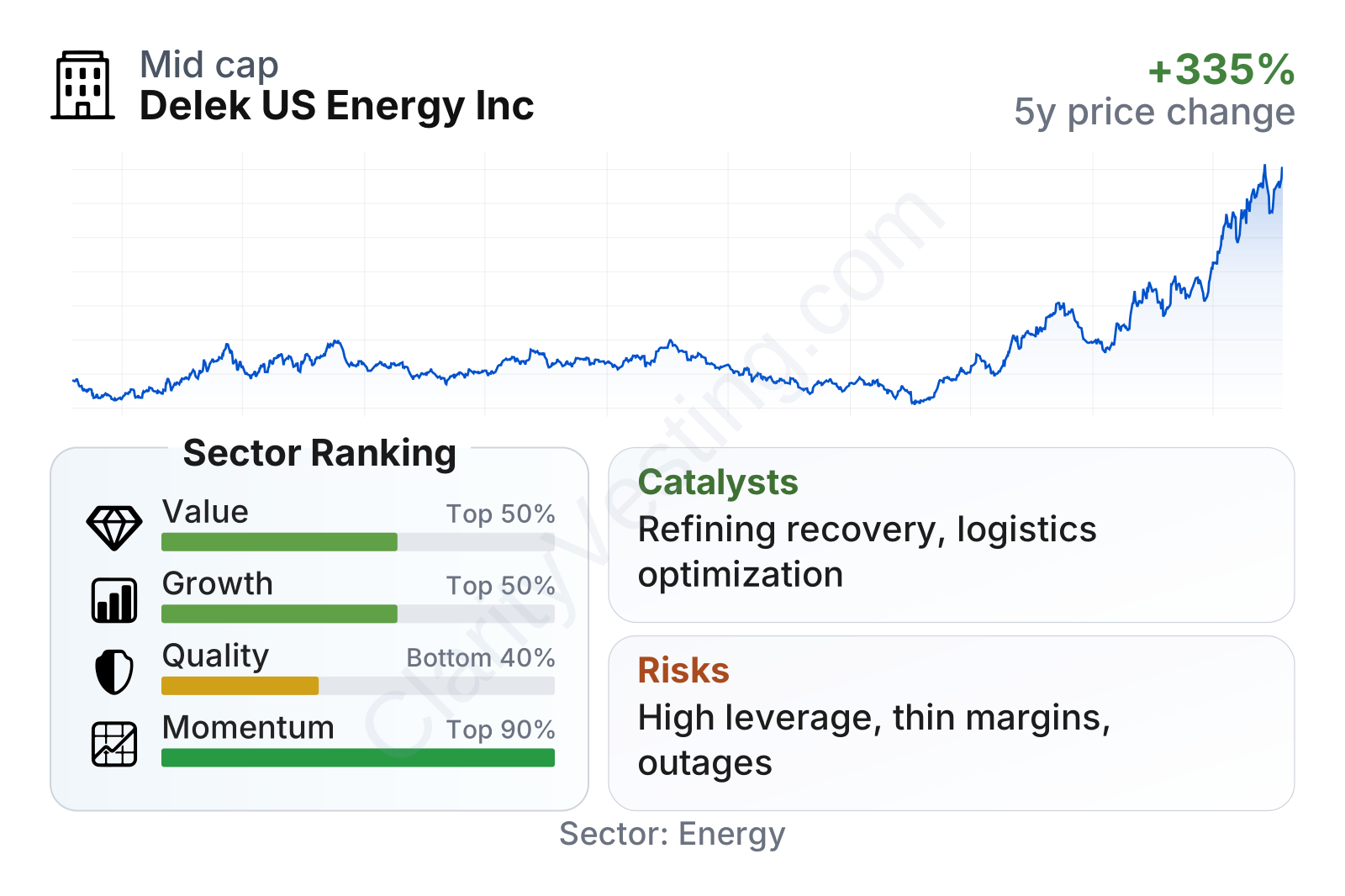
Delek is a mid-sized energy company with a market value a little above $4 billion and a stock volatility that has recently been lower than the broader market. On valuation metrics, the picture is mixed: earnings and enterprise-value-based measures do not look stretched versus the sector, and free cash flow yield stands out as strong, but the price-to-book ratio is unusually high because the balance sheet equity base has been compressed. Growth and momentum rank relatively well, while quality remains weaker because leverage is elevated and margins are thin compared with many peers.
Growth
Delek operates in a mature sector rather than a classic high-growth industry. Fuel refining is not structurally a fast-expanding business in the United States. Demand tends to move with economic activity, travel, freight, and regional supply conditions. For that reason, the growth case depends less on industry expansion and more on execution: running refineries reliably, optimizing crude sourcing, capturing logistics value, and improving cost efficiency.
The company’s strategy still has a credible path to growth because it is built around integration. When refining assets are linked to owned logistics infrastructure, management has more control over feedstock sourcing, transportation, storage, and product distribution. That can improve margins and reduce bottlenecks. Delek has also spent years simplifying and reshaping its portfolio, including actions involving its logistics structure and asset base, which can make the company more focused on cash generation rather than simply chasing volume.
Recent revenue trends show how cyclical the business is. After very strong growth in 2022, sales contracted through most of 2023 and 2024, then turned positive again. The latest year-over-year rebound is notable and sits well above the sector median, suggesting that operating conditions and commercial execution have improved from the trough. Even so, one strong period does not erase the volatility that comes with refining.
Cash generation is another important piece of the growth picture. Free cash flow has been volatile, including a deep negative period, but it has recovered meaningfully. The current trailing free cash flow level is strong relative to the company’s size, and that helps explain why its free cash flow yield screens well versus the sector. For a refiner, sustained cash generation matters because it can support debt reduction, maintenance spending, and shareholder distributions without depending on unusually favorable market conditions.
A practical catalyst for the next phase is any sustained improvement in refining utilization and margin capture. If Delek can keep plants running more consistently and pair that with better logistics contribution, incremental earnings can scale quickly. Another potential opportunity is continued optimization of the midstream side, which can support a steadier earnings base than refining alone. Recent company communications have also emphasized operational progress and portfolio actions aimed at strengthening returns, which is more meaningful than pure revenue growth in this industry.
Risks
This article is for informational purposes only and does not constitute financial advice. Some content is AI-generated. See Disclaimer


