Stock Analysis · DHT Holdings Inc (DHT)
Overview
DHT Holdings Inc. is a crude oil shipping company. It owns and operates a fleet of very large crude carriers, usually called VLCCs, which are among the biggest tankers used to move crude oil between major producing and consuming regions. The company is incorporated in Bermuda, managed from Monaco and Norway, and listed in the United States. Its business is straightforward: it earns money by transporting crude oil for oil companies, traders, and other charterers under voyage charters, time charters, and spot market arrangements.
For a long-term reader, the key point is that DHT is not an oil producer betting on oil discoveries or refinery margins. It is a shipping operator whose results are mainly driven by tanker supply and demand, freight rates, vessel utilization, operating costs, and fleet management decisions.
DHT’s revenue is highly concentrated in one activity, which makes the business easy to understand but also cyclical.
- Crude oil tanker operations: approximately almost all revenue. This includes freight earned from transporting crude oil on VLCCs in the spot market, on time-charter contracts, and through contract-of-affreightment type arrangements where applicable.
- Other shipping-related income: typically a small residual portion. This can include items such as ancillary service income or accounting effects tied to charter structures, but it is not a major economic driver.
The business mix matters because DHT is effectively a focused pure-play on the VLCC market. That can be attractive when tanker rates are strong, because there is little diversification to dilute the upside. The same concentration also means results can swing quickly when freight markets soften.
The multi-year picture shows a major improvement in economics since 2021. Revenue and operating profit have risen sharply from the weaker shipping environment seen a few years ago, while interest expense has fallen and net income has turned firmly positive. That combination suggests the company has benefited from both stronger market conditions and a healthier balance sheet.
Key Figures
| Metric | Value | Sector ⓘ |
|---|---|---|
| Date | Oct 17, 2026 | |
| Context | ||
| Sector | Energy | |
| Industry | Oil & Gas Midstream | |
| Market Cap ⓘ | $4.29B | |
| Beta ⓘ | -0.06 | |
Value (Cheapness) | ||
| P/E Ratio ⓘ | 8.92 | 15.44 |
| P/B Ratio ⓘ | 3.03 | 1.73 |
| FCF Yield ⓘ | 0.83% | 8.20% |
| Dividend Yield ⓘ | 18.35% | 3.59% |
| EBIT / EV ⓘ | 13.23% | 7.46% |
| PEG ⓘ | 1.19 | |
Growth (Business expansion) | ||
| Revenue Growth ⓘ | 95.50% | 26.90% |
| RPS Growth (5Y CAGR) ⓘ | 15.30% | 6.90% |
| EPS Growth (5Y CAGR) ⓘ | 86.47% | -15.73% |
| BVPS Growth (5Y CAGR) ⓘ | 3.28% | 6.07% |
| Margin Growth (5Y Trend) ⓘ | 40.43% | 0.58% |
| FCF Growth (5Y CAGR) ⓘ | -26.50% | 1.86% |
| DPS Growth (5Y CAGR) ⓘ | 54.27% | 16.79% |
Quality (Business durability) | ||
| ROIC (Latest) ⓘ | 30.45% | 11.40% |
| ROA (Latest) ⓘ | 29.55% | 6.06% |
| ROIC (5Y Median) ⓘ | 13.31% | 10.30% |
| ROA (5Y Median) ⓘ | 10.75% | 5.42% |
| Net Debt / EBIT (Latest) ⓘ | 0.56 | 1.64 |
| Net Debt / EBIT (5Y Median) ⓘ | 1.82 | 1.83 |
| Net Debt / EBITDA (Latest) ⓘ | 0.46 | 1.08 |
| Net Debt / Assets ⓘ | 15.11% | 17.29% |
| EBITDA / Interest ⓘ | 37.98 | 9.64 |
| Operating Margin (Latest) ⓘ | 67.79% | 16.27% |
| Operating Margin (5Y Median) ⓘ | 34.81% | 20.39% |
| Debt to Equity (Latest) ⓘ | 32.70% | 54.76% |
| Profit Margin (Latest) ⓘ | 59.31% | 8.82% |
| Free Cash Flow (Latest) ⓘ | $35.73M | |
Momentum (Price trend) | ||
| 3Y Return ⓘ | +213.67% | +67.38% |
| 12M Return (excl. last month) ⓘ | +106.17% | +49.19% |
| 6M Return ⓘ | +60.52% | +7.07% |
| Price vs. 200-Day MA ⓘ | +47.81% | +9.56% |
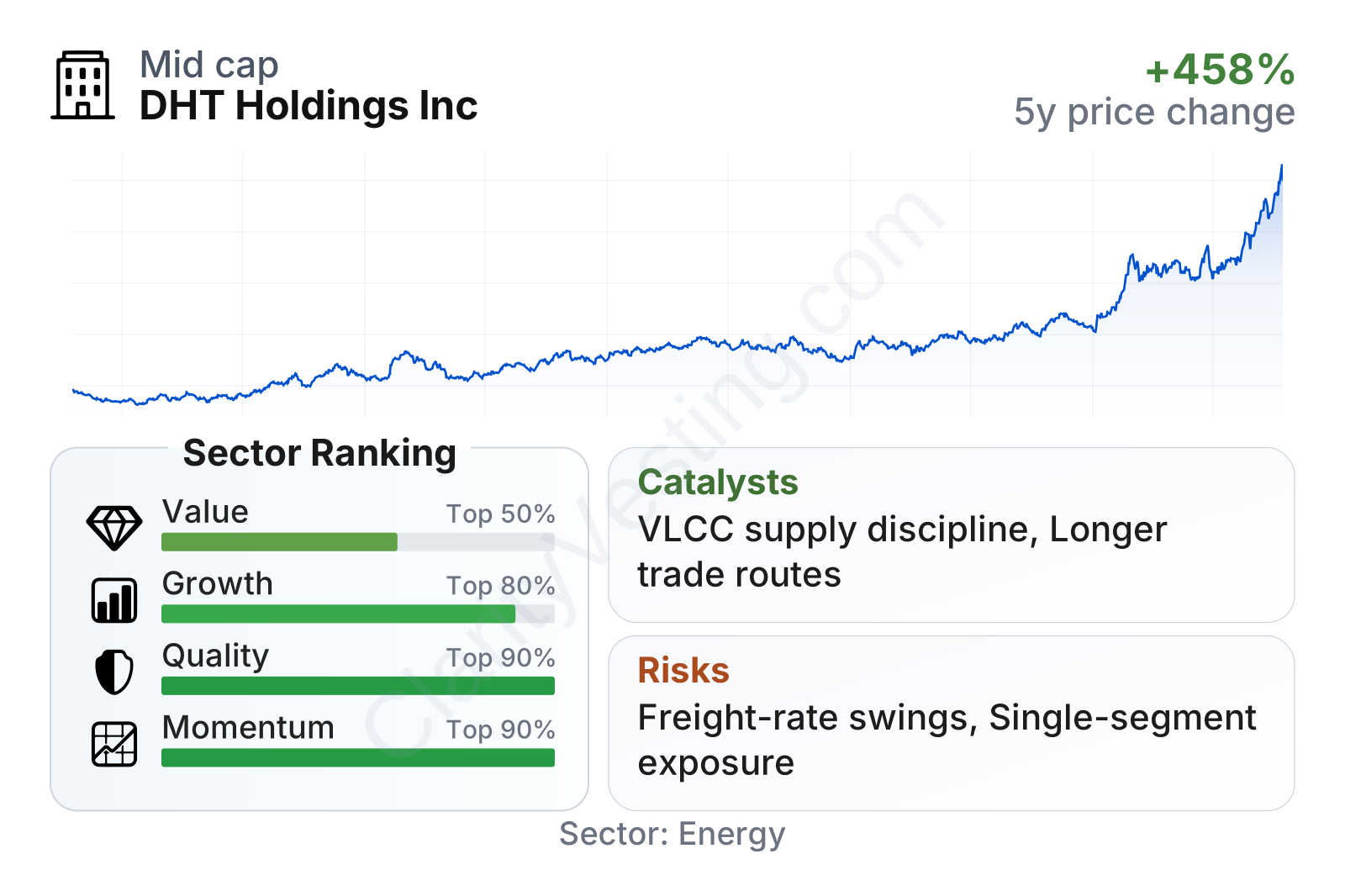
DHT currently sits in a mid-sized range within the public energy universe, with unusually strong quality, growth, and momentum readings versus much of its sector. Profitability stands out in particular: returns on capital and assets are well above sector medians, while leverage is lower than many peers. On valuation, the picture is mixed. The earnings multiple is low, but the book-value multiple is richer, which often happens when a shipping company is earning high profits from a favorable cycle. The dividend yield is very high on a trailing basis, but readers should remember that shipping payouts often move with market conditions rather than following a fixed, steadily rising pattern.
Growth
DHT operates in a sector that is not a classic secular growth industry like software or cloud computing, but it can still offer strong multi-year expansion periods. Demand for crude tanker transportation depends on global oil consumption, export volumes, trade routes, and what is known as ton-mile demand, meaning not just how much oil moves, but how far it has to travel. Changes in sanctions, trade flows, and refinery locations can increase shipping demand even if global oil volumes grow only modestly.
The company’s strategy is sensible for this type of market. DHT focuses on a single vessel class where scale, technical know-how, customer relationships, and cost control matter. Management has also emphasized balance sheet discipline, chartering flexibility, and shareholder distributions. In shipping, that matters because overexpansion at the wrong point in the cycle can destroy returns. A cleaner approach is often to keep the fleet competitive, avoid excessive leverage, and let rate strength flow through earnings.
The recent revenue trend shows how strongly operating leverage can work in DHT’s favor. After a weak patch in 2025, year-over-year growth reaccelerated sharply in 2026 and is running well above the broader sector. That suggests the company is capturing a favorable rate environment rather than merely treading water.
Free cash flow has been more uneven. DHT generated strong cash over much of the recent period, but trailing free cash flow turned negative in early 2026 before recovering to a modest positive level in the latest metrics. That kind of volatility is normal in shipping because vessel drydockings, working-capital movements, debt payments, and fleet investments can distort short-term cash generation. For long-term analysis, the more important point is that the underlying earnings power has improved markedly since 2021.
A meaningful catalyst for DHT is the supply side of the VLCC market. New tanker ordering has been relatively restrained across the industry compared with earlier shipping booms, partly because of shipyard capacity constraints, financing discipline, and uncertainty around future propulsion technologies and environmental regulation. If global crude trade remains firm while fleet growth stays controlled, operators with existing modern fleets can benefit from stronger utilization and freight rates.
Another possible tailwind is geopolitics. Longer trade routes caused by sanctions, rerouting, or shifts in sourcing can support demand for large crude tankers. This does not make DHT immune to oil-market weakness, but it can improve the shipping backdrop even when headline oil demand growth is not spectacular.
Risks
This article is for informational purposes only and does not constitute financial advice. Some content is AI-generated. See Disclaimer


