Stock Analysis · Danaher Corporation (DHR)
Overview
Danaher Corporation is a large healthcare and life sciences company that sells instruments, software, consumables, and services used in research labs, biopharma manufacturing, and clinical diagnostics. In simple terms, it provides many of the tools that help scientists discover drugs, produce biologic medicines, and analyze patient samples. The company is especially known for its disciplined operating system, frequent acquisitions, and focus on businesses with recurring demand.
After portfolio changes in recent years, Danaher is centered on three major segments: Biotechnology, Life Sciences, and Diagnostics. Biotechnology is tied to equipment and supplies used in the development and manufacturing of biologic drugs. Life Sciences includes research tools and laboratory workflows. Diagnostics covers instruments, tests, and related systems used in hospitals, labs, and clinical settings.
Based on the latest annual mix, Danaher’s revenue sources can be summarized approximately as follows:
- Biotechnology: about 45% of revenue. This includes bioprocessing tools, filtration, purification, and other products used by pharmaceutical and biotechnology customers to develop and manufacture biologic medicines.
- Life Sciences: about 33% of revenue. This segment includes genomics, microscopy, mass spectrometry, lab automation, and a broad range of instruments, reagents, and software used in academic, government, and industrial research.
- Diagnostics: about 22% of revenue. This includes clinical diagnostics platforms, pathology-related products, and tools used to detect or monitor disease in patient samples.
The business model is attractive because a meaningful share of sales comes from recurring consumables, service, and workflow-linked products rather than one-time equipment alone. That can make revenue more resilient, although Danaher is still exposed to swings in bioprocessing orders and customer spending cycles.
The profit structure shows a business with strong gross margins and sizable operating earnings, but it also highlights how revenue and net income stepped down after the unusually strong pandemic-era period. More recently, gross profit has held up better than net income, suggesting Danaher still retains pricing power and a solid business mix even while earnings have been pressured by slower demand and portfolio changes.
Key Figures
| Metric | Value | Sector ⓘ |
|---|---|---|
| Date | Oct 24, 2026 | |
| Context | ||
| Sector | Healthcare | |
| Industry | Diagnostics & Research | |
| Market Cap ⓘ | $164.40B | |
| Beta ⓘ | 0.80 | |
Value (Cheapness) | ||
| P/E Ratio ⓘ | 38.72 | 25.42 |
| P/B Ratio ⓘ | 3.03 | 3.08 |
| FCF Yield ⓘ | 3.48% | 3.12% |
| Dividend Yield ⓘ | N/A | 1.85% |
| EBIT / EV ⓘ | 2.84% | 0.56% |
| PEG ⓘ | 1.32 | |
Growth (Business expansion) | ||
| Revenue Growth ⓘ | 5.50% | 7.50% |
| RPS Growth (5Y CAGR) ⓘ | -3.58% | 8.60% |
| EPS Growth (5Y CAGR) ⓘ | -14.41% | -17.73% |
| BVPS Growth (5Y CAGR) ⓘ | 6.77% | 3.72% |
| Margin Growth (5Y Trend) ⓘ | -8.31% | -0.57% |
| FCF Growth (5Y CAGR) ⓘ | -7.11% | 0.96% |
| DPS Growth (5Y CAGR) ⓘ | 5.23% | 6.69% |
Quality (Business durability) | ||
| ROIC (Latest) ⓘ | 5.87% | 3.17% |
| ROA (Latest) ⓘ | 4.90% | 2.98% |
| ROIC (5Y Median) ⓘ | 6.99% | 4.56% |
| ROA (5Y Median) ⓘ | 5.62% | 1.87% |
| Net Debt / EBIT (Latest) ⓘ | 4.39 | 1.34 |
| Net Debt / EBIT (5Y Median) ⓘ | 2.64 | 1.86 |
| Net Debt / EBITDA (Latest) ⓘ | 2.93 | 1.00 |
| Net Debt / Assets ⓘ | 22.30% | 5.06% |
| EBITDA / Interest ⓘ | 19.69 | 9.55 |
| Operating Margin (Latest) ⓘ | 20.13% | 9.25% |
| Operating Margin (5Y Median) ⓘ | 21.77% | 7.33% |
| Debt to Equity (Latest) ⓘ | 49.39% | 26.68% |
| Profit Margin (Latest) ⓘ | 15.95% | 3.34% |
| Free Cash Flow (Latest) ⓘ | $5.73B | |
Momentum (Price trend) | ||
| 3Y Return ⓘ | +14.59% | +51.61% |
| 12M Return (excl. last month) ⓘ | +16.94% | +19.90% |
| 6M Return ⓘ | +25.32% | +10.10% |
| Price vs. 200-Day MA ⓘ | +14.57% | +6.44% |
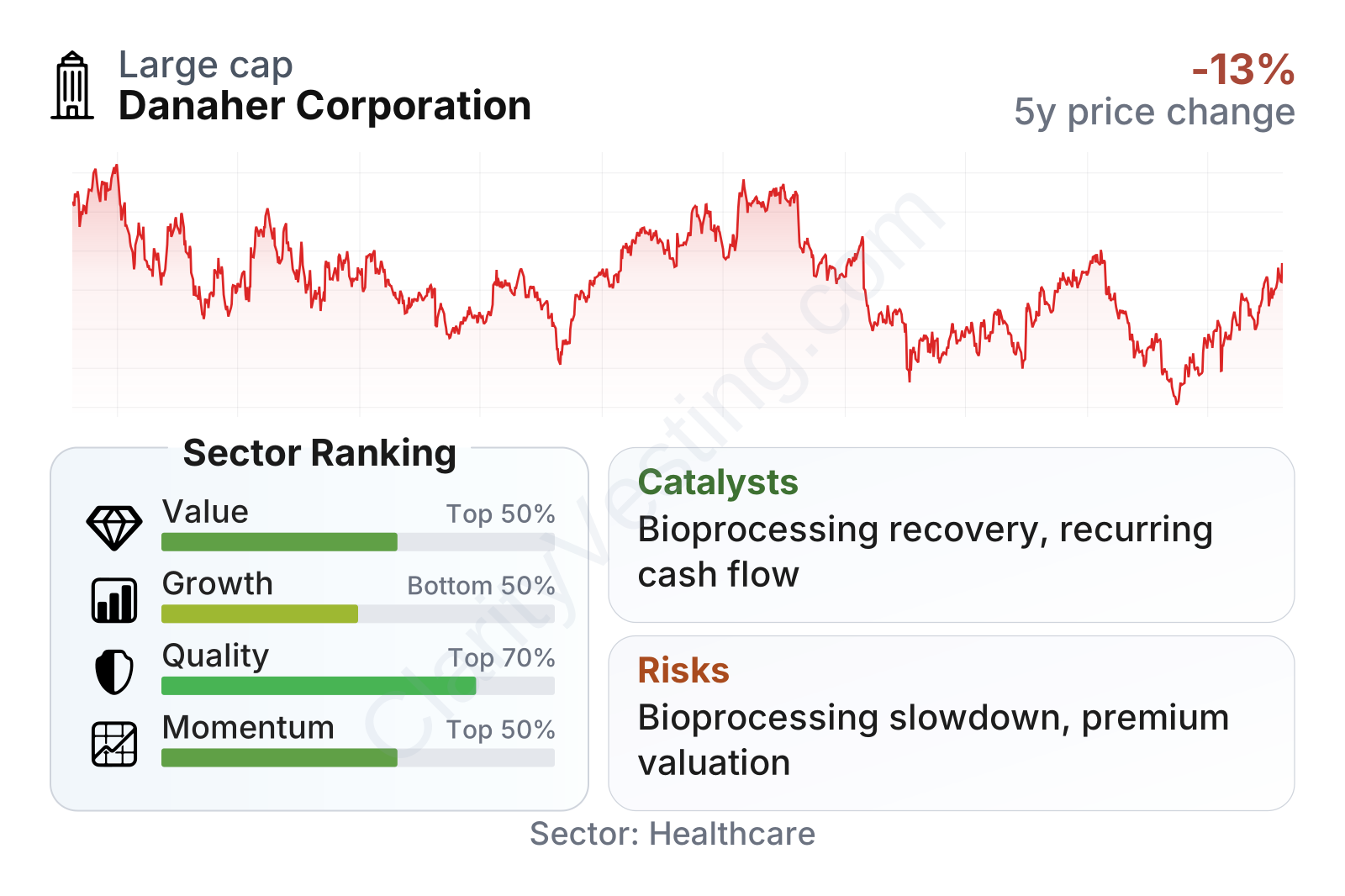
Danaher remains one of the larger companies in healthcare tools, with relatively low share-price volatility versus the broader market. On profitability and capital efficiency, it still ranks well within its sector: returns on assets and invested capital are above typical peer levels, and operating margins remain far stronger than the sector median. Value measures are more mixed. The stock trades at a clear premium on earnings, while cash-flow-based measures look less stretched than the headline P/E might suggest. Growth and share-price momentum have been weaker over longer periods, reflecting the post-pandemic slowdown, although shorter-term momentum has improved.
Growth
Danaher operates in areas that should keep benefiting from long-term structural demand. Biologic drug development, laboratory automation, precision medicine, and advanced diagnostics are all supported by rising healthcare needs, more complex therapies, and the need for faster, more reliable testing. These are not niche trends. They are broad industry shifts that can support demand for years, even if quarterly orders remain uneven.
The company’s strategy also makes sense for future growth. Danaher has a long record of improving acquired businesses, concentrating on higher-margin niches, and reinvesting in markets where customers face high switching costs. Its exposure to bioprocessing is especially important because biologic drugs are difficult to make and require specialized equipment and consumables throughout development and commercial production. Once a customer validates a production workflow, changing suppliers can be costly and risky.
Revenue growth has normalized sharply from the exceptional levels seen earlier in the decade. After several quarters of contraction, growth turned positive again and has recently moved into the mid-single-digit range. That does not place Danaher among the faster-growing names in its sector today, but it does suggest the business may be moving beyond the deepest part of the post-pandemic adjustment, particularly in bioprocessing.
Cash generation remains an important strength. Free cash flow has come down from earlier highs, but it is still substantial in absolute terms and has shown some stabilization after the decline. For a company built around acquisitions, research spending, and portfolio reshaping, that level of cash generation gives Danaher meaningful flexibility.
A notable recent opportunity is the continued recovery in bioprocessing demand, which management has been watching closely through order patterns and customer inventory normalization. In addition, Danaher has kept investing in higher-growth scientific and clinical workflows, including molecular tools, next-generation therapeutics support, and software-enabled lab productivity. These are areas where customers often prioritize reliability and integration over price alone.
Risks
This article is for informational purposes only and does not constitute financial advice. Some content is AI-generated. See Disclaimer


