Stock Analysis · Diversified Healthcare Trust (DHC)
Overview
Diversified Healthcare Trust is a real estate investment trust, or REIT, focused on healthcare properties. In simple terms, it owns buildings used in healthcare and senior living, then earns money from rent and from operating certain communities. Its portfolio is concentrated in two main areas: medical office and life science properties, and senior housing communities.
The business is not a pure landlord model across the whole portfolio. A meaningful part of DHC’s assets, especially senior housing, is tied to property-level operating performance such as resident occupancy, labor costs, and care-related expenses. That makes the company more exposed to day-to-day operating conditions than some healthcare REITs that rely mostly on long-term fixed leases.
Based on the latest company reporting, DHC’s main revenue sources are approximately the following:
- Resident fees and services from senior housing operations: roughly 60% to 70% of total revenue. This includes monthly payments from residents and related service income at communities managed for DHC.
- Rental income from medical office and life science properties: roughly 25% to 35% of total revenue. This comes from leased space used by health systems, physician groups, and research-oriented tenants.
- Other property-related income: generally a small single-source category, including items such as parking, recoveries, and other ancillary revenue where applicable.
This mix matters because senior housing can benefit more directly from a recovery in occupancy and pricing, while medical office properties usually offer steadier cash generation. DHC therefore combines a potentially improving operating segment with a more traditional healthcare real estate base.
The longer-term income flow shows a business that has kept revenue fairly large in dollar terms, but profitability has weakened. Interest expense has remained heavy, and net income has moved from positive territory earlier in the period to sizable losses more recently. That pattern helps explain why the company’s investment case depends heavily on operational recovery rather than on already-strong earnings.
Key Figures
| Metric | Value | Sector ⓘ |
|---|---|---|
| Date | Oct 17, 2026 | |
| Context | ||
| Sector | Real Estate | |
| Industry | REIT - Healthcare Facilities | |
| Market Cap ⓘ | $1.81B | |
| Beta ⓘ | 2.27 | |
Value (Cheapness) | ||
| P/E Ratio ⓘ | N/A | 17.38 |
| P/B Ratio ⓘ | 1.16 | 0.85 |
| FCF Yield ⓘ | -5.34% | 7.38% |
| Dividend Yield ⓘ | 0.52% | 4.85% |
| EBIT / EV ⓘ | -1.16% | 3.78% |
| PEG ⓘ | 1.89 | |
Growth (Business expansion) | ||
| Revenue Growth ⓘ | -4.50% | 5.30% |
| RPS Growth (5Y CAGR) ⓘ | 2.44% | 6.02% |
| EPS Growth (5Y CAGR) ⓘ | -32.38% | -11.37% |
| BVPS Growth (5Y CAGR) ⓘ | -11.28% | 0.45% |
| Margin Growth (5Y Trend) ⓘ | N/A | -0.22% |
| FCF Growth (5Y CAGR) ⓘ | -25.39% | 5.40% |
| DPS Growth (5Y CAGR) ⓘ | 0.07% | 5.02% |
Quality (Business durability) | ||
| ROIC (Latest) ⓘ | -0.94% | 5.69% |
| ROE (Latest) ⓘ | -16.26% | 7.56% |
| ROA (Latest) ⓘ | -5.96% | 2.85% |
| ROIC (5Y Median) ⓘ | -0.86% | 4.22% |
| ROE (5Y Median) ⓘ | -11.80% | 6.03% |
| ROA (5Y Median) ⓘ | -5.13% | 2.44% |
| Net Debt / EBIT (Latest) ⓘ | N/A | 7.59 |
| Net Debt / EBIT (5Y Median) ⓘ | N/A | 8.40 |
| Net Debt / EBITDA (Latest) ⓘ | 11.32 | 5.27 |
| Net Debt / Assets ⓘ | 54.29% | 37.76% |
| EBITDA / Interest ⓘ | 0.93 | 4.10 |
| Operating Margin (Latest) ⓘ | -3.30% | 35.29% |
| Operating Margin (5Y Median) ⓘ | -3.68% | 37.31% |
| Debt to Equity (Latest) ⓘ | 152.76% | 88.87% |
| Profit Margin (Latest) ⓘ | -17.73% | 19.61% |
| Free Cash Flow (Latest) ⓘ | -$96.59M | |
Momentum (Price trend) | ||
| 3Y Return ⓘ | +313.79% | +30.75% |
| 12M Return (excl. last month) ⓘ | +77.68% | +4.36% |
| 6M Return ⓘ | +2.40% | -2.52% |
| Price vs. 200-Day MA ⓘ | -0.18% | -2.34% |
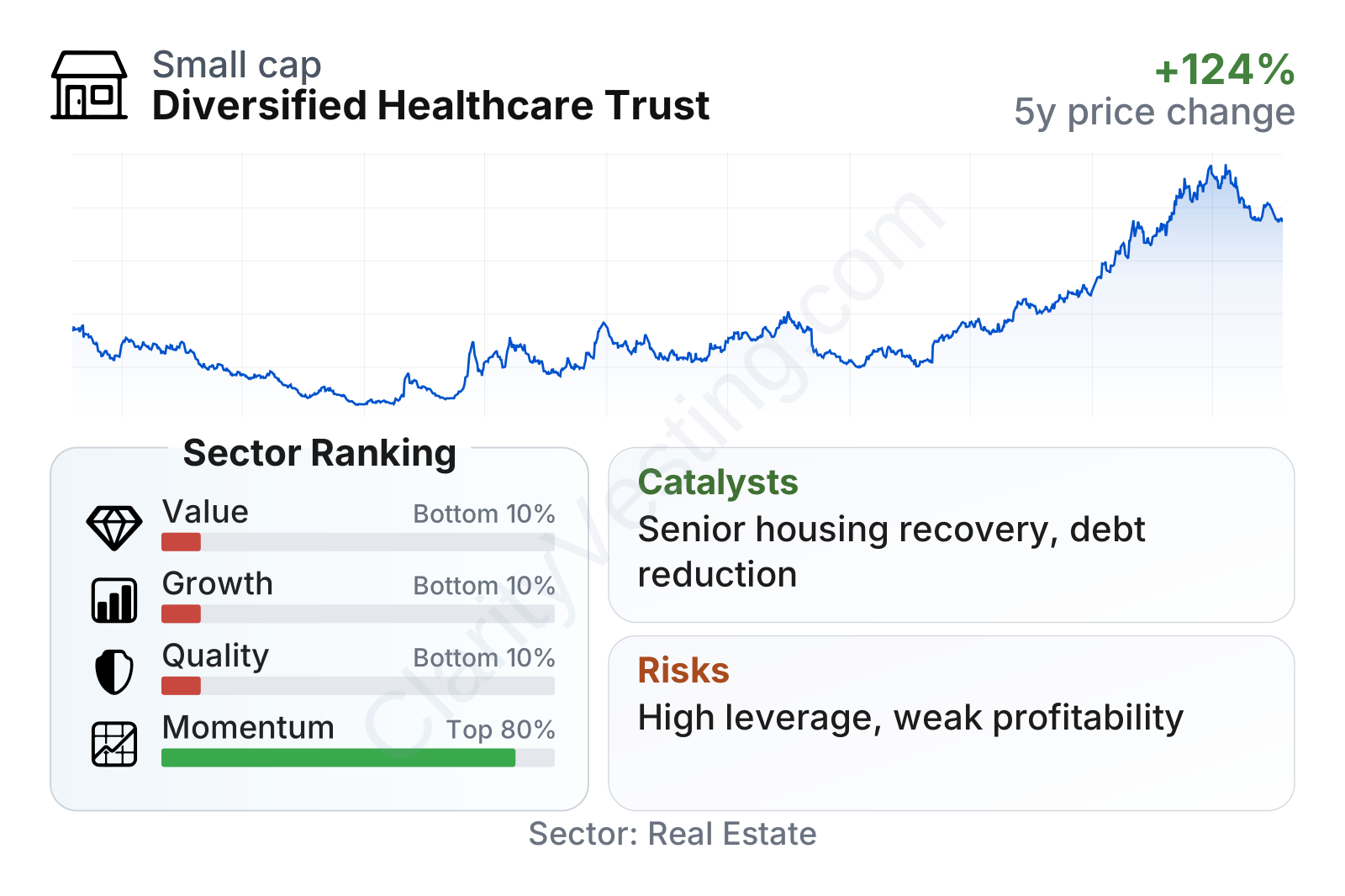
DHC is a mid-sized healthcare REIT by market value, but its operating profile is currently weak relative to much of the real estate sector. The scorecard is strongest on recent share-price momentum, while value, growth, and quality metrics rank near the lower end of the sector. In plain language, the stock market has recently become more optimistic, but the underlying business still shows negative profitability, weak cash generation, and above-average balance-sheet strain.
The share-price chart highlights how dramatic that change in market sentiment has been. After a deep collapse in 2022 and early 2023, the stock rebounded sharply through 2024, 2025, and into 2026. That rebound is notable, but it also means the market is already pricing in a better outlook than the recent financial results alone would suggest.
Growth
DHC operates in a part of real estate with a credible long-term demand backdrop. The aging U.S. population supports the need for senior housing, and healthcare delivery continues to require outpatient facilities such as medical office buildings. Over time, older demographics can lift occupancy, rent, and service revenue, especially for owners that already control a large installed portfolio.
The company’s strategy makes sense in principle because it is positioned in property types linked to aging and healthcare usage rather than in more cyclical office or retail niches. The biggest internal growth lever is senior housing recovery. If more units are filled and resident rates rise faster than expenses, revenue can grow meaningfully because fixed property costs are spread across more occupied units.
Revenue per share has improved gradually over the last several years, which suggests the asset base is still producing substantial top-line income despite the company’s broader profitability problems. That is an important distinction: DHC does not look like a shrinking shell, but rather a company whose revenue base has not yet translated into healthy earnings and cash flow.
The dividend per share has been nearly flat at a very low level. For a REIT, that signals management has kept distributions extremely conservative while the company works through leverage and operating pressures. In practical terms, the current equity case is tied far more to business recovery than to income generation.
A key catalyst is the possibility that senior housing fundamentals continue to improve. The sector has benefited in recent years from recovering occupancy after earlier disruptions, while new construction has been relatively restrained in many markets. Limited new supply can help existing owners push pricing if demand keeps building. For DHC, even moderate improvement can have an outsized effect because its current profitability is starting from a depressed level.
Another positive factor is portfolio quality in medical office and life science real estate, where healthcare systems and research-related users can create durable tenancy. If DHC can preserve occupancy, renew leases at favorable economics, and selectively recycle assets, this part of the portfolio can act as a stabilizer while senior housing works through a longer recovery path.
Risks
This article is for informational purposes only and does not constitute financial advice. Some content is AI-generated. See Disclaimer


