Stock Analysis · Quest Diagnostics Incorporated (DGX)
Overview
Quest Diagnostics is one of the largest diagnostic testing companies in the United States. It operates a nationwide network of laboratories, patient service centers, and logistics infrastructure that helps physicians, hospitals, health plans, employers, and patients order and receive medical tests. In simple terms, the company analyzes blood, tissue, and other specimens to help detect disease, monitor treatment, and support prevention and wellness programs.
The business is mainly tied to routine and specialized lab testing rather than high-risk drug development, which gives it a more predictable operating profile than many other healthcare companies. Demand comes from everyday healthcare use: annual checkups, chronic disease monitoring, cancer screening, hospital testing needs, and employer health programs.
Quest reports revenue primarily through its diagnostic information services activities, with additional disclosure around customer channels and service categories. Based on recent company reporting, the main revenue drivers can be summarized as follows:
- Diagnostic testing services for physicians and patients: the largest source of revenue, driven by routine blood work, pathology, and specialty testing ordered in outpatient settings.
- Hospital and health system laboratory services: testing performed for hospitals, reference lab work, and outsourced lab operations.
- Advanced and esoteric testing: higher-complexity areas such as genetic, oncology, neurological, and other specialty diagnostics.
- Population health and employer services: drug testing, biometric screening, wellness-related services, and programs for employers and insurers.
Quest does not present a simple product-by-product revenue split in the same way that a consumer goods company might. However, the business is heavily concentrated in diagnostic information services in the U.S., which accounts for the overwhelming majority of total revenue. Customer concentration is also broad rather than reliant on one large client, which reduces single-customer risk.
The broader financial picture shows a company that experienced a pandemic-era revenue spike, then a normalization period, and more recently a return to expansion. Revenue has moved back above pre-normalization levels, while profitability remains solid even though it is below the unusually strong pandemic peak.
The multi-year income flow shows that revenue and operating profit surged during the pandemic testing period, then reset as COVID-related demand faded. More recently, sales and operating income have recovered, suggesting the underlying core lab business remains healthy even without that temporary boost.
Key Figures
| Metric | Value | Sector ⓘ |
|---|---|---|
| Date | Oct 17, 2026 | |
| Context | ||
| Sector | Healthcare | |
| Industry | Diagnostics & Research | |
| Market Cap ⓘ | $25.76B | |
| Beta ⓘ | 0.54 | |
Value (Cheapness) | ||
| P/E Ratio ⓘ | 24.78 | 24.79 |
| P/B Ratio ⓘ | 3.76 | 3.08 |
| FCF Yield ⓘ | 4.74% | 3.15% |
| Dividend Yield ⓘ | 1.44% | 1.94% |
| EBIT / EV ⓘ | 5.23% | 0.57% |
| PEG ⓘ | 1.53 | |
Growth (Business expansion) | ||
| Revenue Growth ⓘ | 10.20% | 7.45% |
| RPS Growth (5Y CAGR) ⓘ | 3.75% | 8.61% |
| EPS Growth (5Y CAGR) ⓘ | -14.07% | -17.81% |
| BVPS Growth (5Y CAGR) ⓘ | 5.68% | 3.72% |
| Margin Growth (5Y Trend) ⓘ | -10.78% | -0.62% |
| FCF Growth (5Y CAGR) ⓘ | -7.17% | 1.04% |
| DPS Growth (5Y CAGR) ⓘ | 6.66% | 6.77% |
Quality (Business durability) | ||
| ROIC (Latest) ⓘ | 9.77% | 3.24% |
| ROA (Latest) ⓘ | 6.41% | 3.01% |
| ROIC (5Y Median) ⓘ | 10.80% | 4.60% |
| ROA (5Y Median) ⓘ | 6.36% | 1.89% |
| Net Debt / EBIT (Latest) ⓘ | 3.50 | 1.34 |
| Net Debt / EBIT (5Y Median) ⓘ | 3.81 | 1.84 |
| Net Debt / EBITDA (Latest) ⓘ | 2.59 | 1.00 |
| Net Debt / Assets ⓘ | 33.99% | 5.45% |
| EBITDA / Interest ⓘ | 8.50 | 9.64 |
| Operating Margin (Latest) ⓘ | 14.24% | 9.27% |
| Operating Margin (5Y Median) ⓘ | 14.19% | 7.38% |
| Debt to Equity (Latest) ⓘ | 84.93% | 28.58% |
| Profit Margin (Latest) ⓘ | 9.19% | 3.59% |
| Free Cash Flow (Latest) ⓘ | $1.22B | |
Momentum (Price trend) | ||
| 3Y Return ⓘ | +106.08% | +42.80% |
| 12M Return (excl. last month) ⓘ | +39.19% | +18.50% |
| 6M Return ⓘ | +25.91% | +7.57% |
| Price vs. 200-Day MA ⓘ | +15.53% | +5.12% |
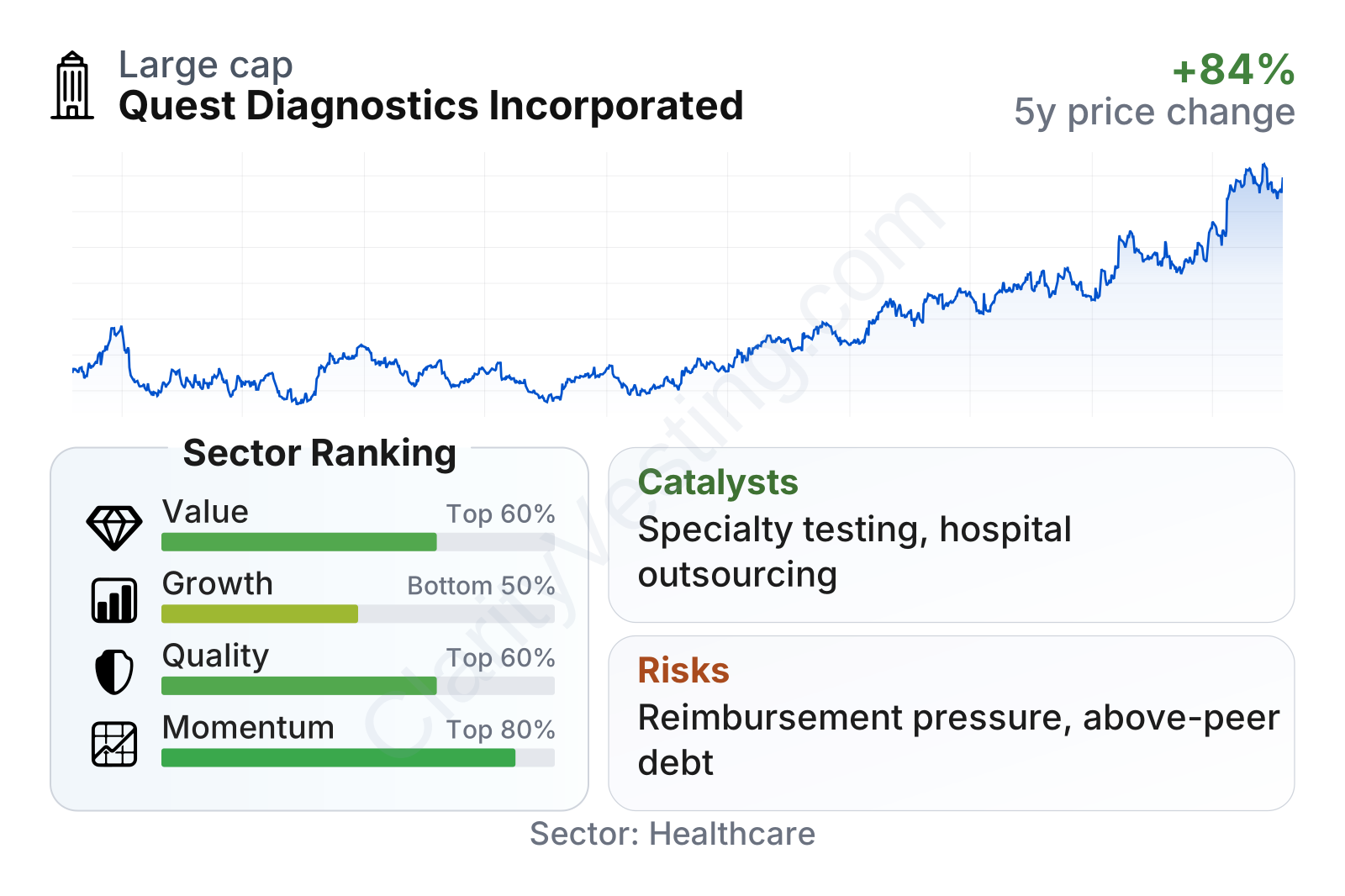
Quest stands out as a large, lower-volatility healthcare company, with a beta well below 1. Profitability and returns on capital are comfortably above the sector median, which supports the view that this is a disciplined, cash-generating operator. Growth metrics are more mixed: recent revenue growth has improved, but the longer-term growth profile still looks modest for healthcare. Valuation measures are near the sector on earnings, somewhat richer on book value, and stronger on cash flow-based measures, reflecting a business that is mature but financially productive.
The share price trend has also been notably steady. Over the last several years, the stock has moved upward with fewer sharp swings than many healthcare names, which fits the company’s more defensive business model.
Growth
Diagnostic testing is part of a healthcare segment that benefits from durable long-term demand. An aging population, greater screening activity, rising chronic disease prevalence, and increased use of precision medicine all support continued need for lab services. This is not a hypergrowth industry, but it is a structurally important one, and testing is often a necessary step in medical decision-making.
Quest’s growth strategy appears practical rather than speculative. The company has focused on expanding higher-value specialty testing, partnering with health systems, improving access through consumer channels, and using acquisitions to add capabilities or strengthen regional density. That makes sense for a business where scale, logistics, payer relationships, and lab efficiency are major advantages.
Revenue growth has clearly improved after the post-pandemic decline. Recent year-over-year gains around the high-single-digit to low-double-digit range suggest that the company is no longer just stabilizing; it is growing again from a more normal operating base. That matters because it indicates the core franchise is carrying the business rather than one-off COVID testing demand.
Cash generation has also rebounded. Free cash flow fell sharply after the pandemic peak, but the more recent trend shows a meaningful recovery to above $1 billion on a trailing basis. For a mature diagnostics company, that is important because cash supports acquisitions, technology investment, debt service, and shareholder returns without requiring aggressive assumptions.
A meaningful catalyst is the continuing shift toward specialty and advanced diagnostics, which typically carry better economics and can deepen clinical relevance. Another potential growth driver is hospital outsourcing: many health systems want to control costs and may prefer partnerships with national lab operators that already have scale. Quest has also continued to highlight operational excellence, network reach, and consumer access as levers for volume growth.
Recent company updates have pointed to ongoing acquisition activity and portfolio expansion in advanced diagnostics and lab services. Those moves do not transform the company overnight, but they reinforce a sensible strategy: use an already large platform to absorb more testing volume and mix into more specialized categories.
Risks
This article is for informational purposes only and does not constitute financial advice. Some content is AI-generated. See Disclaimer


