Stock Analysis · Diageo plc (DGEAF)
Overview
Diageo plc is one of the world’s largest premium alcoholic beverage companies. It owns a broad portfolio of spirits and beer brands sold across North America, Europe, Asia Pacific, Latin America, the Caribbean, and Africa. Its best-known labels include Johnnie Walker, Don Julio, Casamigos, Crown Royal, Smirnoff, Tanqueray, Guinness, Baileys, and Captain Morgan. The business is built around brand ownership, marketing, distribution, and pricing power rather than high-volume commodity production, which is why margins have historically been stronger than much of the broader beverage industry.
Revenue mainly comes from selling beverage alcohol through large international brands, with spirits representing the clear majority of sales. Based on the latest annual reporting structure, the main sources of revenue are approximately:
- Tequila and mezcal: about 20% to 25% of net sales, led by Don Julio and Casamigos.
- Scotch whisky: about 20% to 25%, primarily Johnnie Walker and other Scotch brands.
- Beer: about 15% to 20%, mainly Guinness and related variants.
- Vodka: about 10% to 15%, led by Smirnoff and Cîroc.
- Canadian whisky: about 5% to 10%, mainly Crown Royal.
- Rum: about 5% to 10%, mainly Captain Morgan.
- Liqueurs: about 5% to 10%, including Baileys and Sheridan’s.
- Gin: about 5% to 10%, led by Tanqueray and Gordon’s.
- Other spirits and wine: a smaller contribution, including regional brands and smaller categories.
Geographically, North America has been the largest profit engine in recent years, while Europe, Asia Pacific, Latin America, Africa, and the Caribbean provide diversification. That mix matters because Diageo is not dependent on one single drink type or one single country, although performance in the United States remains especially important.
The business flow also shows a familiar pattern for a branded consumer company: strong gross profit, high marketing and distribution spending, and solid cash generation. More recently, revenue has been uneven and net income has become more volatile, suggesting that the company is still working through a tougher operating period rather than moving in a straight line upward.
Key Figures
| Metric | Value | Sector ⓘ |
|---|---|---|
| Date | Oct 03, 2026 | |
| Context | ||
| Sector | Consumer Defensive | |
| Industry | Beverages - Wineries & Distilleries | |
| Market Cap ⓘ | $47.76B | |
| Beta ⓘ | 0.32 | |
Value (Cheapness) | ||
| P/E Ratio ⓘ | 27.90 | 18.16 |
| P/B Ratio ⓘ | 5.44 | 1.27 |
| FCF Yield ⓘ | 12.97% | 12.39% |
| Dividend Yield ⓘ | 2.29% | 2.83% |
| EBIT / EV ⓘ | 17.02% | 6.45% |
| PEG ⓘ | 0.54 | |
Growth (Business expansion) | ||
| Revenue Growth ⓘ | -1.70% | 3.80% |
| RPS Growth (5Y CAGR) ⓘ | 4.49% | 6.20% |
| EPS Growth (5Y CAGR) ⓘ | -8.22% | -14.64% |
| BVPS Growth (5Y CAGR) ⓘ | 4.06% | 3.26% |
| Margin Growth (5Y Trend) ⓘ | -2.78% | -0.25% |
| FCF Growth (5Y CAGR) ⓘ | 2.69% | 4.65% |
| DPS Growth (5Y CAGR) ⓘ | 2.55% | 6.86% |
Quality (Business durability) | ||
| ROIC (Latest) ⓘ | 26.71% | 12.58% |
| ROA (Latest) ⓘ | 10.21% | 6.35% |
| ROIC (5Y Median) ⓘ | 18.23% | 10.36% |
| ROA (5Y Median) ⓘ | 9.56% | 5.44% |
| Net Debt / EBIT (Latest) ⓘ | 1.77 | 1.91 |
| Net Debt / EBIT (5Y Median) ⓘ | 2.88 | 2.32 |
| Net Debt / EBITDA (Latest) ⓘ | 1.41 | 1.36 |
| Net Debt / Assets ⓘ | 44.19% | 21.25% |
| EBITDA / Interest ⓘ | 6.86 | 9.61 |
| Operating Margin (Latest) ⓘ | 25.25% | 8.96% |
| Operating Margin (5Y Median) ⓘ | 31.13% | 9.53% |
| Debt to Equity (Latest) ⓘ | 204.41% | 71.66% |
| Profit Margin (Latest) ⓘ | 8.84% | 5.40% |
| Free Cash Flow (Latest) ⓘ | $6.20B | |
Momentum (Price trend) | ||
| 3Y Return ⓘ | -36.38% | +15.25% |
| 12M Return (excl. last month) ⓘ | -14.38% | +2.63% |
| 6M Return ⓘ | +15.88% | +2.43% |
| Price vs. 200-Day MA ⓘ | +0.35% | +0.43% |
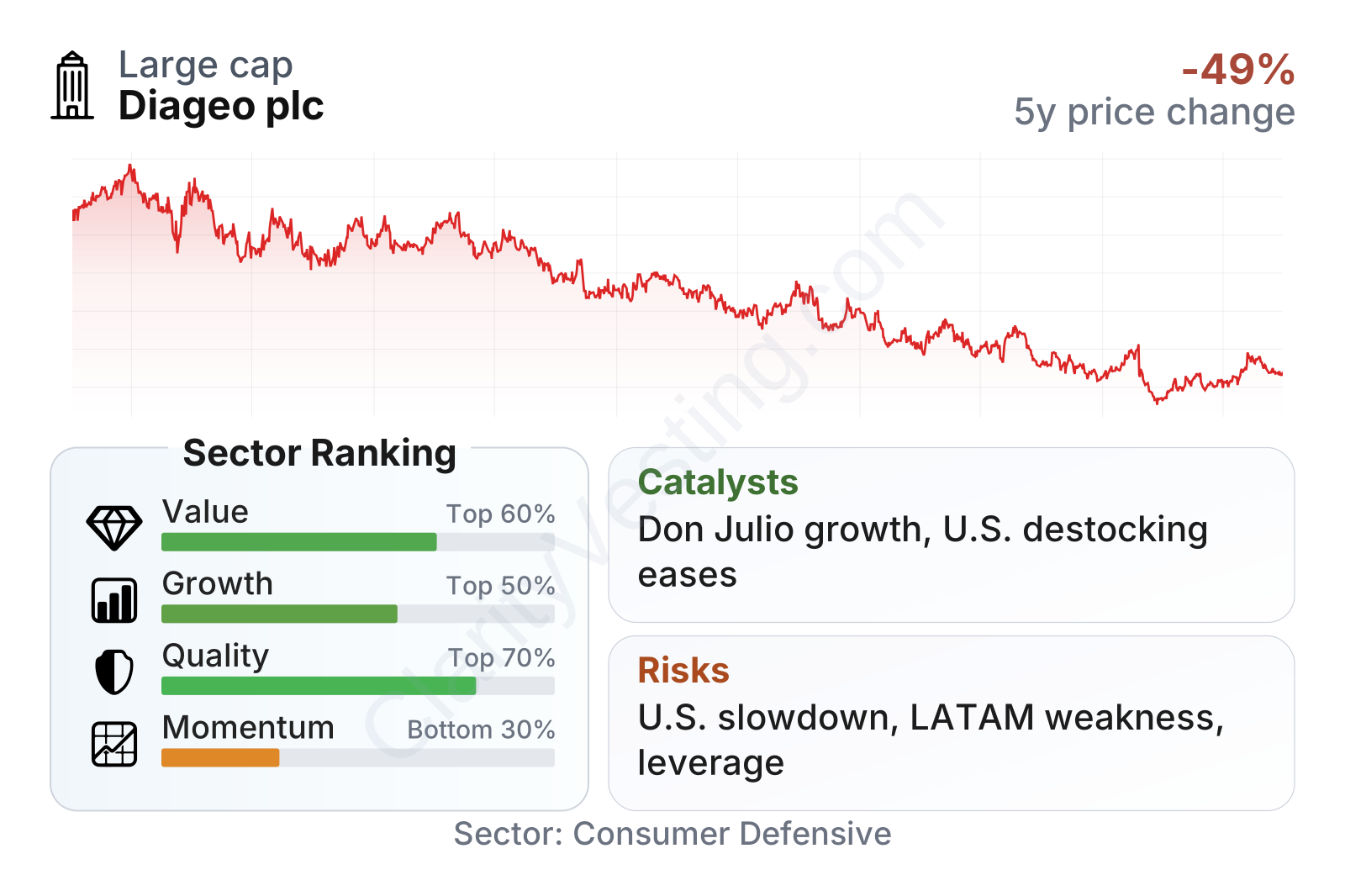
Diageo is a very large global consumer staples company with unusually low share-price volatility for a stock, reflected in a beta near 0.3. Profitability remains a core strength: operating margin is far above the sector median, return on invested capital is also well above peers, and free cash flow remains substantial. That points to durable brand economics even during a slower phase.
The weaker side is growth and market performance. Recent revenue has slipped slightly year over year, long-term sales growth has been moderate rather than fast, and margin trend over the last five years has softened. Share-price momentum has also lagged the sector over one and three years, even though the stock has shown some recovery over the past six months. Balance-sheet leverage is manageable in operating terms, but debt to equity is elevated, so capital structure deserves attention alongside earnings quality.
Growth
Diageo operates in a sector that is mature overall, but still capable of long-term growth through premiumization, geographic expansion, and product mix improvements. Alcohol demand does not usually grow like a high-tech category, yet premium spirits have historically offered a better growth profile than many other consumer staples segments because consumers often trade up within categories. That is especially relevant for tequila, premium Scotch, and high-end ready-to-drink extensions.
The company’s strategy is logical for this environment. Management has concentrated capital behind global premium brands, selective price increases, marketing support, and expansion in faster-growing categories. Tequila has been an important driver, especially through Don Julio, and Guinness has also remained a valuable brand with room for international expansion beyond its traditional base. Diageo has also been reshaping its portfolio over time, exiting less strategic assets and focusing more on categories where brand strength and pricing power are strongest.
For future growth, the strongest catalyst is likely to be a normalization of demand after a difficult stretch in parts of the spirits market, especially in the United States and Latin America. If inventory levels at distributors and retailers stabilize, reported sales can improve even without a major jump in end-consumer demand. Premium tequila remains another meaningful opportunity because it is one of the most attractive spirits categories globally, and Diageo already has significant scale there.
Another supportive element is Diageo’s cash generation. Even with slower growth, the company still produces strong cash flow, which can support brand investment, debt management, and dividends. In a consumer staples business, that financial flexibility can be an important advantage when weaker competitors need to cut spending.
Recent company updates have shown that management remains focused on efficiency, inventory discipline, and protecting brand equity rather than chasing short-term volume. That approach may limit near-term acceleration, but it is consistent with preserving the premium positioning that underpins long-term margins.
Risks
This article is for informational purposes only and does not constitute financial advice. Some content is AI-generated. See Disclaimer