Stock Analysis · Definity Financial Corporation (DFYFF)
Overview
Definity Financial Corporation is a Canadian property and casualty insurer. In simple terms, it sells insurance policies that protect people and businesses against losses such as car accidents, damage to homes, liability claims, and commercial risks. The company operates through well-known brands including Economical Insurance, Sonnet, Family Insurance Solutions, and Petline. Its business model is typical for an insurer: it collects premiums, pays claims, and invests part of its insurance float to generate additional income.
Its revenue is primarily tied to insurance activity, with investment income acting as a secondary contributor. Based on company reporting, the business is largely organized around underwriting lines rather than many unrelated activities.
- Personal auto insurance: the largest source of premiums, covering private passenger vehicles and related liability and accident coverage.
- Personal property insurance: home, condo, tenant, and related personal property protection.
- Commercial lines insurance: policies for businesses, including property, liability, and specialized commercial risks.
- Other personal lines: smaller activities such as pet insurance and niche personal protection products.
- Investment income: income generated from the company’s investment portfolio, which supports overall profitability but is not the core operating engine.
Exact line-by-line revenue percentages can shift by quarter because claims trends, premium rate changes, and acquisitions can materially change the mix. Still, public disclosures indicate that personal insurance is the core of the company, with commercial insurance forming a meaningful but smaller share, and investment income remaining a much smaller contributor than premiums.
One useful operating trend is that total revenue has expanded steadily in recent years, moving from roughly $2.1 billion in 2022 to more than $3.4 billion on a trailing basis by late 2025, while operating income also improved materially over that period. That points to a company that has been scaling its underwriting base even though earnings quality has become less even more recently.
Key Figures
| Metric | Value | Sector ⓘ |
|---|---|---|
| Date | Nov 21, 2026 | |
| Context | ||
| Sector | Financial Services | |
| Industry | Insurance - Property & Casualty | |
| Market Cap ⓘ | $6.30B | |
| Beta ⓘ | 0.14 | |
Value (Cheapness) | ||
| P/E Ratio ⓘ | 37.02 | 12.01 |
| P/B Ratio ⓘ | N/A | 1.48 |
| FCF Yield ⓘ | 4.41% | 8.77% |
| Dividend Yield ⓘ | 1.58% | 3.01% |
| EBIT / EV ⓘ | 4.02% | 8.31% |
| PEG ⓘ | N/A | |
Growth (Business expansion) | ||
| Revenue Growth ⓘ | 31.00% | 6.70% |
| RPS Growth (5Y CAGR) ⓘ | 12.72% | 12.35% |
| EPS Growth (5Y CAGR) ⓘ | -35.05% | -0.27% |
| BVPS Growth (5Y CAGR) ⓘ | 13.05% | 4.83% |
| Margin Growth (5Y Trend) ⓘ | 8.50% | -4.16% |
| FCF Growth (5Y CAGR) ⓘ | -10.90% | 4.69% |
| DPS Growth (5Y CAGR) ⓘ | N/A | 8.82% |
Quality (Business durability) | ||
| ROIC (Latest) ⓘ | 5.67% | 9.49% |
| ROE (Latest) ⓘ | 6.30% | 14.02% |
| ROA (Latest) ⓘ | 2.10% | 1.53% |
| ROIC (5Y Median) ⓘ | 14.77% | 7.80% |
| ROE (5Y Median) ⓘ | 11.64% | 12.09% |
| ROA (5Y Median) ⓘ | 4.50% | 1.28% |
| Net Debt / EBIT (Latest) ⓘ | 3.18 | 0.88 |
| Net Debt / EBIT (5Y Median) ⓘ | N/A | 0.73 |
| Net Debt / EBITDA (Latest) ⓘ | N/A | 0.71 |
| Operating Margin (Latest) ⓘ | 6.16% | 23.37% |
| Operating Margin (5Y Median) ⓘ | 12.02% | 24.29% |
| Debt to Equity (Latest) ⓘ | N/A | 59.34% |
| Profit Margin (Latest) ⓘ | 3.79% | 26.65% |
| Free Cash Flow (Latest) ⓘ | $278.17M | |
Momentum (Price trend) | ||
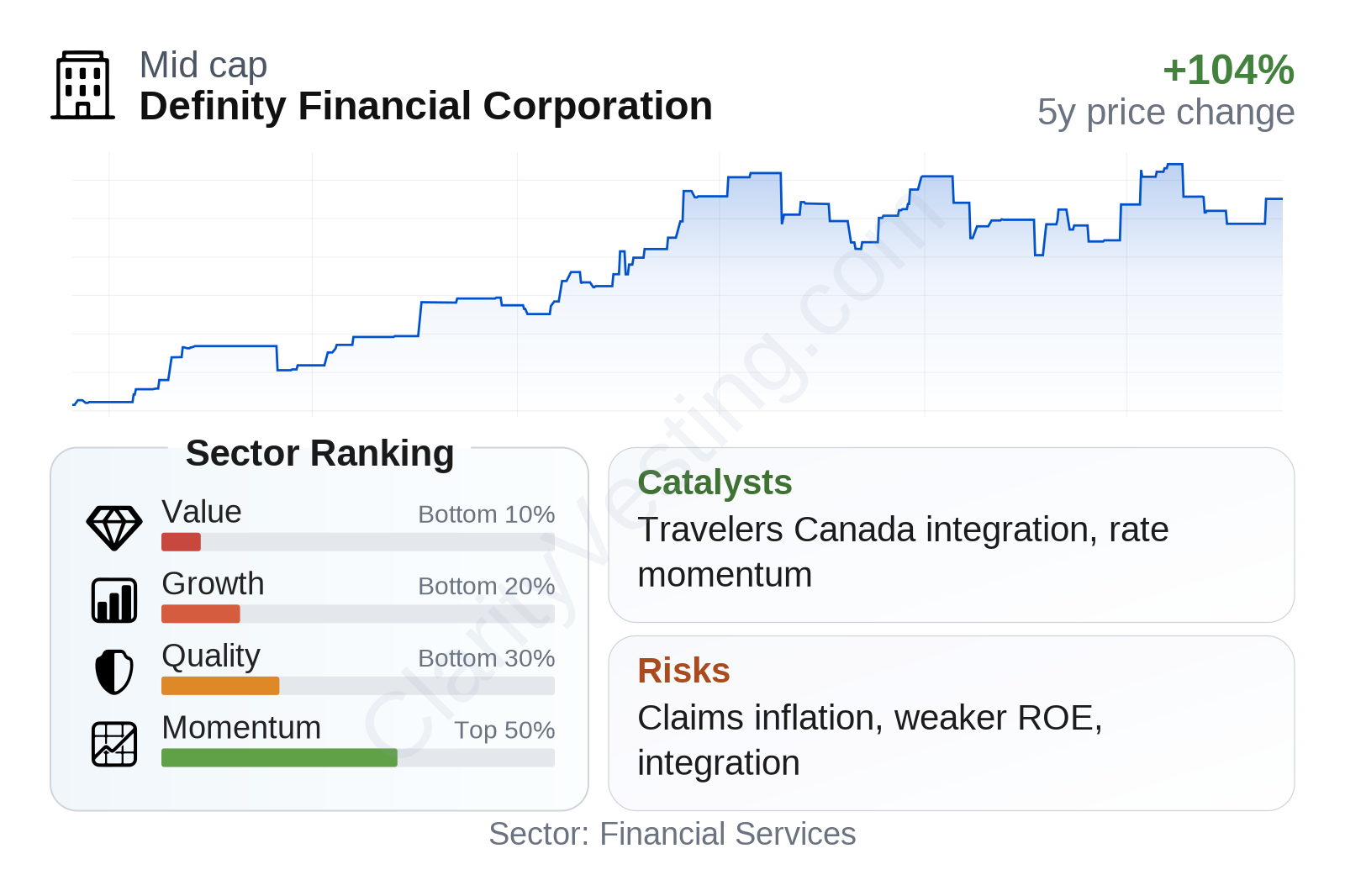
| 3Y Return ⓘ | +103.89% | +73.29% |
| 12M Return (excl. last month) ⓘ | -0.71% | +18.35% |
| 6M Return ⓘ | +7.05% | +3.24% |
| Price vs. 200-Day MA ⓘ | +3.59% | +2.17% |
Definity sits in the mid-cap range and its share price volatility has been unusually low, with a beta near 0.14. Over three years, the stock has delivered a strong gain, but shorter-term momentum has been less impressive versus the broader financial sector. The market currently values the company at a much richer earnings multiple than the sector median, while its free cash flow yield, dividend yield, and operating earnings yield are all less favorable than typical sector levels. In other words, the market is assigning a premium despite weaker current factor rankings in value, quality, and momentum.
That premium likely reflects confidence in the franchise, pricing power in Canadian P&C insurance, and the company’s record of expanding its balance sheet and premium base. But it also means expectations already appear elevated relative to many peers.
Growth
The sector itself has attractive long-term characteristics. Property and casualty insurance tends to benefit from population growth, rising insured values, higher repair and replacement costs, and periodic premium repricing after industry loss events. In Canada, auto and home insurance remain essential products rather than optional spending, which gives the business a durable demand base.
Definity’s strategy for future growth is logical. It combines traditional broker-distributed insurance with digital distribution through Sonnet, while also broadening its reach in commercial insurance and specialty niches. Scale matters in insurance because larger players can spread fixed costs, invest more in claims and pricing technology, and diversify risk across more policies. Definity has been moving in that direction.
A notable catalyst is the company’s expansion through acquisition. In 2025, Definity closed the acquisition of Travelers Canada, which significantly increased scale, especially in personal and commercial lines. That deal can create cross-selling opportunities, broader broker relationships, a larger customer base, and expense synergies if integration goes well. For a company of Definity’s size, this is a meaningful strategic step rather than a minor add-on.
Another positive signal is top-line momentum. Revenue growth of about 31% year over year is far above the sector median. Over five years, revenue per share has also grown at a low-double-digit annual pace, roughly in line with or slightly above the sector. Book value per share has risen even faster, which is important for insurers because book value often reflects the gradual accumulation of underwriting profits and investment returns.
The weaker point is earnings per share. Recent EPS has moved down from prior levels, and the five-year EPS growth record is negative. This suggests that while Definity is growing, that growth has not flowed smoothly into per-share profit. Claims severity, catastrophe losses, integration costs, reserve movements, or financing effects may all play a role. For long-term analysis, that makes revenue growth less convincing unless profitability stabilizes again.
The rise in book value per share is one of the stronger parts of the company’s profile. It has climbed sharply over the last several years, showing that the underlying capital base has been compounding even as EPS has become more uneven. In insurance, this can matter because a stronger capital base supports premium growth, regulatory flexibility, and resilience after large claims events.
Risks
This article is for informational purposes only and does not constitute financial advice. Some content is AI-generated. See Disclaimer