Stock Analysis · Definium Therapeutics Inc (DFTX)
Overview
Definium Therapeutics Inc is a biotechnology company developing medicines rather than selling a broad portfolio of established products. In practical terms, that means the business is centered on research, clinical development, and regulatory progress. The company appears to be in the stage where value depends mainly on whether its drug candidates can generate strong trial results, move through the approval process, and eventually become commercial products or partnership assets.
At this point, the company’s economic model is still largely pre-revenue. Recent annual figures show essentially no recurring revenue, while operating expenses remain substantial and are led by research spending. That profile is common in biotechnology: cash is spent upfront to fund laboratories, clinical trials, manufacturing preparation, and corporate infrastructure, with the hope of much larger future revenue if a therapy succeeds.
Main economic sources currently visible are best understood as follows:
- Product revenue: approximately 0%. The company has not yet established a meaningful commercial sales base.
- Collaboration or licensing revenue: not material enough in the latest annual figures to represent a stable revenue line.
- Financing-related funding: while not revenue in accounting terms, capital raised from equity or debt has been the practical source used to support operations.
The expense structure gives a clearer picture of what the company is doing today. In the latest annual period, research and development represented roughly 71% of total operating expenses, while selling, general, and administrative costs represented about 29%. That mix suggests management is still directing most spending toward advancing the pipeline rather than supporting a large commercial organization.
The multi-year trend also shows an increasingly aggressive development push. Operating expenses have climbed materially over time, especially in research and development, while revenue has remained near zero. That is a classic high-risk, high-upside biotech profile: scientific progress can change the business quickly, but there is little operating support if progress stalls.
The company’s financial flow remains dominated by development spending rather than sales generation. The most notable trend is the sharp rise in research expense over the last few years, which indicates a pipeline that is being pushed forward more aggressively, but also a business becoming more cash-intensive.
Key Figures
| Metric | Value | Sector ⓘ |
|---|---|---|
| Date | Oct 24, 2026 | |
| Context | ||
| Sector | Healthcare | |
| Industry | Biotechnology | |
| Market Cap ⓘ | $4.77B | |
| Beta ⓘ | 2.19 | |
Value (Cheapness) | ||
| P/E Ratio ⓘ | N/A | 25.42 |
| P/B Ratio ⓘ | 4.34 | 3.08 |
| FCF Yield ⓘ | -3.50% | 3.12% |
| Dividend Yield ⓘ | N/A | 1.85% |
| EBIT / EV ⓘ | -8.48% | 0.56% |
| PEG ⓘ | N/A | |
Growth (Business expansion) | ||
| Revenue Growth ⓘ | N/A | 7.50% |
| RPS Growth (5Y CAGR) ⓘ | N/A | 8.60% |
| EPS Growth (5Y CAGR) ⓘ | N/A | -17.73% |
| BVPS Growth (5Y CAGR) ⓘ | -9.47% | 3.72% |
| Margin Growth (5Y Trend) ⓘ | N/A | -0.57% |
| FCF Growth (5Y CAGR) ⓘ | N/A | 0.96% |
| DPS Growth (5Y CAGR) ⓘ | N/A | 6.69% |
Quality (Business durability) | ||
| ROIC (Latest) ⓘ | -58.39% | 3.17% |
| ROA (Latest) ⓘ | -52.42% | 2.98% |
| ROIC (5Y Median) ⓘ | N/A | 4.56% |
| ROA (5Y Median) ⓘ | -50.94% | 1.87% |
| Net Debt / EBIT (Latest) ⓘ | N/A | 1.34 |
| Net Debt / EBIT (5Y Median) ⓘ | N/A | 1.86 |
| Net Debt / EBITDA (Latest) ⓘ | N/A | 1.00 |
| Net Debt / Assets ⓘ | -55.60% | 5.06% |
| EBITDA / Interest ⓘ | N/A | 9.55 |
| Operating Margin (Latest) ⓘ | N/A | 9.25% |
| Operating Margin (5Y Median) ⓘ | N/A | 7.33% |
| Debt to Equity (Latest) ⓘ | 3.97% | 26.68% |
| Profit Margin (Latest) ⓘ | N/A | 3.34% |
| Free Cash Flow (Latest) ⓘ | -$166.87M | |
Momentum (Price trend) | ||
| 3Y Return ⓘ | +1268.82% | +51.61% |
| 12M Return (excl. last month) ⓘ | +322.64% | +19.90% |
| 6M Return ⓘ | +55.98% | +10.10% |
| Price vs. 200-Day MA ⓘ | +24.43% | +6.44% |
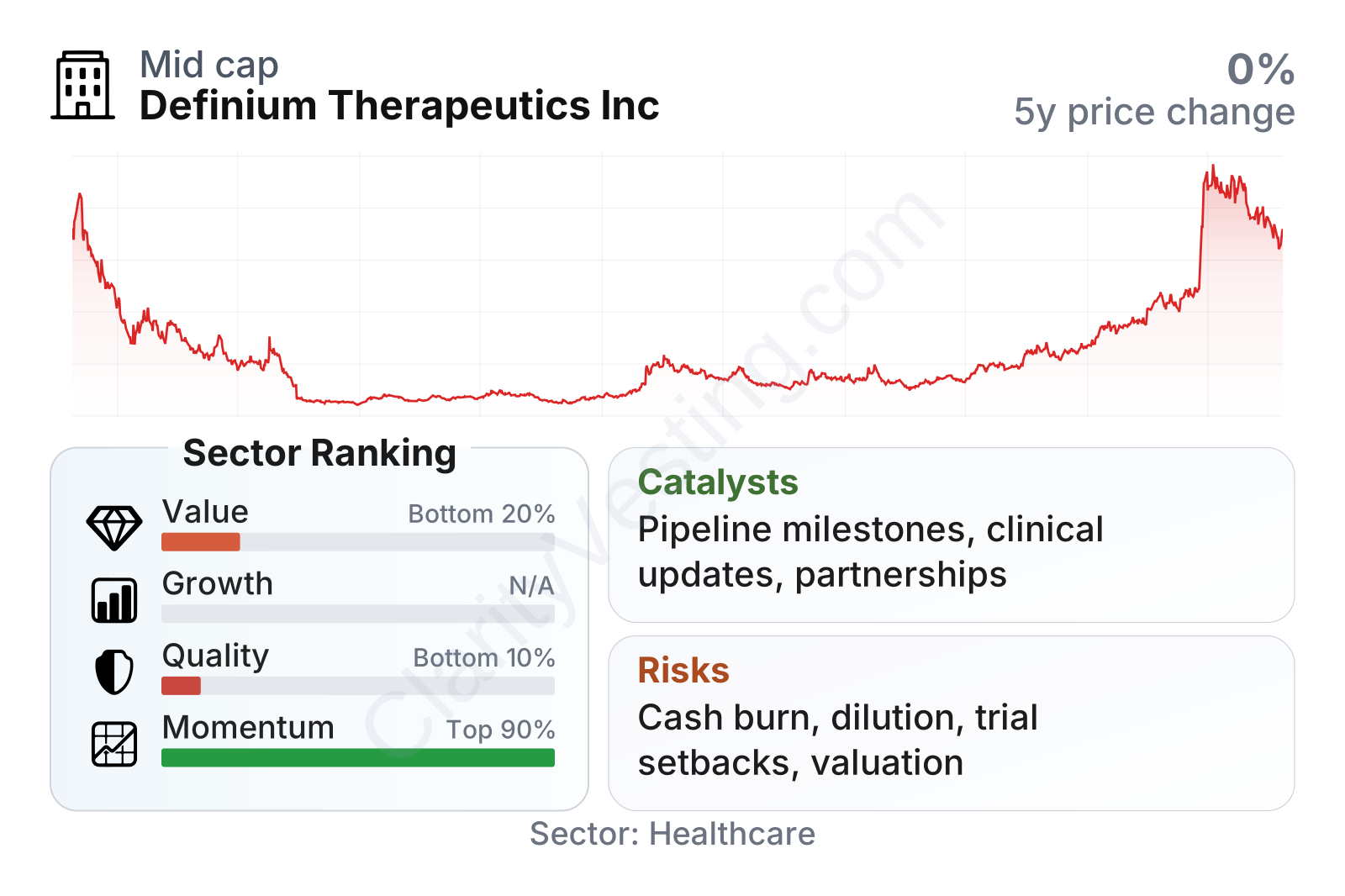
Definium sits in the mid-cap range for biotechnology and has shown very strong recent market momentum, but the underlying fundamentals remain typical of a company still in the development stage. The stock has been highly volatile, with a beta above 2, meaning price moves have been much larger than the broader market. Relative valuation metrics screen poorly versus the healthcare sector because the company is not yet producing earnings or free cash flow, and quality metrics are very weak for the same reason. On the other hand, leverage is low and net cash characteristics appear stronger than many biotech peers, which provides some financial flexibility even though profitability is absent.
Growth
Biotechnology remains a sector with meaningful long-term growth potential because successful therapies can create very large markets and long commercial lifecycles. Growth in this industry does not usually happen in a straight line. Instead, it tends to come in steps tied to trial results, regulatory updates, partnerships, and launch milestones. For a company like Definium, future expansion depends far less on current sales trends and far more on whether its lead programs can clear those milestones.
That strategy can make sense if the pipeline addresses important medical needs and if management is concentrating capital on the most promising assets. The company’s spending pattern suggests exactly that kind of approach: a rising share of resources is going into development activity. In biotech, this can be a positive signal when it reflects pipeline advancement, broader trials, or preparation for later-stage studies. It also helps explain why traditional revenue growth measures are not very useful yet; the business is still building toward a possible inflection point rather than harvesting mature demand.
One recent positive indicator is market behavior. The stock has appreciated sharply over the last year and over the last three years, outperforming most healthcare names by a wide margin. Price action alone does not prove business quality, but in biotechnology it often reflects rising expectations around clinical or strategic progress. The magnitude of the rerating suggests the market is assigning significantly higher odds to future value creation than it did in earlier periods.
The main limitation is that cash burn is moving in the opposite direction. Free cash flow has become more negative over time, which means growth is currently being financed by cash consumption rather than by internally generated funds. That does not invalidate the growth case, but it makes timing important: future catalysts need to arrive before the funding burden becomes too heavy.
Risks
This article is for informational purposes only and does not constitute financial advice. Some content is AI-generated. See Disclaimer


