Stock Analysis · Dairy Farm International Holdings Ltd (DFIHY)
Overview
Dairy Farm International Holdings Ltd is a large Asian retail group focused on everyday consumer spending. Its businesses sell food, health and beauty products, convenience items, home furnishings, and restaurant meals across several markets in North and Southeast Asia. The company is part of the Jardine Matheson group and operates through a mix of owned retail chains and associates.
Its revenue base is led by food retailing, while profit exposure is also influenced by associates and higher-margin specialty formats. Based on recent annual reporting, the business mix can be summarized approximately as follows:
- Food: about 56% of sales. This includes supermarkets, hypermarkets, and grocery retailing, mainly under banners such as Wellcome, Yonghui-related exposure, and other food chains in key Asian markets.
- Health and Beauty: about 18% of sales. This includes pharmacy-led and personal care retailing, mainly through Guardian and Mannings.
- Convenience: about 15% of sales. This is largely the 7-Eleven store network in markets where the group has franchise or operating rights.
- Home Furnishings: about 9% of sales. This segment is primarily IKEA operations in several Asian territories.
- Restaurants and other activities: about 2% of sales. This includes selected restaurant interests and smaller operations.
The company has been reshaping its portfolio in recent years, reducing weaker exposure and putting more emphasis on businesses with stronger brand recognition, store productivity, and cash generation. That matters because Dairy Farm is not a pure grocery chain: it is a broad retail platform whose quality depends on execution across several formats and countries.
The financial flow over the last few years shows a business with relatively stable revenue around the high single-digit billions of dollars, but much more volatile profitability. Gross profit has held up better than operating profit, which suggests that the bigger issue has been overhead, restructuring, impairments, and efficiency rather than a collapse in customer demand. The rebound in 2025 operating income and net income is therefore an important sign that the restructuring effort has started to translate into cleaner earnings.
Key Figures
| Metric | Value | Sector ⓘ |
|---|---|---|
| Date | Oct 17, 2026 | |
| Context | ||
| Sector | Consumer Defensive | |
| Industry | Grocery Stores | |
| Market Cap ⓘ | $4.44B | |
| Beta ⓘ | 0.50 | |
Value (Cheapness) | ||
| P/E Ratio ⓘ | 11.40 | 17.88 |
| P/B Ratio ⓘ | 23.91 | 1.29 |
| FCF Yield ⓘ | 41.07% | 12.39% |
| Dividend Yield ⓘ | 3.73% | 2.85% |
| EBIT / EV ⓘ | 10.72% | 6.43% |
| PEG ⓘ | 1.92 | |
Growth (Business expansion) | ||
| Revenue Growth ⓘ | -5.70% | 4.10% |
| RPS Growth (5Y CAGR) ⓘ | -0.42% | 6.18% |
| EPS Growth (5Y CAGR) ⓘ | N/A | -13.59% |
| BVPS Growth (5Y CAGR) ⓘ | -32.72% | 3.20% |
| Margin Growth (5Y Trend) ⓘ | 0.72% | -0.15% |
| FCF Growth (5Y CAGR) ⓘ | 7.79% | 4.10% |
| DPS Growth (5Y CAGR) ⓘ | 39.29% | 6.79% |
Quality (Business durability) | ||
| ROIC (Latest) ⓘ | N/A | 12.34% |
| ROA (Latest) ⓘ | N/A | 6.30% |
| ROIC (5Y Median) ⓘ | 8.90% | 10.49% |
| ROA (5Y Median) ⓘ | 0.45% | 5.44% |
| Net Debt / EBIT (Latest) ⓘ | 2.72 | 1.96 |
| Net Debt / EBIT (5Y Median) ⓘ | 13.62 | 2.35 |
| Net Debt / EBITDA (Latest) ⓘ | 1.05 | 1.38 |
| Net Debt / Assets ⓘ | 48.88% | 21.51% |
| EBITDA / Interest ⓘ | N/A | 9.46 |
| Operating Margin (Latest) ⓘ | 4.76% | 8.87% |
| Operating Margin (5Y Median) ⓘ | 2.72% | 9.53% |
| Debt to Equity (Latest) ⓘ | 1165.06% | 72.35% |
| Profit Margin (Latest) ⓘ | 4.52% | 5.40% |
| Free Cash Flow (Latest) ⓘ | $1.82B | |
Momentum (Price trend) | ||
| 3Y Return ⓘ | +77.64% | +20.92% |
| 12M Return (excl. last month) ⓘ | +18.62% | +2.13% |
| 6M Return ⓘ | -22.06% | +1.26% |
| Price vs. 200-Day MA ⓘ | +54.90% | +1.39% |
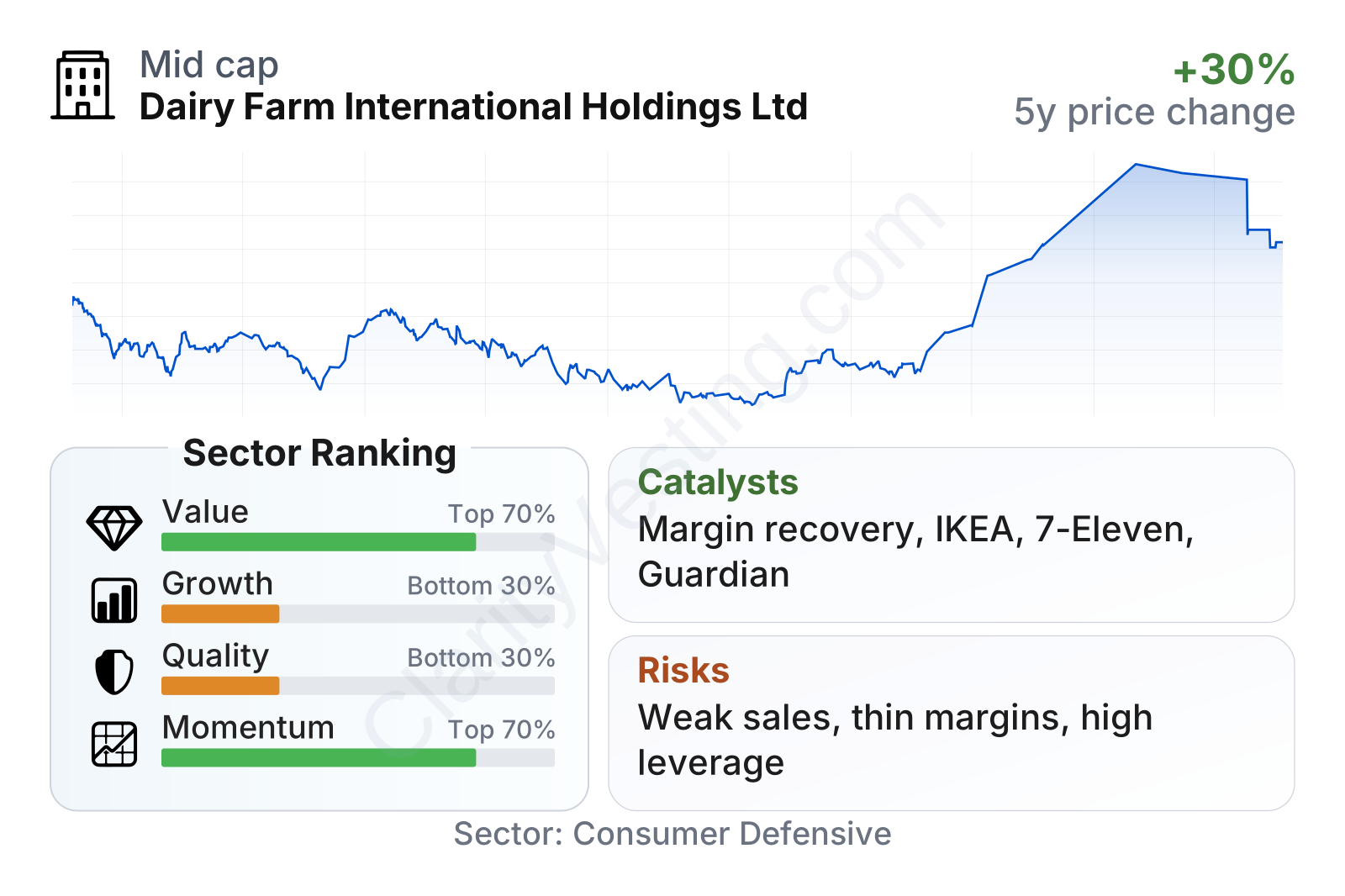
Dairy Farm looks mixed on headline metrics. On valuation measures, it screens cheaper than much of the consumer defensive sector, with a P/E ratio below the sector median, a dividend yield modestly above the sector median, and unusually strong free cash flow generation relative to its market value. The tradeoff is that growth and quality rankings are weaker. Revenue has recently declined, margins remain below typical sector levels, and leverage measures are elevated. Share price performance has improved meaningfully over a multi-year view, but the last six months have been noticeably weaker, which suggests the market has become more selective after a strong earlier rerating.
The company is also relatively low-volatility for an equity, with a beta well below 1. That tends to fit the essential-retail nature of the business, although the earnings record itself has been much less steady than the stock’s defensive sector label might imply.
Growth
Dairy Farm operates in sectors that are structurally relevant for the long run. Grocery, convenience, pharmacies, and value-focused home furnishings are all tied to recurring household spending. These are not fast-growth categories in the way software or semiconductors can be, but they can produce durable demand because people continue buying food, personal care products, and daily essentials in both strong and weak economies.
The more important question is not whether retail demand exists, but whether Dairy Farm can grow within that demand. Its recent strategy appears more rational than expansive. Management has been simplifying the portfolio, improving store execution, tightening costs, and focusing capital on formats where the group has stronger brand equity and local scale. That is often the right approach for a mature retailer: better returns can come from improving store productivity and margins rather than simply opening more locations.
There are a few visible catalysts. First, the convenience and health-and-beauty businesses can benefit from urban density, frequent purchases, and better margins than traditional supermarkets. Second, IKEA gives the company exposure to a globally recognized retail concept that can deepen customer traffic and basket size in its territories. Third, if the company continues to remove underperforming assets and improve overhead discipline, even modest sales growth could translate into a larger improvement in profit than revenue trends alone would suggest.
Recent company reporting has also pointed to improved profitability after a very weak 2024. That is important because the latest recovery was not driven by booming top-line expansion; it came from better operating execution. For a long-term assessment, this can be more durable than temporary sales spikes if management can sustain it over several reporting periods.
Risks
This article is for informational purposes only and does not constitute financial advice. Some content is AI-generated. See Disclaimer


