Stock Analysis · Douglas Emmett Inc (DEI)
Overview
Douglas Emmett is a real estate investment trust, or REIT, focused mainly on owning and operating office buildings and apartment communities in a small number of high-income coastal markets. Its properties are concentrated in Los Angeles County, CA and Honolulu, HI. The company’s strategy is relatively narrow: it targets neighborhoods with supply constraints, high barriers to new construction, and tenants that often want to stay close to established business districts.
In practical terms, Douglas Emmett makes money by leasing space and collecting rent. Based on recent annual reporting, revenue is dominated by office rental operations, with multifamily apartments providing a smaller but still meaningful share, plus a limited contribution from parking and other property-related income.
- Office rental revenue: approximately 75% to 80% of total revenue. This includes rent from office tenants and related recoveries tied to building operations.
- Multifamily rental revenue: approximately 15% to 20% of total revenue. This comes from apartment communities, mainly in the same core markets.
- Parking and other income: approximately 3% to 7% of total revenue. This typically includes parking, storage, tenant reimbursements, and other ancillary property income.
The business remains property-heavy and recurring by nature, which is typical for a landlord model, but the mix also explains why office market conditions still matter far more than any other single factor for Douglas Emmett’s results.
Revenue has been broadly stable around the $1.0 billion level in recent years, but profit available to shareholders has been much more volatile. Operating income has held up better than net income, while interest expense has climbed materially, showing that financing costs have become a major pressure point.
The overall picture is of a specialized urban landlord with fairly resilient top-line rent collections, but with a profit stream that has become more sensitive to debt costs than it was a few years ago.
Key Figures
| Metric | Value | Sector ⓘ |
|---|---|---|
| Date | Oct 17, 2026 | |
| Context | ||
| Sector | Real Estate | |
| Industry | REIT - Office | |
| Market Cap ⓘ | $1.87B | |
| Beta ⓘ | 1.21 | |
Value (Cheapness) | ||
| P/E Ratio ⓘ | N/A | 17.38 |
| P/B Ratio ⓘ | 9.93 | 0.85 |
| FCF Yield ⓘ | 10.22% | 7.38% |
| Dividend Yield ⓘ | 7.73% | 4.85% |
| EBIT / EV ⓘ | 2.92% | 3.78% |
| PEG ⓘ | 11.67 | |
Growth (Business expansion) | ||
| Revenue Growth ⓘ | 1.60% | 5.30% |
| RPS Growth (5Y CAGR) ⓘ | 3.46% | 6.02% |
| EPS Growth (5Y CAGR) ⓘ | -11.36% | -11.37% |
| BVPS Growth (5Y CAGR) ⓘ | -38.30% | 0.45% |
| Margin Growth (5Y Trend) ⓘ | 3.25% | -0.22% |
| FCF Growth (5Y CAGR) ⓘ | 6.03% | 5.40% |
| DPS Growth (5Y CAGR) ⓘ | -9.24% | 5.02% |
Quality (Business durability) | ||
| ROIC (Latest) ⓘ | 2.14% | 5.69% |
| ROE (Latest) ⓘ | -8.85% | 7.56% |
| ROA (Latest) ⓘ | -0.24% | 2.85% |
| ROIC (5Y Median) ⓘ | 1.34% | 4.22% |
| ROE (5Y Median) ⓘ | 3.73% | 6.03% |
| ROA (5Y Median) ⓘ | 0.25% | 2.44% |
| Net Debt / EBIT (Latest) ⓘ | 26.22 | 7.59 |
| Net Debt / EBIT (5Y Median) ⓘ | 21.37 | 8.40 |
| Net Debt / EBITDA (Latest) ⓘ | 8.97 | 5.27 |
| Net Debt / Assets ⓘ | 56.43% | 37.76% |
| EBITDA / Interest ⓘ | 2.19 | 4.10 |
| Operating Margin (Latest) ⓘ | 20.40% | 35.29% |
| Operating Margin (5Y Median) ⓘ | 24.03% | 37.31% |
| Debt to Equity (Latest) ⓘ | 312.49% | 88.87% |
| Profit Margin (Latest) ⓘ | -2.27% | 19.61% |
| Free Cash Flow (Latest) ⓘ | $190.88M | |
Momentum (Price trend) | ||
| 3Y Return ⓘ | -7.46% | +30.75% |
| 12M Return (excl. last month) ⓘ | -33.23% | +4.36% |
| 6M Return ⓘ | -1.93% | -2.52% |
| Price vs. 200-Day MA ⓘ | -9.20% | -2.34% |
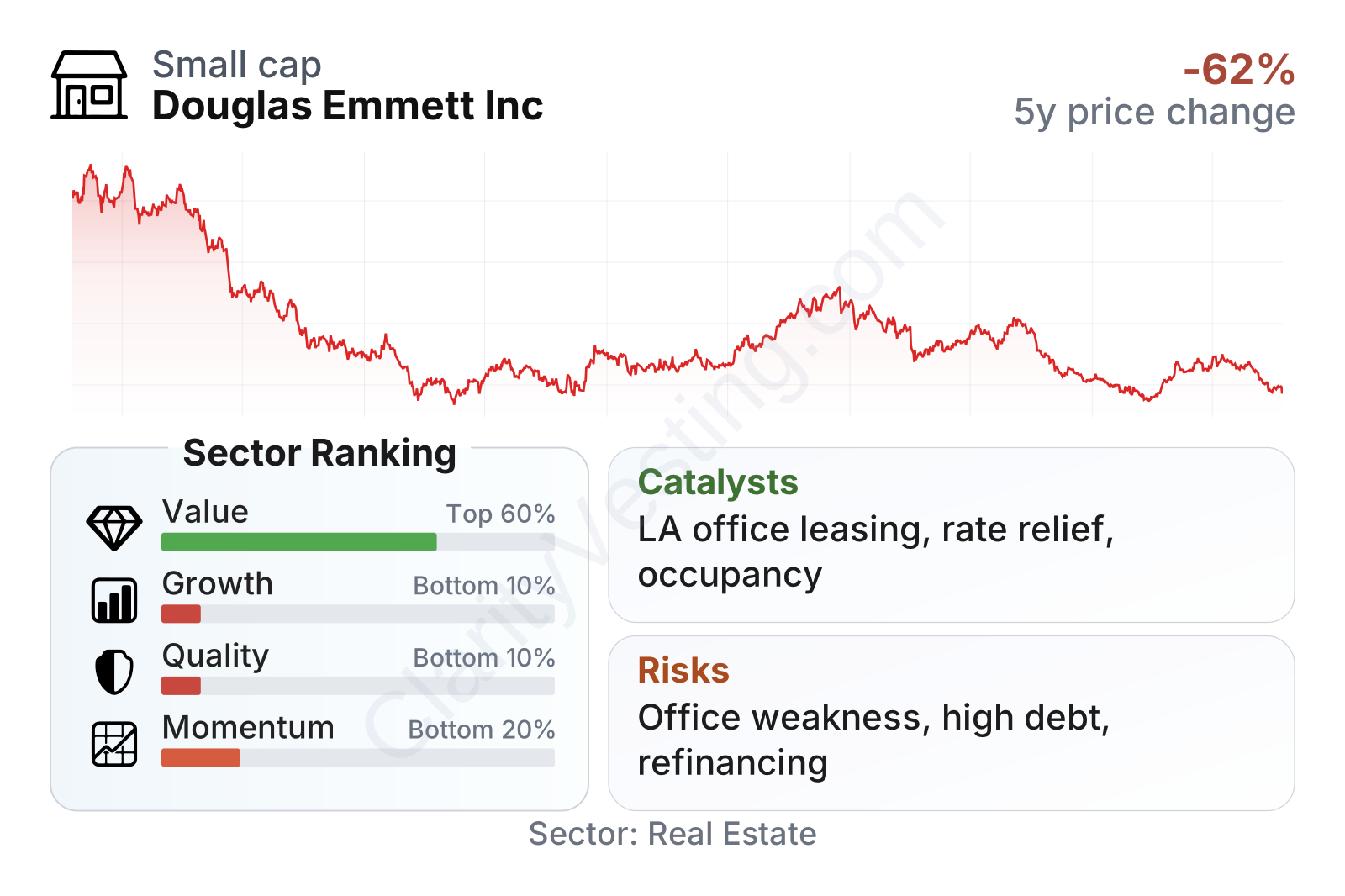
Douglas Emmett sits in the mid-range on valuation factors overall, but the breakdown is uneven. Free cash flow yield and dividend yield look strong versus many real estate peers, while growth, profitability, and balance-sheet quality rank much lower. That combination usually signals a company whose current income profile appears appealing on the surface, but where the underlying operating engine is under more strain than the headline yield suggests.
The share price has been highly volatile over the last several years, with a steep decline from 2022 levels and only partial recoveries since then. That pattern matches the broader pressure on office-focused REITs, but Douglas Emmett’s weaker profitability and heavier leverage have made the rebound less durable than for stronger peers.
Growth
Douglas Emmett operates in a sector that is split in two. Multifamily housing in supply-constrained coastal markets still benefits from long-term demand drivers such as high home prices, limited land availability, and population density in desirable submarkets. Office real estate is much less straightforward. Demand has been reshaped by hybrid work, corporate space optimization, and slower leasing decisions. That means the company is exposed to a part of real estate that is not in a broad secular growth phase today.
Its strategy still has a rational long-term logic. By focusing on premium submarkets in Los Angeles and Honolulu, the company is trying to own assets in locations where replacement supply is difficult and where well-located buildings can recover occupancy faster than average assets when market conditions improve. The apartment portfolio adds a stabilizing element because housing demand is generally more durable than office demand.
Revenue per share has been comparatively steady over the last five years, improving from 2021 and then flattening near recent levels. That suggests the company has managed to preserve a large part of its rental base despite difficult office conditions, but it also shows limited expansion. In other words, the business has been defending revenue better than it has been growing it.
One potential catalyst is any sustained improvement in office leasing across West Los Angeles and Honolulu, especially if companies begin committing to space for longer periods again. Another is lower interest rates or improved credit conditions, which could ease refinancing pressure and support property values across the office REIT sector. Douglas Emmett has also emphasized leasing activity, occupancy recovery, and disciplined capital allocation in its public communications, which matters because even modest occupancy gains can have a sizable effect on cash flow in a fixed-cost property business.
The dividend record shows a reset from earlier levels and then a more stable base. That matters because it reflects the company’s adjustment to a tougher operating and financing environment. The current payout remains meaningful, but the longer-term pattern points to preservation rather than expansion.
Recent company updates have continued to highlight leasing execution, debt management, and operations in core neighborhoods rather than major expansion. That makes near-term growth more dependent on better use of the existing portfolio than on acquisitions or development.
Risks
This article is for informational purposes only and does not constitute financial advice. Some content is AI-generated. See Disclaimer


