Stock Analysis · Deere & Company (DE)
Overview
Deere & Company is one of the best-known manufacturers of agricultural, construction, and forestry equipment in the world. Its products include tractors, combines, sprayers, planters, excavators, loaders, roadbuilding machines, and a broad range of parts and precision technology. The company also operates a financing arm that helps customers and dealers fund equipment purchases and leases. For a long-term view, Deere is not simply a machinery producer; it is also a provider of farm productivity tools, connected equipment, software-enabled precision agriculture, and recurring after-sale support.
Its revenue base is spread across equipment sales, replacement parts, technology features, and financing activities. Based on Deere’s recent annual reporting structure, the main sources of revenue are approximately the following:
- Production & Precision Agriculture: about 42% of total net sales and revenues. This includes large and mid-size tractors, combines, cotton equipment, sugarcane harvesters, and precision agriculture tools used to improve yields, reduce inputs, and automate field operations.
- Small Agriculture & Turf: about 24%. This segment includes small tractors, hay and forage equipment, turf products, riding mowers, and equipment sold to dairy, livestock, and property maintenance customers.
- Construction & Forestry: about 22%. This covers earthmoving equipment, roadbuilding machinery, compact construction machines, and forestry equipment.
- Financial Services: about 12% of total revenue. This activity mainly includes retail financing, leases, revolving charge accounts, and wholesale financing for dealers.
That mix matters because Deere is exposed to several end markets at once. Agriculture remains the core business, but the company also benefits from construction demand and from financing income tied to its installed equipment base. Over time, parts, services, software, and technology can make the business more resilient than a pure one-time equipment seller.
The long-term earnings profile has also shown how powerful Deere’s operating model can be when conditions are supportive. Revenue rose strongly through 2023 before cooling in 2024 and 2025 as equipment demand normalized, yet margins remained better than many industrial peers. This suggests Deere’s product mix, pricing discipline, and service ecosystem have added durability even during a downturn.
The profit structure became meaningfully stronger between 2021 and 2023, with operating income expanding faster than revenue. Even after the recent pullback, Deere still appears to be generating a healthier earnings mix than it did earlier in the cycle, although interest expense has become a more visible drag.
Key Figures
| Metric | Value | Sector ⓘ |
|---|---|---|
| Date | Oct 24, 2026 | |
| Context | ||
| Sector | Industrials | |
| Industry | Farm & Heavy Construction Machinery | |
| Market Cap ⓘ | $170.46B | |
| Beta ⓘ | 0.87 | |
Value (Cheapness) | ||
| P/E Ratio ⓘ | 35.14 | 22.29 |
| P/B Ratio ⓘ | 6.17 | 1.98 |
| FCF Yield ⓘ | 2.27% | 6.26% |
| Dividend Yield ⓘ | 1.03% | 1.92% |
| EBIT / EV ⓘ | 3.81% | 4.83% |
| PEG ⓘ | 1.59 | |
Growth (Business expansion) | ||
| Revenue Growth ⓘ | 4.90% | 9.30% |
| RPS Growth (5Y CAGR) ⓘ | 4.65% | 7.76% |
| EPS Growth (5Y CAGR) ⓘ | -12.93% | -13.17% |
| BVPS Growth (5Y CAGR) ⓘ | 12.88% | 6.13% |
| Margin Growth (5Y Trend) ⓘ | 1.13% | 0.74% |
| FCF Growth (5Y CAGR) ⓘ | -10.98% | 10.79% |
| DPS Growth (5Y CAGR) ⓘ | 17.58% | 9.41% |
Quality (Business durability) | ||
| ROIC (Latest) ⓘ | 7.77% | 10.75% |
| ROA (Latest) ⓘ | 4.56% | 5.41% |
| ROIC (5Y Median) ⓘ | 11.19% | 9.37% |
| ROA (5Y Median) ⓘ | 7.49% | 4.95% |
| Net Debt / EBIT (Latest) ⓘ | 5.91 | 2.04 |
| Net Debt / EBIT (5Y Median) ⓘ | 4.65 | 2.27 |
| Net Debt / EBITDA (Latest) ⓘ | 4.72 | 1.39 |
| Net Debt / Assets ⓘ | 51.35% | 19.27% |
| EBITDA / Interest ⓘ | 4.03 | 9.58 |
| Operating Margin (Latest) ⓘ | 19.61% | 10.49% |
| Operating Margin (5Y Median) ⓘ | 21.11% | 10.30% |
| Debt to Equity (Latest) ⓘ | 229.30% | 64.82% |
| Profit Margin (Latest) ⓘ | 10.17% | 6.67% |
| Free Cash Flow (Latest) ⓘ | $3.87B | |
Momentum (Price trend) | ||
| 3Y Return ⓘ | +76.62% | +67.77% |
| 12M Return (excl. last month) ⓘ | +47.63% | +12.05% |
| 6M Return ⓘ | +8.92% | 0.00% |
| Price vs. 200-Day MA ⓘ | +6.68% | +0.67% |
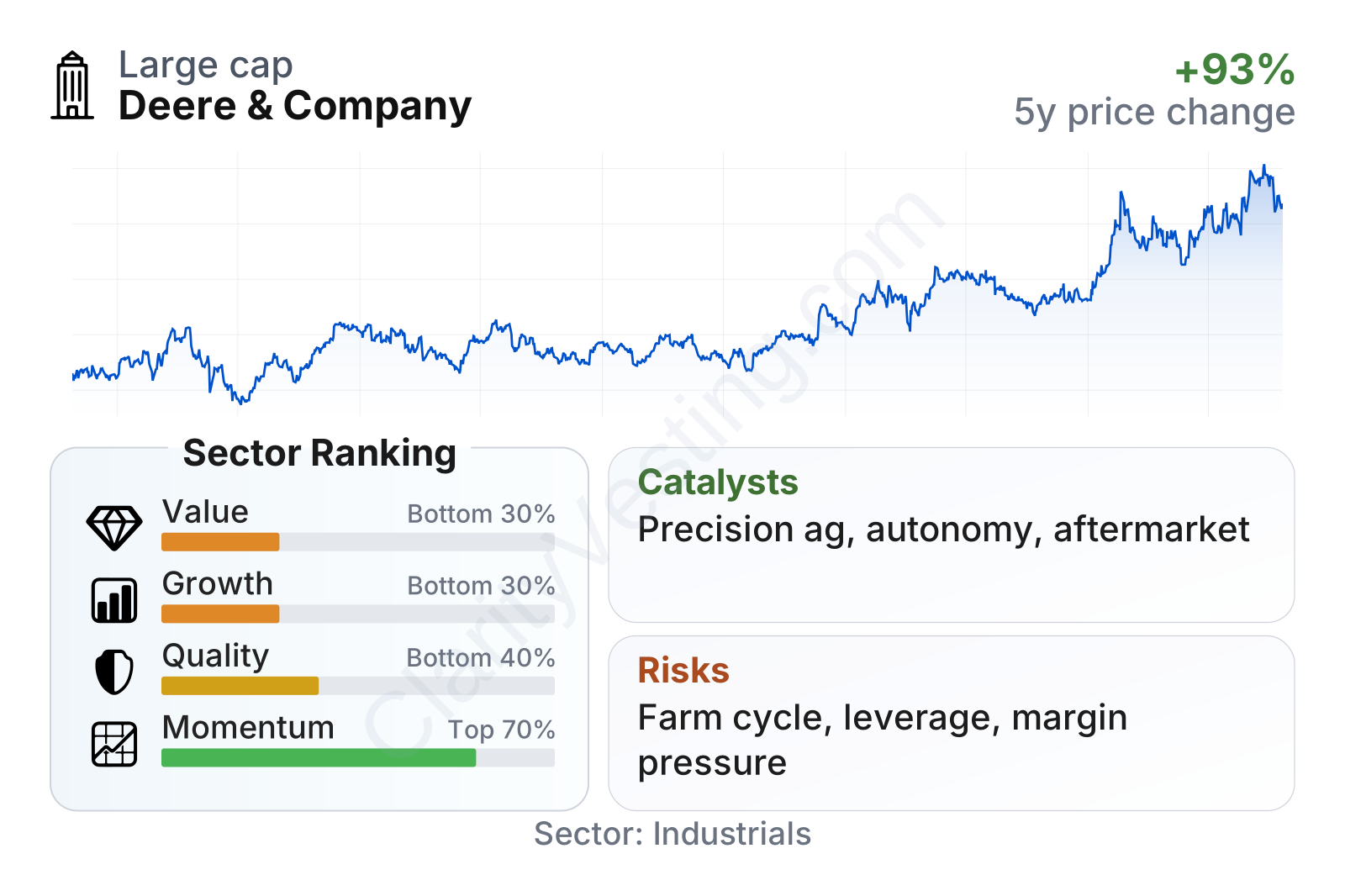
Deere is a very large industrial company with a stock that has recently outperformed much of its sector. The table points to a mixed profile. Profitability remains solid, especially versus many peers, and long-term margin history is notably strong. However, the value and growth sections look weaker: the stock trades at richer multiples than the sector median, while recent growth rates and free cash flow trends have been softer. Momentum is one of the strongest areas, reflecting a share price that has climbed sharply over the last year and over a multiyear period.
Growth
Deere operates in markets that should remain relevant for decades. Global agriculture must keep improving productivity as arable land, labor availability, water efficiency, and input costs remain major constraints. That creates a favorable backdrop for precision agriculture, automation, and data-enabled equipment. Construction and infrastructure are also long-duration markets, although they are more cyclical from year to year.
Deere’s strategy for future growth is broadly logical. The company has been investing in precision spraying, autonomous and semi-autonomous machine capabilities, connected operations, and software tools that help farmers use seed, fertilizer, chemicals, fuel, and labor more efficiently. These offerings can strengthen customer loyalty because they are embedded in how the machine is used, not just in the original purchase. In simple terms, Deere is trying to move from selling iron to selling productivity.
The recent growth pattern shows a classic machinery cycle rather than a straight line upward. Deere posted exceptionally strong expansion in 2022 and 2023, then went through a steep slowdown and contraction as farm equipment demand normalized. More recently, the trend has turned positive again, with year-over-year revenue growth returning to the mid-single-digit range. That does not remove cyclicality, but it does suggest the business may be moving out of its sharpest downturn phase.
Free cash flow remains positive in the billions of dollars, which is important for a capital-intensive manufacturer. The recent level is below the strongest point reached during the cycle, but it still indicates meaningful cash generation. For a company like Deere, that supports continued investment in product development, dealer support, dividends, and buybacks when conditions allow.
A major catalyst is the broader adoption of precision agriculture. Farmers are under pressure to raise output while controlling costs, and Deere’s connected machinery, guidance systems, targeted spraying, and digital farm tools are positioned directly around that need. Another growth lever is aftermarket revenue: once Deere places equipment in the field, parts, maintenance, upgrades, and technology subscriptions can extend the economic relationship well beyond the initial sale.
Recent company updates have also highlighted continued work around autonomy, smart spraying, and technology integration across the equipment lineup. Those initiatives matter because they can support pricing power and help Deere defend margins even if unit demand remains uneven. In a mature equipment industry, technology-led productivity gains are one of the clearest ways to keep growing faster than the underlying market.
Risks
This article is for informational purposes only and does not constitute financial advice. Some content is AI-generated. See Disclaimer