Stock Analysis · Discovery Limited (DCYHF)
Overview
Discovery Limited is a South African financial services group best known for health insurance, life insurance, investment products, and banking built around a behavior-based model. Its core idea is that encouraging healthier and safer behavior can lower claims over time while also improving customer loyalty. The company operates mainly through Discovery Health, Discovery Life, Discovery Invest, Discovery Insure, Discovery Bank, and its international shared-value partnerships.
In simple terms, Discovery earns money by collecting premiums and fees from customers who use its insurance, health administration, savings, and banking products. It also benefits from investment income on the assets it manages and holds on behalf of policyholders and shareholders.
The group’s revenue mix can shift from year to year because insurance accounting and investment-related items can be volatile, but the business is broadly centered on the following sources:
- Health-related operations and administration fees — a major contributor, largely through Discovery Health, which administers medical schemes and related services in South Africa.
- Life insurance and savings products — a major contributor, mainly from Discovery Life and Discovery Invest, including protection products, retirement savings, and long-term investments.
- Short-term insurance — a smaller but meaningful contributor through Discovery Insure, focused on auto and related cover.
- Banking — still a developing revenue stream through Discovery Bank, coming from deposits, lending, card usage, and transaction activity.
- International operations and partnerships — earnings from shared-value insurance and wellness partnerships, including arrangements that use Discovery’s model in other countries.
- Investment income — returns generated on capital and policyholder-related assets, which can materially affect reported results.
Recent results indicate that health and life-related activities remain the economic backbone of the group, while banking and international partnerships are important longer-term expansion areas rather than the largest profit sources today.
The business has also been scaling up in absolute terms. Total revenue has risen from roughly ZAR 68 billion in fiscal 2022 to more than ZAR 92 billion in fiscal 2026, while net income has also moved higher over that period despite some accounting volatility in cost lines.
The broad trend is positive: revenue and operating profit have expanded over several years, and net income has improved meaningfully. At the same time, the cost structure can look uneven from one year to the next, which is normal for a financial group with insurance, investment, and banking activities that are sensitive to claims, market movements, and accounting classifications.
Key Figures
| Metric | Value | Sector ⓘ |
|---|---|---|
| Date | Oct 31, 2026 | |
| Context | ||
| Sector | Financial Services | |
| Industry | Insurance - Life | |
| Market Cap ⓘ | $10.44B | |
| Beta ⓘ | 0.59 | |
Value (Cheapness) | ||
| P/E Ratio ⓘ | 13.62 | 12.20 |
| P/B Ratio ⓘ | 0.01 | 1.26 |
| FCF Yield ⓘ | 98.05% | 9.87% |
| Dividend Yield ⓘ | 24.73% | 2.87% |
| EBIT / EV ⓘ | N/A | 8.17% |
| PEG ⓘ | N/A | |
Growth (Business expansion) | ||
| Revenue Growth ⓘ | 9.90% | 8.40% |
| RPS Growth (5Y CAGR) ⓘ | 116.57% | 12.31% |
| EPS Growth (5Y CAGR) ⓘ | -20.49% | -4.03% |
| BVPS Growth (5Y CAGR) ⓘ | 123.67% | 4.96% |
| Margin Growth (5Y Trend) ⓘ | 9.96% | -4.14% |
| FCF Growth (5Y CAGR) ⓘ | 15.09% | 4.70% |
| DPS Growth (5Y CAGR) ⓘ | 403.03% | 8.85% |
Quality (Business durability) | ||
| ROIC (Latest) ⓘ | N/A | 9.35% |
| ROE (Latest) ⓘ | 30.76% | 13.95% |
| ROA (Latest) ⓘ | 6.55% | 1.57% |
| ROIC (5Y Median) ⓘ | 11.43% | 7.78% |
| ROE (5Y Median) ⓘ | 12.12% | 12.12% |
| ROA (5Y Median) ⓘ | 2.52% | 1.28% |
| Net Debt / EBIT (Latest) ⓘ | N/A | 0.99 |
| Net Debt / EBIT (5Y Median) ⓘ | 0.02 | 0.73 |
| Net Debt / EBITDA (Latest) ⓘ | -0.07 | 0.79 |
| Operating Margin (Latest) ⓘ | N/A | 22.61% |
| Operating Margin (5Y Median) ⓘ | 16.56% | 24.52% |
| Debt to Equity (Latest) ⓘ | 22.61% | 58.76% |
| Profit Margin (Latest) ⓘ | 15.85% | 26.18% |
| Free Cash Flow (Latest) ⓘ | $10.24B | |
Momentum (Price trend) | ||
| 3Y Return ⓘ | +150.94% | +95.34% |
| 12M Return (excl. last month) ⓘ | +72.16% | +16.22% |
| 6M Return ⓘ | +70.57% | +7.41% |
| Price vs. 200-Day MA ⓘ | +39.16% | +5.48% |
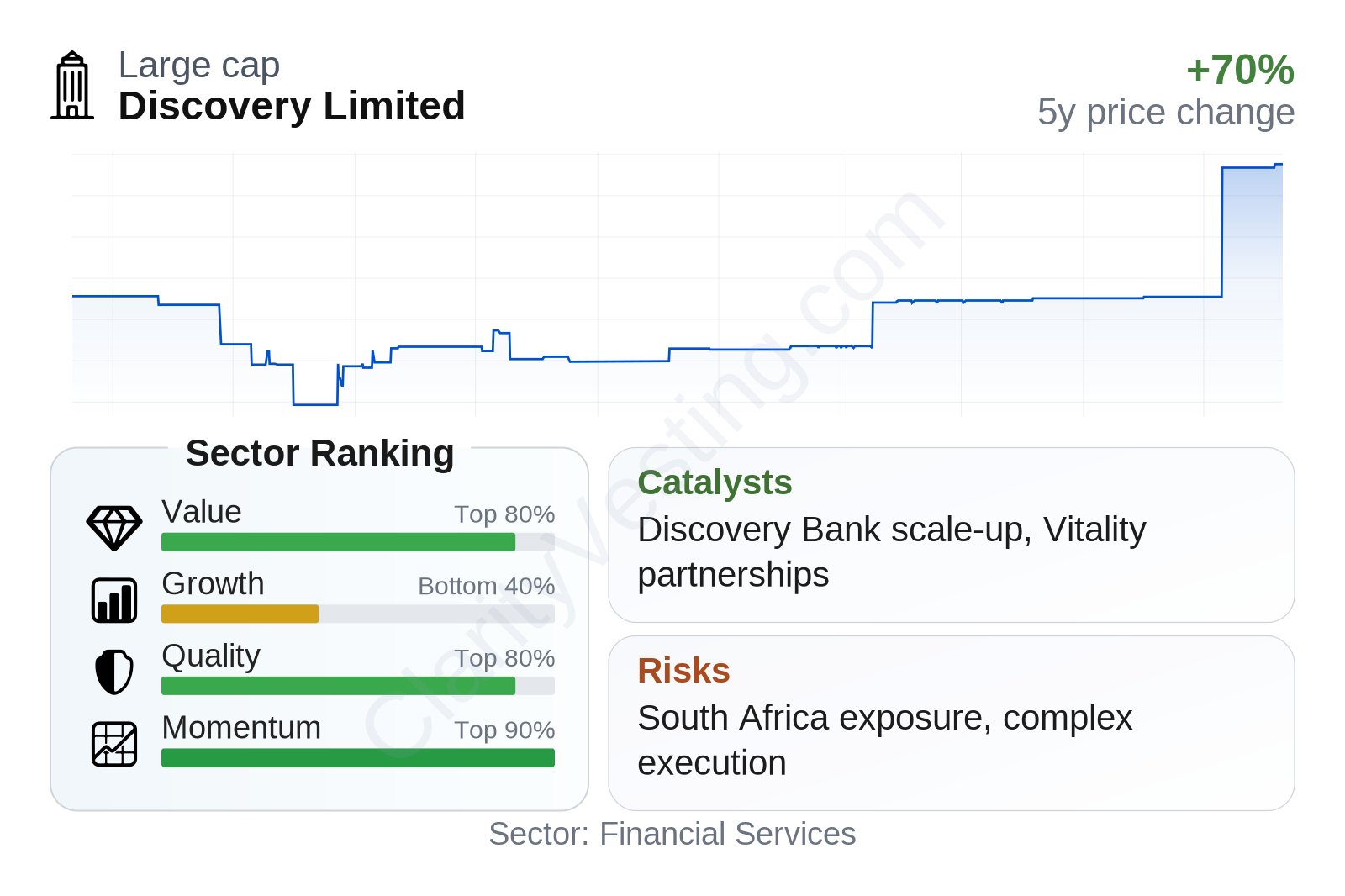
Discovery is a large financial services company with a market value around the low tens of billions of dollars and a relatively low beta, which suggests the stock has historically moved less sharply than the broader market. On fundamental factors, the picture is mixed but interesting. Value metrics look unusually strong, largely because the price-to-book ratio is far below the sector median and the trailing cash flow and dividend measures screen very favorably. Quality is also solid, supported by high returns on equity and assets and a balance sheet that appears less leveraged than many peers. Growth is more moderate overall, with healthy revenue expansion and strong book value and cash flow progression, although earnings growth has not been smooth over a full five-year period. Price momentum has been especially strong, meaning the market has already recognized some of the recent operational improvement.
Growth
Discovery operates in segments that still offer long-term room for expansion. Health coverage, retirement-related products, digital banking, and behavior-linked insurance all benefit from structural demand drivers: aging populations, rising healthcare usage, the need for personal savings, and greater demand for digital financial services. In South Africa specifically, private healthcare administration and integrated financial wellness products remain relevant categories, and Discovery has built a brand that is closely associated with innovation in these areas.
The company’s strategy is coherent. Instead of selling isolated products, it tries to build an ecosystem around customers’ daily financial and health decisions. That matters because a customer using health, life, investments, insurance, and banking products together is usually more valuable and harder to lose. Discovery Bank is particularly important here. On its own, banking can be expensive to build, but as part of a broader platform it can deepen relationships and create more cross-selling opportunities across the group.
A second growth engine is the company’s international model. Discovery has spent years developing wellness and insurance frameworks that partners can adapt abroad. That can be attractive because it allows expansion without always needing to build a full retail presence from scratch in every market. If those partnerships keep scaling, they can add fee income and diversify the group away from the South African economy alone.
The latest earnings profile points to improving profitability, even if the long-term record is not perfectly linear. Recent annual results showed a clear rise in net income and operating profit, which supports the view that earlier investments in banking and platform capabilities are becoming easier to absorb. That said, earnings in financial services can move around with claims, lapse rates, market levels, and new business spending, so a single year does not tell the whole story.
Book value per share has trended upward over time, which usually matters for insurers and banks because it reflects growth in the capital base that supports future business. The latest jump looks unusually large and may reflect accounting or capital structure effects rather than only underlying operating momentum, so the broader multi-year direction is more informative than the most recent point alone.
As for catalysts, one of the clearest is continued scaling at Discovery Bank. Another is margin improvement if customer growth continues without costs rising at the same pace. The company also benefits from a distinctive wellness-linked model that can support better claims experience over time if member engagement remains high. Recent market performance suggests that investors have responded positively to these themes.
Risks
This article is for informational purposes only and does not constitute financial advice. Some content is AI-generated. See Disclaimer