Stock Analysis · Dime Community Bancshares Inc (DCOM)
Overview
Dime Community Bancshares is a regional bank centered on the New York metropolitan area. Through Dime Community Bank, it gathers deposits from consumers and businesses, then uses that funding to make loans, especially to commercial borrowers. Its franchise is built around local relationships in one of the largest banking markets in the country, with a meaningful presence in multifamily real estate, commercial real estate, business banking, and consumer banking.
For a bank like Dime, revenue does not work the same way it does for an industrial or technology company. The largest source is usually net interest income, which is the spread between what the bank earns on loans and securities and what it pays on deposits and other funding. A smaller but still useful layer comes from fees and service income.
Based on recent company filings, Dime’s revenue mix is heavily weighted toward interest-related income. Approximate sources are:
- Net interest income: about 85% to 90% — income from loans, securities, and cash balances, minus interest paid on deposits and borrowings.
- Non-interest income: about 10% to 15% — includes deposit account fees, loan-related fees, mortgage banking income, wealth-related fees, and other banking service income.
On the lending side, the loan book is mainly tied to income-producing real estate and commercial activity in the New York area. Multifamily and commercial real estate have historically been the largest categories, followed by commercial and industrial lending, residential mortgages, and consumer loans. On the funding side, core deposits are critical because they are generally a lower-cost and more stable source of funding than wholesale borrowing.
The recent income pattern shows how sensitive a regional bank can be to interest rates. Revenue expanded strongly into 2025, but profitability was pressured in 2024 before improving again, reflecting the industrywide squeeze from higher deposit costs and then some recovery as balance-sheet pricing adjusted.
The operating picture improved in 2025 after a much weaker 2024. Revenue moved higher over the last several years, but earnings were more volatile because funding costs rose sharply before easing relative to asset yields.
Key Figures
| Metric | Value | Sector ⓘ |
|---|---|---|
| Date | Oct 24, 2026 | |
| Context | ||
| Sector | Financial Services | |
| Industry | Banks - Regional | |
| Market Cap ⓘ | $1.80B | |
| Beta ⓘ | 1.01 | |
Value (Cheapness) | ||
| P/E Ratio ⓘ | 14.70 | 12.46 |
| P/B Ratio ⓘ | 1.20 | 1.25 |
| FCF Yield ⓘ | 10.99% | 9.82% |
| Dividend Yield ⓘ | N/A | 2.94% |
| EBIT / EV ⓘ | 35.68% | 8.11% |
| PEG ⓘ | 3.76 | |
Growth (Business expansion) | ||
| Revenue Growth ⓘ | 12.00% | 9.10% |
| RPS Growth (5Y CAGR) ⓘ | 11.52% | 12.31% |
| EPS Growth (5Y CAGR) ⓘ | -10.96% | -6.97% |
| BVPS Growth (5Y CAGR) ⓘ | 2.83% | 5.02% |
| Margin Growth (5Y Trend) ⓘ | -13.26% | -4.00% |
| FCF Growth (5Y CAGR) ⓘ | 5.67% | 4.71% |
| DPS Growth (5Y CAGR) ⓘ | -0.69% | 8.92% |
Quality (Business durability) | ||
| ROIC (Latest) ⓘ | N/A | 9.18% |
| ROE (Latest) ⓘ | 9.53% | 13.93% |
| ROA (Latest) ⓘ | 0.92% | 1.57% |
| ROIC (5Y Median) ⓘ | 5.09% | 7.80% |
| ROE (5Y Median) ⓘ | 8.02% | 12.15% |
| ROA (5Y Median) ⓘ | 0.75% | 1.28% |
| Net Debt / EBIT (Latest) ⓘ | -6.94 | 1.02 |
| Net Debt / EBIT (5Y Median) ⓘ | -0.70 | 0.72 |
| Net Debt / EBITDA (Latest) ⓘ | -7.72 | 0.88 |
| Operating Margin (Latest) ⓘ | 24.54% | 22.30% |
| Operating Margin (5Y Median) ⓘ | 22.46% | 24.50% |
| Debt to Equity (Latest) ⓘ | 40.27% | 59.34% |
| Profit Margin (Latest) ⓘ | 29.36% | 26.42% |
| Free Cash Flow (Latest) ⓘ | $197.62M | |
Momentum (Price trend) | ||
| 3Y Return ⓘ | +161.67% | +95.73% |
| 12M Return (excl. last month) ⓘ | +35.04% | +17.30% |
| 6M Return ⓘ | +20.24% | +6.07% |
| Price vs. 200-Day MA ⓘ | +15.82% | +5.36% |
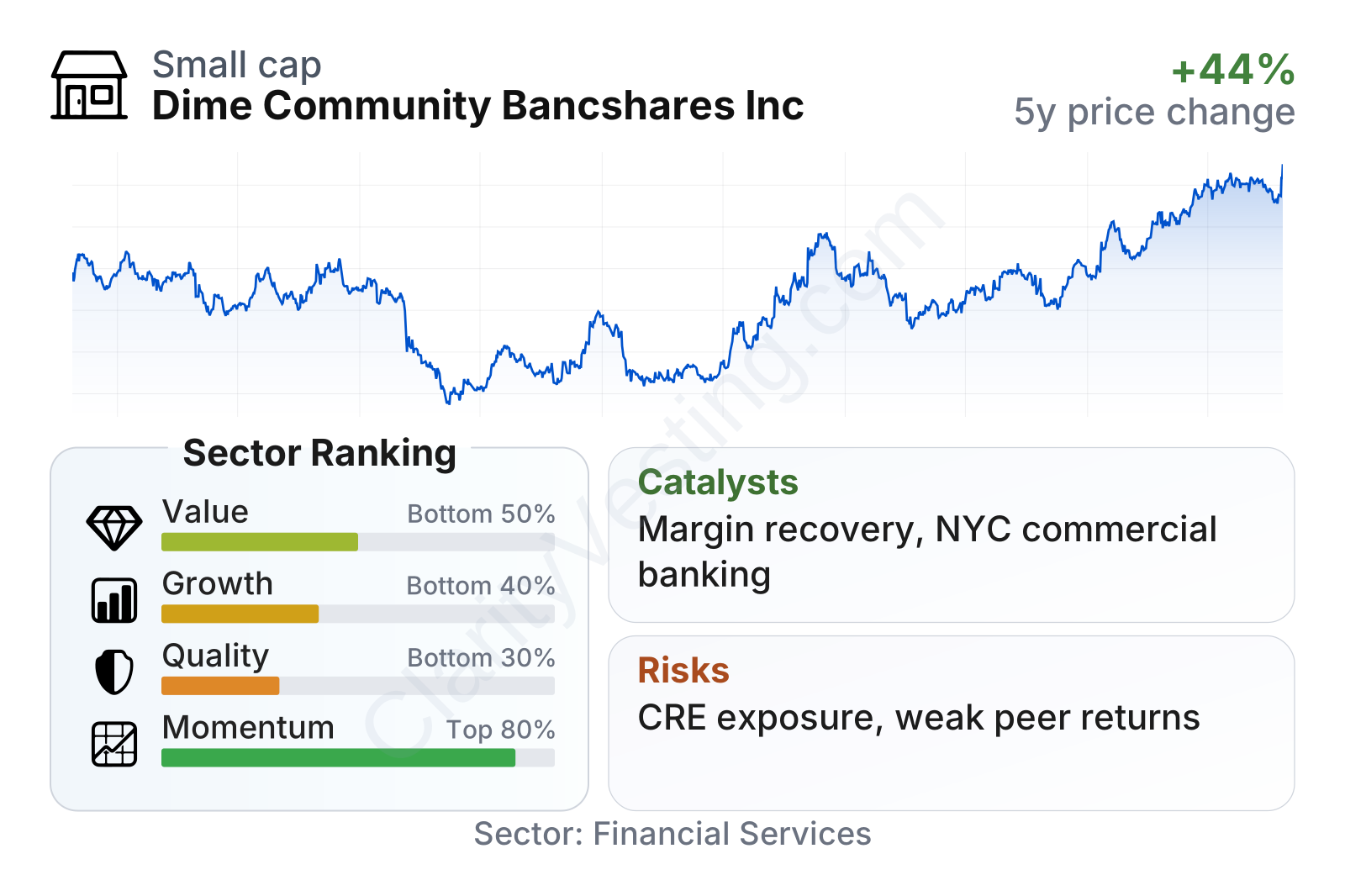
Dime is a mid-sized regional bank with market performance that has recently been stronger than much of its sector. The stock’s momentum has outpaced the median regional bank over the last 6 months, 12 months, and 3 years. On valuation, the picture is mixed: the price-to-earnings ratio is somewhat above the sector median, while the price-to-book ratio remains slightly below the sector median. Quality and growth rankings are weaker than peers, which helps explain why the shares do not command a clear premium despite the rebound in price.
The current profile suggests a bank that has regained market confidence after a difficult period, but that still needs stronger profitability and steadier compounding to move into the upper tier of regional banks.
Growth
Dime operates in a mature industry, so the main growth question is less about a booming sector and more about whether the bank can grow profitably in its local market. The New York metro area remains attractive because it has dense commercial activity, a large deposit base, and constant financing needs for property owners and small and mid-sized businesses. That creates opportunity, but it is also one of the most competitive banking regions in the country.
The company’s strategy is logical for long-term expansion: deepen commercial relationships, add operating accounts and treasury services, expand business banking, and gradually improve the deposit mix so funding becomes cheaper and more stable. In banking, this matters because better deposits can lift margins without requiring rapid balance-sheet growth. Dime has also emphasized relationship banking rather than trying to compete nationally on scale.
Earnings per share show a business that is recovering rather than growing in a straight line. Profitability rose strongly in 2022, fell in 2023 and especially 2024 as the rate environment hurt margins, then improved in 2025. That pattern points to a bank with earnings leverage if spread income normalizes, but also one whose results can swing materially when funding costs move quickly.
Book value per share has trended upward over the last several years despite some fluctuation, which is important for a bank. It indicates that, even through a difficult margin cycle, the company has still been building capital over time. That supports future lending capacity and provides a partial cushion if credit conditions worsen.
A notable catalyst is the possibility of further margin improvement if deposit costs stabilize faster than asset yields decline. Another is continued loan growth in selected commercial categories, especially if management remains disciplined on pricing and credit. Recent company communications have also pointed to ongoing efforts to strengthen commercial banking capabilities and fee-generating client relationships, which could make revenue less dependent on pure spread income over time.
Risks
This article is for informational purposes only and does not constitute financial advice. Some content is AI-generated. See Disclaimer


