Stock Analysis · Donaldson Company Inc (DCI)
Overview
Donaldson Company is an industrial filtration specialist. In simple terms, it designs and sells products that clean air, gases, liquids, and exhaust streams so engines, machines, industrial equipment, and manufacturing processes can run more reliably and meet performance or emissions requirements. The company serves a wide range of end markets, including trucks, off-road equipment, industrial manufacturing, food and beverage, life sciences, aerospace, and data center-related applications.
Donaldson’s revenue comes mainly from two operating segments, with filtration replacement parts remaining an important recurring component of the business. Based on the company’s latest annual reporting, the mix is approximately as follows:
- Mobile Solutions: about 57% of revenue — filtration systems and replacement filters for on-road trucks, construction and mining equipment, agriculture, aerospace and defense, and other mobile machinery.
- Industrial Solutions: about 43% of revenue — dust collection, industrial air filtration, compressed air and gas purification, process filtration, bioprocessing components, and related applications for factories and specialized production environments.
Within those segments, a meaningful share of sales comes from the aftermarket, where customers regularly replace used filters. That matters because replacement demand is typically steadier than demand for brand-new equipment. The business profile also shows a company that converts a solid portion of revenue into operating profit, although recent years have included some swings in net income due to costs, financing, and acquisition integration.
Over the last five fiscal years, revenue has risen from roughly $3.3 billion to nearly $3.9 billion, while gross profit and operating income have also expanded. The broad pattern suggests a business that has preserved pricing power and discipline on operating costs even while material, labor, and interest expenses have moved around.
Key Figures
| Metric | Value | Sector ⓘ |
|---|---|---|
| Date | Oct 24, 2026 | |
| Context | ||
| Sector | Industrials | |
| Industry | Specialty Industrial Machinery | |
| Market Cap ⓘ | $10.15B | |
| Beta ⓘ | 0.87 | |
Value (Cheapness) | ||
| P/E Ratio ⓘ | 22.75 | 22.29 |
| P/B Ratio ⓘ | 5.92 | 1.98 |
| FCF Yield ⓘ | 4.20% | 6.26% |
| Dividend Yield ⓘ | 1.42% | 1.92% |
| EBIT / EV ⓘ | 5.59% | 4.83% |
| PEG ⓘ | 1.59 | |
Growth (Business expansion) | ||
| Revenue Growth ⓘ | 8.00% | 9.30% |
| RPS Growth (5Y CAGR) ⓘ | 5.69% | 7.76% |
| EPS Growth (5Y CAGR) ⓘ | 10.29% | -13.17% |
| BVPS Growth (5Y CAGR) ⓘ | 13.40% | 6.13% |
| Margin Growth (5Y Trend) ⓘ | 2.29% | 0.74% |
| FCF Growth (5Y CAGR) ⓘ | 26.27% | 10.79% |
| DPS Growth (5Y CAGR) ⓘ | 8.03% | 9.41% |
Quality (Business durability) | ||
| ROIC (Latest) ⓘ | N/A | 10.75% |
| ROA (Latest) ⓘ | 12.94% | 5.41% |
| ROIC (5Y Median) ⓘ | 32.11% | 9.37% |
| ROA (5Y Median) ⓘ | 13.31% | 4.95% |
| Net Debt / EBIT (Latest) ⓘ | 1.82 | 2.04 |
| Net Debt / EBIT (5Y Median) ⓘ | 1.08 | 2.27 |
| Net Debt / EBITDA (Latest) ⓘ | 1.56 | 1.39 |
| Net Debt / Assets ⓘ | 28.40% | 19.27% |
| EBITDA / Interest ⓘ | 20.22 | 9.58 |
| Operating Margin (Latest) ⓘ | 16.00% | 10.49% |
| Operating Margin (5Y Median) ⓘ | 14.22% | 10.30% |
| Debt to Equity (Latest) ⓘ | 78.37% | 64.82% |
| Profit Margin (Latest) ⓘ | 11.68% | 6.67% |
| Free Cash Flow (Latest) ⓘ | $426.30M | |
Momentum (Price trend) | ||
| 3Y Return ⓘ | +58.21% | +67.77% |
| 12M Return (excl. last month) ⓘ | +7.54% | +12.05% |
| 6M Return ⓘ | +0.99% | 0.00% |
| Price vs. 200-Day MA ⓘ | -2.08% | +0.67% |
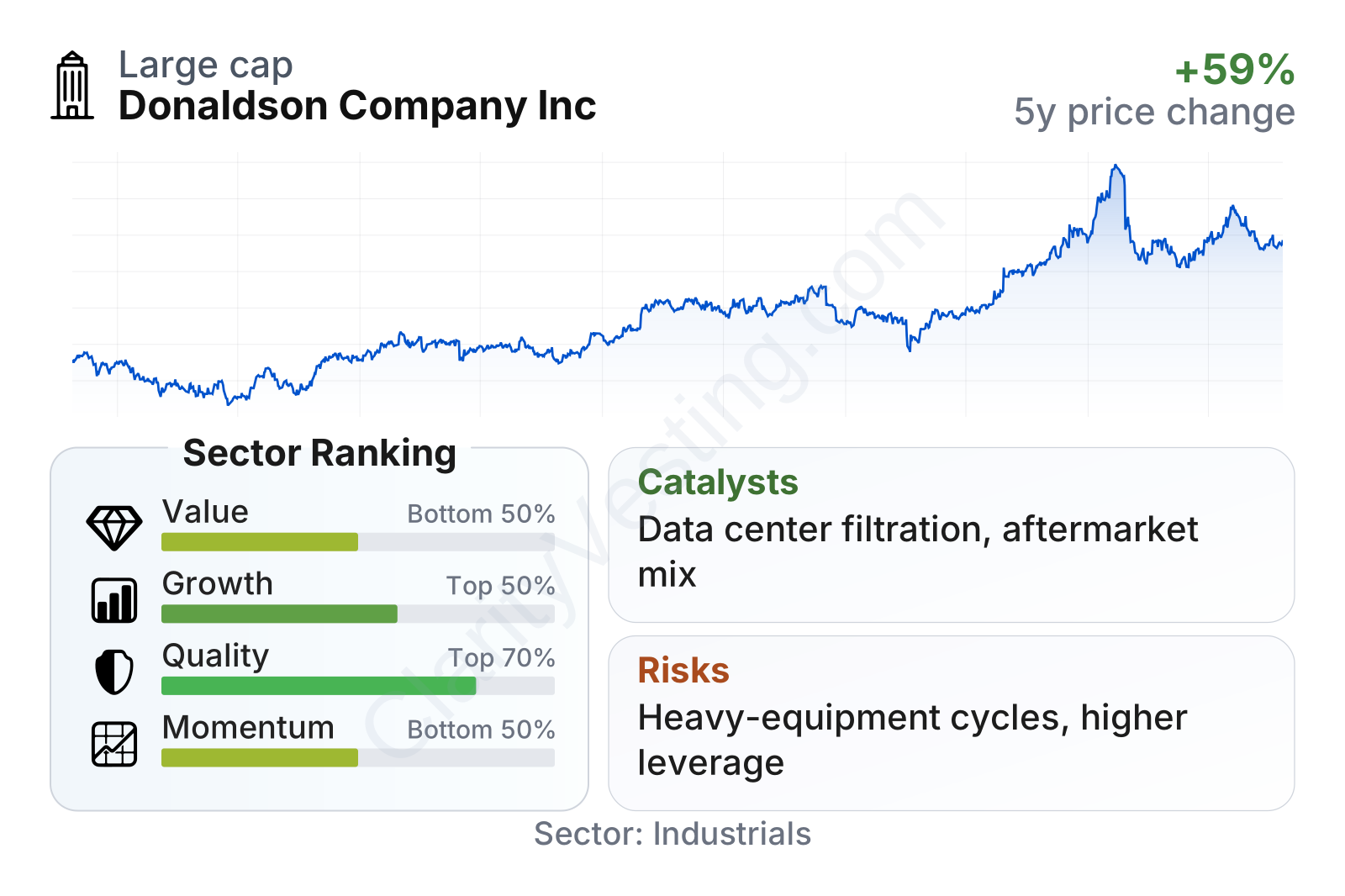
Donaldson is a mid-to-large industrial company with a market value around $10 billion and a share price that has generally trended upward over the last five years, though not in a straight line. The latest metrics point to a balanced profile: valuation is close to the sector median on earnings, growth is respectable rather than exceptional, and profitability stands out more clearly than momentum. Quality indicators are particularly notable, with returns on assets and long-term returns on invested capital well above many industrial peers. At the same time, income-oriented metrics such as dividend yield and free cash flow yield are not especially high relative to the sector.
Growth
Donaldson operates in a sector with durable long-term demand. Filtration is not a trendy product category, but it benefits from several persistent drivers: stricter air quality and emissions standards, the need to protect increasingly expensive equipment, growing automation in manufacturing, higher purity requirements in specialized industrial processes, and the expansion of data infrastructure that needs contamination control and cooling-related air management. These are practical needs rather than discretionary ones, which gives the company a stable base to build on.
The growth strategy is also fairly logical. Donaldson has been investing in areas beyond its traditional engine and dust-collection roots, especially in industrial filtration and life sciences-related applications, where customers often care more about reliability and certification than price alone. That can support stronger margins and deeper customer relationships. The company has also used acquisitions to broaden its technologies and end markets, which can help reduce dependence on any single industrial cycle.
Recent revenue growth has not been explosive, but it has improved again after a softer patch. The latest year-over-year pace is around 8%, close to the broader industrial median, and the longer record shows Donaldson can return to growth after brief periods of stagnation. Over a five-year view, revenue per share growth has been moderate, while earnings per share growth has been stronger, which suggests management has been able to protect margins and allocate capital with some discipline.
Cash generation is another useful point for long-term analysis. Free cash flow climbed sharply over the past several years, moving from a little above $200 million to the mid-$300 million range, after peaking higher in 2024. That pattern is not perfectly smooth, but the broader trend is constructive. A filtration company that can consistently turn profits into cash has more flexibility for dividends, acquisitions, debt service, and internal investment.
One meaningful catalyst is the continued expansion of higher-value industrial applications, especially where filtration is mission-critical rather than optional. Another is the replacement cycle: once Donaldson equipment is installed, customers often continue buying compatible filters and consumables. Recent company updates have also highlighted demand tied to data center filtration and specialized industrial projects, which could support a more attractive mix over time if those categories keep scaling.
Risks
This article is for informational purposes only and does not constitute financial advice. Some content is AI-generated. See Disclaimer


