Stock Analysis · DCC PLC (DCCPY)
Overview
DCC PLC is an Irish distribution and services group with operations across energy, healthcare, and technology. For U.S. investors using the ADR ticker DCCPY, the company can look at first glance like a pure energy business because it is classified in the energy sector and its largest unit is fuel distribution. In practice, DCC is a diversified operator that makes money by moving products through logistics networks, supplying business customers, and adding services around those products.
The business has historically been organized around three main divisions: Energy, Healthcare, and Technology. Energy is the core engine, covering transport fuels, heating oil, LPG, and related services for commercial, industrial, and retail customers. Healthcare supplies medical devices, pharmaceuticals, and other healthcare products. Technology distributes IT hardware, software, and accessories, mainly to business and channel partners.
Based on the latest annual structure and recent group reporting, the main sources of revenue are approximately:
- Energy: about 80% to 85% of group revenue. This includes road fuels, commercial fuels, heating products, LPG, and energy-related services.
- Technology: about 10% to 15% of group revenue. This mainly includes distribution of technology hardware, software, consumer electronics, and business IT products.
- Healthcare: about 5% to 10% of group revenue. This includes medical, surgical, pharmaceutical, and related healthcare distribution activities.
One important point for long-term readers: revenue mix does not tell the whole economic story. Fuel distribution is a very high-revenue but low-margin activity, so profit contribution can be more balanced than revenue share alone suggests. Recent group financial flows also show this clearly: sales have come down from the 2023 peak as fuel prices normalized and portfolio changes took effect, but gross profit and operating profit have held up much better than revenue. That usually signals a business with some resilience in underlying margins, even if reported sales are volatile.
The recent pattern suggests a business that is generating fairly stable gross profit and operating income despite lower reported sales, but the sharp drop in net income in the latest fiscal year shows that below-the-line items and exceptional pressures can materially affect final earnings.
Key Figures
| Metric | Value | Sector ⓘ |
|---|---|---|
| Date | Oct 03, 2026 | |
| Context | ||
| Sector | Energy | |
| Industry | Oil & Gas Refining & Marketing | |
| Market Cap ⓘ | $7.83B | |
| Beta ⓘ | 0.73 | |
Value (Cheapness) | ||
| P/E Ratio ⓘ | 24.13 | 14.47 |
| P/B Ratio ⓘ | 4.16 | 1.70 |
| FCF Yield ⓘ | 10.92% | 8.66% |
| Dividend Yield ⓘ | 3.02% | 3.77% |
| EBIT / EV ⓘ | N/A | 7.46% |
| PEG ⓘ | N/A | |
Growth (Business expansion) | ||
| Revenue Growth ⓘ | 1.30% | 27.35% |
| RPS Growth (5Y CAGR) ⓘ | -1.97% | 6.75% |
| EPS Growth (5Y CAGR) ⓘ | -10.88% | -15.45% |
| BVPS Growth (5Y CAGR) ⓘ | -6.16% | 5.85% |
| Margin Growth (5Y Trend) ⓘ | 0.64% | 0.75% |
| FCF Growth (5Y CAGR) ⓘ | 17.05% | 3.62% |
| DPS Growth (5Y CAGR) ⓘ | 8.08% | 16.85% |
Quality (Business durability) | ||
| ROIC (Latest) ⓘ | 13.79% | 11.33% |
| ROA (Latest) ⓘ | 2.59% | 6.03% |
| ROIC (5Y Median) ⓘ | 8.45% | 10.16% |
| ROA (5Y Median) ⓘ | 3.38% | 5.34% |
| Net Debt / EBIT (Latest) ⓘ | 1.35 | 1.62 |
| Net Debt / EBIT (5Y Median) ⓘ | 2.21 | 1.91 |
| Net Debt / EBITDA (Latest) ⓘ | 0.78 | 1.06 |
| Net Debt / Assets ⓘ | 14.39% | 17.29% |
| EBITDA / Interest ⓘ | 7.06 | 9.64 |
| Operating Margin (Latest) ⓘ | 2.63% | 16.32% |
| Operating Margin (5Y Median) ⓘ | 2.81% | 19.53% |
| Debt to Equity (Latest) ⓘ | 100.63% | 54.41% |
| Profit Margin (Latest) ⓘ | 0.09% | 8.79% |
| Free Cash Flow (Latest) ⓘ | $855.12M | |
Momentum (Price trend) | ||
| 3Y Return ⓘ | +132.77% | +62.93% |
| 12M Return (excl. last month) ⓘ | +44.74% | +44.83% |
| 6M Return ⓘ | +57.62% | -1.62% |
| Price vs. 200-Day MA ⓘ | +21.81% | +5.18% |
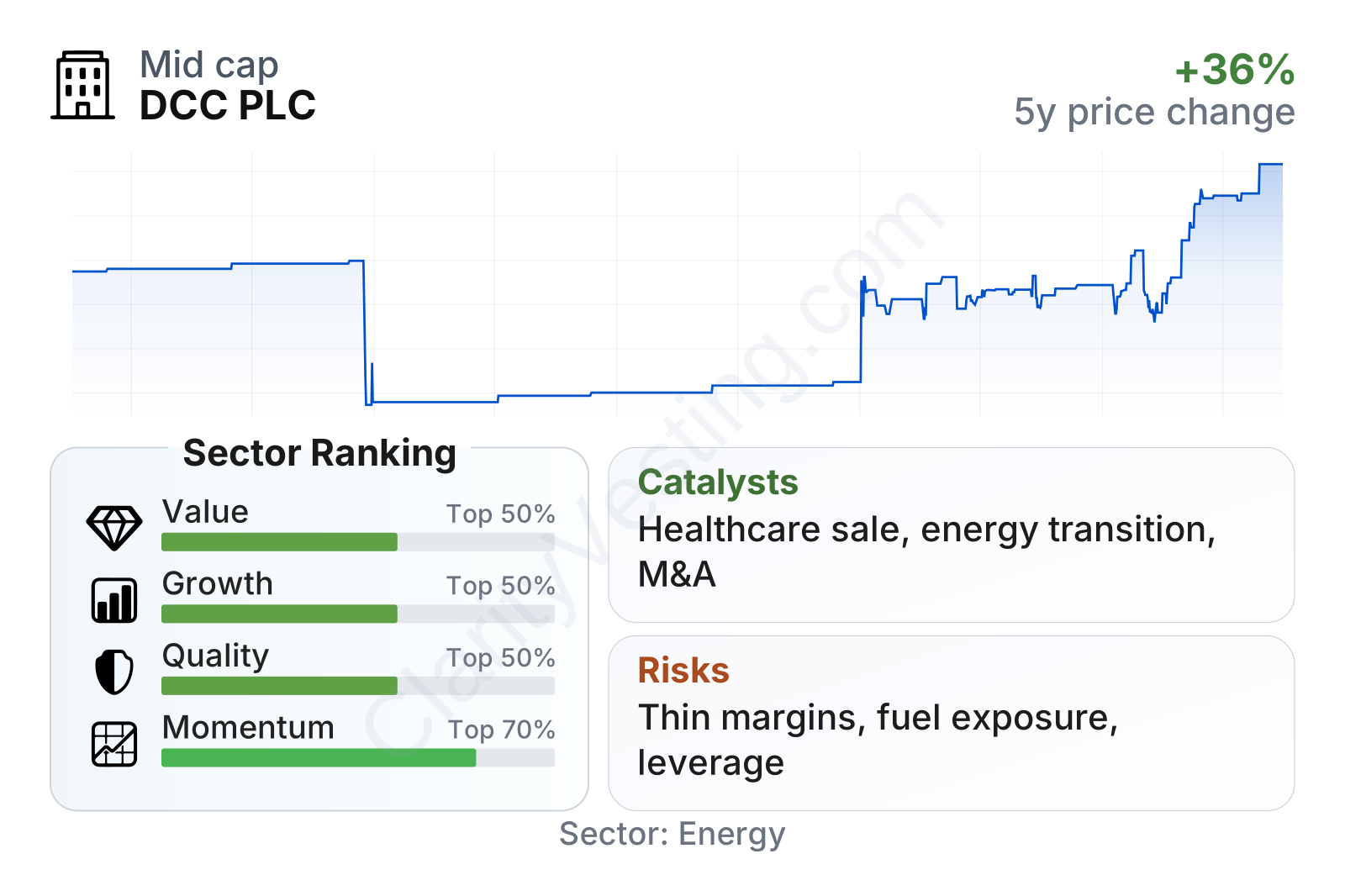
DCC sits in the large mid-cap range, with a share price that has been notably stronger over the last three years and especially over the last six months. The metrics present a mixed profile. On one hand, cash generation looks solid, return on invested capital is above the sector median, and leverage measured against EBITDA is not stretched. On the other hand, traditional valuation multiples such as P/E and P/B stand above sector medians, while growth metrics are weaker than many peers in the energy universe. The overall picture is of a company that scores better on operational discipline and cash flow than on rapid expansion.
Growth
DCC operates in sectors with very different growth profiles. The traditional fuel distribution business is mature in many of its markets, so it is not a natural high-growth area. However, it remains essential infrastructure and can still grow through market share gains, acquisitions, network efficiency, and service expansion. Healthcare generally offers steadier structural demand because it is tied to medical consumption and demographics. Technology distribution can add volume but tends to be cyclical and competitive.
The strategic logic for future growth has been fairly consistent for years: build scale in distribution, improve routes to market, acquire bolt-on businesses, and use the group structure to allocate capital toward better-return areas. That approach can work well in fragmented industries where size, procurement, logistics, and customer relationships matter. DCC has a long record of acquisitions, and that remains one of its most important growth levers.
A major recent change is the agreement to sell DCC Healthcare. This matters because it simplifies the group and increases its focus on energy and technology. It can also release capital for debt reduction, shareholder returns, or reinvestment in businesses where management sees stronger strategic fit. A simpler structure can make the company easier to understand and may improve how the market assesses the group.
There is also an energy transition angle. DCC has been expanding into areas such as LPG, biofuels, and other lower-carbon energy solutions. These activities are still connected to the group’s existing customer base and distribution capabilities, so they are a logical extension rather than a radical change in direction. If execution is strong, this could help DCC remain relevant even as some legacy fuel categories face long-term pressure.
Near-term top-line growth has been soft, and the recent year-over-year revenue change reflects that. This is not unusual for a fuel-heavy distributor because reported sales move with commodity prices as well as volumes. For DCC, the more relevant long-term question is whether it can keep growing gross profit, operating profit, and cash flow through portfolio reshaping and disciplined capital allocation. The recent strategic moves suggest management is leaning in that direction rather than simply chasing headline revenue.
Risks
This article is for informational purposes only and does not constitute financial advice. Some content is AI-generated. See Disclaimer