Stock Analysis · DCC plc (DCCPF)
Overview
DCC plc is an international sales, marketing, and support services group with a long history of operating as a distributor rather than a manufacturer. For U.S. investors looking at the DCCPF listing, the business is best understood as a collection of essential-product distribution platforms. Historically, fuel and energy have been the largest activities, but the group has also built meaningful positions in healthcare and technology distribution through acquisitions and local market scale.
The company’s model is built around moving large volumes of products, managing supply chains, serving commercial and retail customers, and earning relatively thin margins on dependable, recurring demand. That makes DCC less tied to a single product cycle than a pure producer, but still exposed to volume trends, pricing swings, and execution across many operating units.
Based on DCC’s recent reporting structure and annual disclosures, revenue has mainly come from the following activities:
- Energy: approximately 75% to 80% of group revenue in recent years. This includes fuel distribution, LPG, heating oil, transport fuels, and a growing energy-services and lower-carbon offering.
- Healthcare: approximately 10% to 15% of revenue. This covers medical products, pharmaceuticals, surgical supplies, and related distribution and outsourcing services.
- Technology: approximately 10% to 15% of revenue. This includes value-added distribution of consumer, business, and communications technology products.
One important point for long-term analysis is that revenue mix and profit mix are not always the same. Energy usually brings the largest sales base because fuel is a high-volume business, but profit contribution can be more balanced because healthcare and technology often operate with different margin structures.
The multi-year financial flow also shows the core shape of the business clearly: revenue has moved down from the post-2023 peak, while gross profit has held up better than sales. That suggests DCC has retained some pricing discipline and mix resilience even as top-line activity softened. Operating income stayed relatively stable through 2026, but net income fell sharply in the latest year, which signals that below-operating-line items and other non-operating effects materially affected final earnings.
Key Figures
| Metric | Value | Sector ⓘ |
|---|---|---|
| Date | Oct 17, 2026 | |
| Context | ||
| Sector | Energy | |
| Industry | Oil & Gas Refining & Marketing | |
| Market Cap ⓘ | $7.18B | |
| Beta ⓘ | 0.73 | |
Value (Cheapness) | ||
| P/E Ratio ⓘ | 21.76 | 15.44 |
| P/B Ratio ⓘ | 3.80 | 1.73 |
| FCF Yield ⓘ | 11.82% | 8.20% |
| Dividend Yield ⓘ | 2.58% | 3.59% |
| EBIT / EV ⓘ | N/A | 7.46% |
| PEG ⓘ | N/A | |
Growth (Business expansion) | ||
| Revenue Growth ⓘ | 1.30% | 26.90% |
| RPS Growth (5Y CAGR) ⓘ | -2.30% | 6.90% |
| EPS Growth (5Y CAGR) ⓘ | -19.37% | -15.73% |
| BVPS Growth (5Y CAGR) ⓘ | -6.10% | 6.07% |
| Margin Growth (5Y Trend) ⓘ | 0.73% | 0.58% |
| FCF Growth (5Y CAGR) ⓘ | 16.65% | 1.86% |
| DPS Growth (5Y CAGR) ⓘ | 7.71% | 16.79% |
Quality (Business durability) | ||
| ROIC (Latest) ⓘ | 13.71% | 11.40% |
| ROA (Latest) ⓘ | 2.56% | 6.06% |
| ROIC (5Y Median) ⓘ | 8.35% | 10.30% |
| ROA (5Y Median) ⓘ | 3.38% | 5.42% |
| Net Debt / EBIT (Latest) ⓘ | 1.36 | 1.64 |
| Net Debt / EBIT (5Y Median) ⓘ | 2.24 | 1.83 |
| Net Debt / EBITDA (Latest) ⓘ | 0.76 | 1.08 |
| Net Debt / Assets ⓘ | 14.39% | 17.29% |
| EBITDA / Interest ⓘ | 7.26 | 9.64 |
| Operating Margin (Latest) ⓘ | 2.62% | 16.27% |
| Operating Margin (5Y Median) ⓘ | 2.69% | 20.39% |
| Debt to Equity (Latest) ⓘ | 100.63% | 54.76% |
| Profit Margin (Latest) ⓘ | 0.09% | 8.82% |
| Free Cash Flow (Latest) ⓘ | $848.18M | |
Momentum (Price trend) | ||
| 3Y Return ⓘ | +78.61% | +67.38% |
| 12M Return (excl. last month) ⓘ | +37.25% | +49.19% |
| 6M Return ⓘ | +40.40% | +7.07% |
| Price vs. 200-Day MA ⓘ | +32.35% | +9.56% |
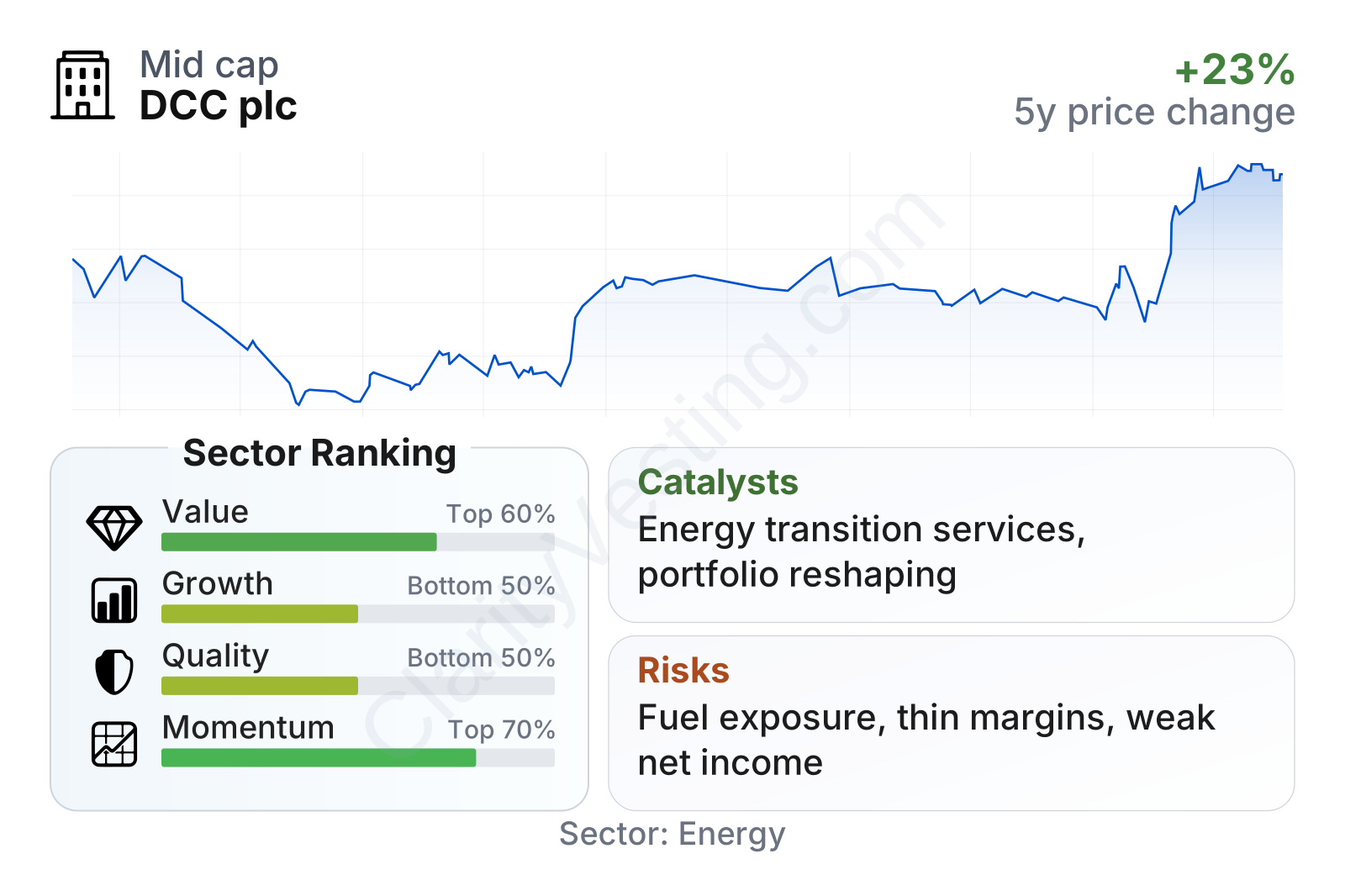
DCC currently sits in a middle ground that is easy to miss at first glance. On valuation, the shares trade at higher earnings and book multiples than the sector median, which means the market is not pricing it like a distressed fuel distributor. At the same time, free cash flow yield is relatively strong, pointing to better cash generation than the headline earnings multiple alone suggests.
Quality indicators are mixed but not weak. Recent return on invested capital is above the sector median, and leverage looks manageable on a net debt to EBITDA basis, below many peers in the energy universe. The challenge is profitability: operating margin is only around 2% to 3%, and net margin is extremely thin, which leaves little room for execution mistakes or adverse pricing moves.
Growth metrics are the softest part of the picture. Recent revenue growth is low, five-year revenue per share has declined, and earnings per share over five years have also moved lower. Even so, free cash flow growth has been much stronger than sector median levels, which matters for a distribution group where cash discipline is often a better signal than headline sales growth.
Share price momentum has improved. The stock has outperformed the sector over three years and has been trading well above its long-term average trend, showing that the market has recently become more constructive on the company despite uneven accounting earnings.
Growth
DCC operates in sectors with different growth profiles. Traditional fuel distribution is mature in many of its markets and does not offer the kind of structural expansion found in software or semiconductors. However, it remains a large and necessary service activity, especially for commercial transport, heating, retail forecourts, and off-grid energy users. That gives DCC a durable demand base, even if the long-term volume outlook for conventional fuels is limited.
The more interesting long-term question is whether DCC can use that installed customer base to reposition its energy operations. Management has been emphasizing energy transition services, including cleaner fuel formats, LPG, biofuels, and adjacent energy solutions. That strategy is logical because DCC already has logistics networks, local customer relationships, and operational scale. In other words, it does not need to invent a new route to market; it can adapt an existing one.
Healthcare also offers a steadier long-term backdrop than fuel. Aging populations, healthcare outsourcing, and the need for reliable medical distribution can support gradual expansion. Technology distribution is less defensive, but it can still add growth through vendor relationships, specialized channels, and bolt-on acquisitions.
DCC’s broader corporate strategy has long relied on acquisitions and operational improvement. That approach makes sense for a company of its type because fragmented distribution markets often contain local operators that can be integrated into a larger network. If integration is done well, DCC can improve purchasing, logistics, and overhead efficiency while preserving customer relationships.
A visible catalyst is portfolio reshaping. The company has been simplifying its business mix and increasing focus on activities that can deliver better returns and stronger strategic fit. Combined with solid free cash flow and moderate balance-sheet leverage, that gives DCC room to keep adjusting the group toward areas with better resilience and cleaner growth prospects.
Risks
This article is for informational purposes only and does not constitute financial advice. Some content is AI-generated. See Disclaimer


