Stock Analysis · Darling Ingredients Inc (DAR)
Overview
Darling Ingredients Inc. is a specialty ingredients and circular economy company that collects animal by-products, used cooking oil, food waste, and other residual materials, then turns them into products with commercial value. In simple terms, it takes waste streams that many industries cannot use and converts them into feed ingredients, fuels, fertilizers, and specialty products. That business model gives the company exposure to agriculture, food, energy, and sustainability themes at the same time.
The company’s revenue comes from several operating segments and joint-venture activity. Based on recent company reporting, the mix is centered on feed ingredients and fuel-related products, with food ingredients and fertilizers playing smaller roles.
- Feed Ingredients – approximately 50% to 55% of revenue. This includes rendered products such as tallow, proteins, blood meal, feather meal, and other ingredients used in pet food, livestock feed, aquaculture, and industrial applications.
- Food Ingredients – approximately 20% to 25% of revenue. This segment includes edible fats, bakery ingredients, specialty proteins, collagen-related products, casings, and ingredients used in food manufacturing.
- Fuel Ingredients – approximately 15% to 20% of revenue. This activity includes used cooking oil collection and feedstocks that can be upgraded into renewable diesel and sustainable aviation fuel.
- Fertilizer and other products – approximately 5% to 10% of revenue. This includes organic fertilizers and additional by-product applications.
- Diamond Green Diesel earnings contribution – not a large reported revenue line inside consolidated sales, but strategically very important for profitability and growth. Darling owns a stake in this renewable diesel joint venture with Valero.
The business has a useful structural feature: part of its competitive position comes from collection networks, processing infrastructure, long-standing supplier relationships, and regulatory know-how. Those are difficult to replicate quickly. Over time, the company has built a global system that turns low-value inputs into products with higher economic value.
Revenue expanded strongly from 2021 to 2023, then profitability compressed in 2024 and especially 2025 before showing signs of recovery. The overall pattern suggests a business with real scale and cash generation, but one that remains sensitive to commodity spreads and cyclical pricing.
Key Figures
| Metric | Value | Sector ⓘ |
|---|---|---|
| Date | Oct 17, 2026 | |
| Context | ||
| Sector | Consumer Defensive | |
| Industry | Packaged Foods | |
| Market Cap ⓘ | $9.64B | |
| Beta ⓘ | 1.05 | |
Value (Cheapness) | ||
| P/E Ratio ⓘ | 16.68 | 17.88 |
| P/B Ratio ⓘ | 1.96 | 1.29 |
| FCF Yield ⓘ | 9.15% | 12.39% |
| Dividend Yield ⓘ | N/A | 2.85% |
| EBIT / EV ⓘ | 7.03% | 6.43% |
| PEG ⓘ | 4.31 | |
Growth (Business expansion) | ||
| Revenue Growth ⓘ | 16.40% | 4.10% |
| RPS Growth (5Y CAGR) ⓘ | 7.81% | 6.18% |
| EPS Growth (5Y CAGR) ⓘ | -8.70% | -13.59% |
| BVPS Growth (5Y CAGR) ⓘ | 10.93% | 3.20% |
| Margin Growth (5Y Trend) ⓘ | -14.00% | -0.15% |
| FCF Growth (5Y CAGR) ⓘ | 12.11% | 4.10% |
| DPS Growth (5Y CAGR) ⓘ | 234.73% | 6.79% |
Quality (Business durability) | ||
| ROIC (Latest) ⓘ | 9.18% | 12.34% |
| ROA (Latest) ⓘ | 5.58% | 6.30% |
| ROIC (5Y Median) ⓘ | 11.07% | 10.49% |
| ROA (5Y Median) ⓘ | 6.39% | 5.44% |
| Net Debt / EBIT (Latest) ⓘ | 4.17 | 1.96 |
| Net Debt / EBIT (5Y Median) ⓘ | 4.61 | 2.35 |
| Net Debt / EBITDA (Latest) ⓘ | 2.70 | 1.38 |
| Net Debt / Assets ⓘ | 36.54% | 21.51% |
| EBITDA / Interest ⓘ | 4.50 | 9.46 |
| Operating Margin (Latest) ⓘ | 14.68% | 8.87% |
| Operating Margin (5Y Median) ⓘ | 14.42% | 9.53% |
| Debt to Equity (Latest) ⓘ | 79.52% | 72.35% |
| Profit Margin (Latest) ⓘ | 9.13% | 5.40% |
| Free Cash Flow (Latest) ⓘ | $881.24M | |
Momentum (Price trend) | ||
| 3Y Return ⓘ | +41.19% | +20.92% |
| 12M Return (excl. last month) ⓘ | +107.09% | +2.13% |
| 6M Return ⓘ | +2.75% | +1.26% |
| Price vs. 200-Day MA ⓘ | +10.43% | +1.39% |
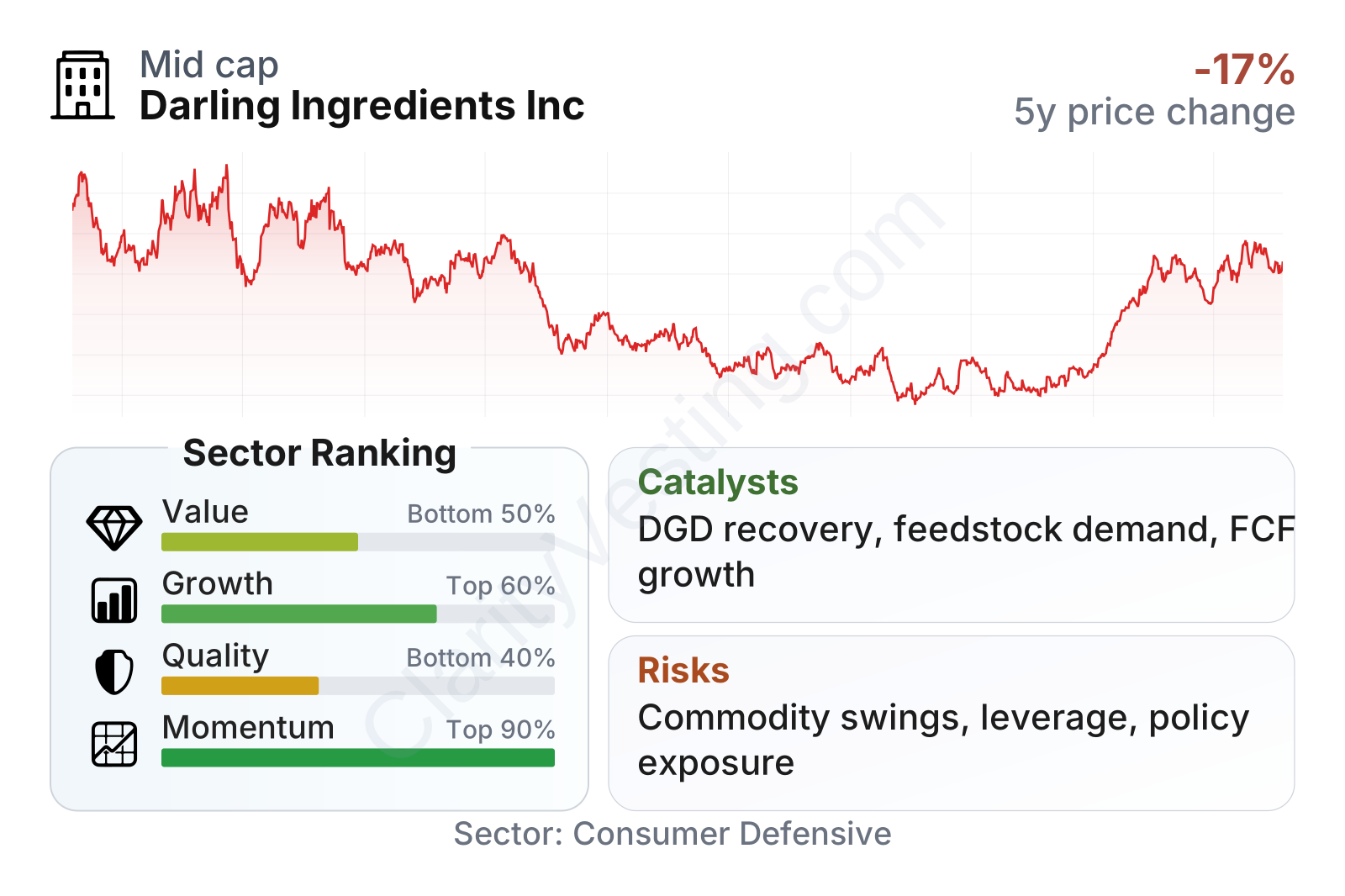
Darling Ingredients is a large mid-cap to lower large-cap company with a stock that has been volatile over the last several years. The recent share-price rebound has been strong, and market momentum now looks much better than the broader sector. On fundamentals, the picture is more mixed: growth indicators are generally above sector norms, profitability is currently solid, but leverage remains heavier than average and valuation is not clearly cheap across every metric.
The factor view is especially telling. Growth ranks in the upper part of the sector, momentum is very strong, and operating profitability remains better than many peers. However, returns on capital are not standout right now, and debt-related measures still weigh on quality. That combination often describes a business coming out of a difficult earnings period rather than one already back to peak economics.
Growth
Darling operates in markets that have favorable long-term demand drivers. The broad sector around waste conversion, animal by-product recycling, low-carbon fuels, renewable feedstocks, and specialty ingredients is supported by environmental regulation, decarbonization targets, and the need to extract more value from existing resources. That does not make growth smooth every year, but it does mean the company is positioned in areas that matter more over time, not less.
A central part of the growth case is the logic of the company’s strategy. Darling is not simply selling commodity products; it is building around hard-to-replace supply chains. Access to used cooking oil, animal fats, and food-processing residuals becomes more valuable as renewable diesel and sustainable aviation fuel capacity expands. In that setting, feedstock control matters. This gives Darling a role near the beginning of the value chain, where scarcity can create bargaining power.
Recent revenue trends show a downturn in 2024 followed by a return to positive year-over-year growth through 2025 and into 2026. The latest pace is clearly ahead of the sector median, which suggests the company has moved beyond the weakest part of the cycle. That said, the earlier swing from rapid expansion to contraction shows how exposed results can be to pricing conditions, especially in fuel-related markets and ingredient values.
Cash generation has been more stable than headline earnings. Free cash flow has trended upward over the last several reported annual periods on this chart, which is an encouraging sign because it suggests the business still converts a meaningful share of its operations into cash even when accounting profits are under pressure. The latest trailing free cash flow is substantial, giving Darling more room to support capital spending, debt reduction, and portfolio development.
The most important catalyst remains low-carbon fuels. Darling’s interest in Diamond Green Diesel links the company to renewable diesel production and, over time, potentially to sustainable aviation fuel. Public policy incentives in North America and Europe continue to support these markets, even if pricing can fluctuate sharply from quarter to quarter. If demand for waste-based feedstocks keeps rising, Darling’s collection and processing footprint becomes more strategically valuable.
Another growth support is portfolio optimization. Management has spent recent years reshaping the business through acquisitions, specialty ingredient expansion, and integration of global collection and rendering assets. If the company can continue improving product mix toward higher-value ingredients and feedstocks, growth does not need to come only from volume increases.
Risks
This article is for informational purposes only and does not constitute financial advice. Some content is AI-generated. See Disclaimer


