Stock Analysis · Delta Air Lines Inc (DAL)
Overview
Delta Air Lines is one of the largest global airlines. It transports passengers across the United States and internationally, and it also earns revenue from loyalty partnerships, cargo services, maintenance work, and related travel services. The company operates a large hub-and-spoke network centered on major airports such as Atlanta, Detroit, Minneapolis-St. Paul, Salt Lake City, Seattle, New York, Boston, and Los Angeles. In simple terms, Delta’s business is about selling seats on flights, filling those planes efficiently, and using its network, brand, and premium offerings to generate higher revenue per traveler.
Passenger air travel is by far the main source of revenue. Based on recent company reporting patterns, Delta’s revenue mix is broadly concentrated in the following areas:
- Passenger revenue: about 85% to 90% — ticket sales across domestic and international routes, including Main Cabin, Comfort+, Premium Select, and Delta One.
- Loyalty and other travel-related revenue: about 8% to 12% — this includes the SkyMiles ecosystem and large commercial partnerships, especially with American Express, plus travel-related fees and ancillary items.
- Cargo and other sources: about 2% to 4% — air freight, third-party maintenance and repair activities, and smaller commercial services.
One of the most important features of Delta’s model is that it is not only selling basic transportation. Management has spent years building premium cabins, airport lounges, co-branded card partnerships, and a more reliable operation. That matters because these areas can lift revenue even when overall industry seat growth is not especially strong.
Over the last several years, revenue recovered sharply from the pandemic period and moved above prior levels, while interest expense trended lower as the balance sheet improved. Profitability has not moved in a straight line, but the broader direction shows that Delta rebuilt scale and cash generation faster than many expected.
Key Figures
| Metric | Value | Sector ⓘ |
|---|---|---|
| Date | Oct 17, 2026 | |
| Context | ||
| Sector | Industrials | |
| Industry | Airlines | |
| Market Cap ⓘ | $52.35B | |
| Beta ⓘ | 1.34 | |
Value (Cheapness) | ||
| P/E Ratio ⓘ | 15.88 | 22.10 |
| P/B Ratio ⓘ | 2.24 | 1.97 |
| FCF Yield ⓘ | 10.85% | 6.38% |
| Dividend Yield ⓘ | 1.00% | 1.94% |
| EBIT / EV ⓘ | 7.06% | 4.79% |
| PEG ⓘ | 39.29 | |
Growth (Business expansion) | ||
| Revenue Growth ⓘ | 21.10% | 9.30% |
| RPS Growth (5Y CAGR) ⓘ | 20.05% | 7.81% |
| EPS Growth (5Y CAGR) ⓘ | 5.56% | -13.06% |
| BVPS Growth (5Y CAGR) ⓘ | 51.25% | 6.14% |
| Margin Growth (5Y Trend) ⓘ | 3.21% | 0.88% |
| FCF Growth (5Y CAGR) ⓘ | 293.67% | 11.01% |
| DPS Growth (5Y CAGR) ⓘ | N/A | 9.48% |
Quality (Business durability) | ||
| ROIC (Latest) ⓘ | 12.24% | 10.84% |
| ROA (Latest) ⓘ | 3.93% | 5.41% |
| ROIC (5Y Median) ⓘ | 12.81% | 9.38% |
| ROA (5Y Median) ⓘ | 4.64% | 4.95% |
| Net Debt / EBIT (Latest) ⓘ | 2.08 | 2.08 |
| Net Debt / EBIT (5Y Median) ⓘ | 3.81 | 2.27 |
| Net Debt / EBITDA (Latest) ⓘ | 1.35 | 1.39 |
| Net Debt / Assets ⓘ | 11.59% | 19.28% |
| EBITDA / Interest ⓘ | 12.33 | 9.58 |
| Operating Margin (Latest) ⓘ | 6.67% | 10.50% |
| Operating Margin (5Y Median) ⓘ | 8.77% | 10.29% |
| Debt to Equity (Latest) ⓘ | 61.13% | 65.48% |
| Profit Margin (Latest) ⓘ | 4.58% | 6.67% |
| Free Cash Flow (Latest) ⓘ | $5.68B | |
Momentum (Price trend) | ||
| 3Y Return ⓘ | +131.73% | +61.68% |
| 12M Return (excl. last month) ⓘ | +34.75% | +12.58% |
| 6M Return ⓘ | +7.45% | 0.00% |
| Price vs. 200-Day MA ⓘ | +0.88% | +0.02% |
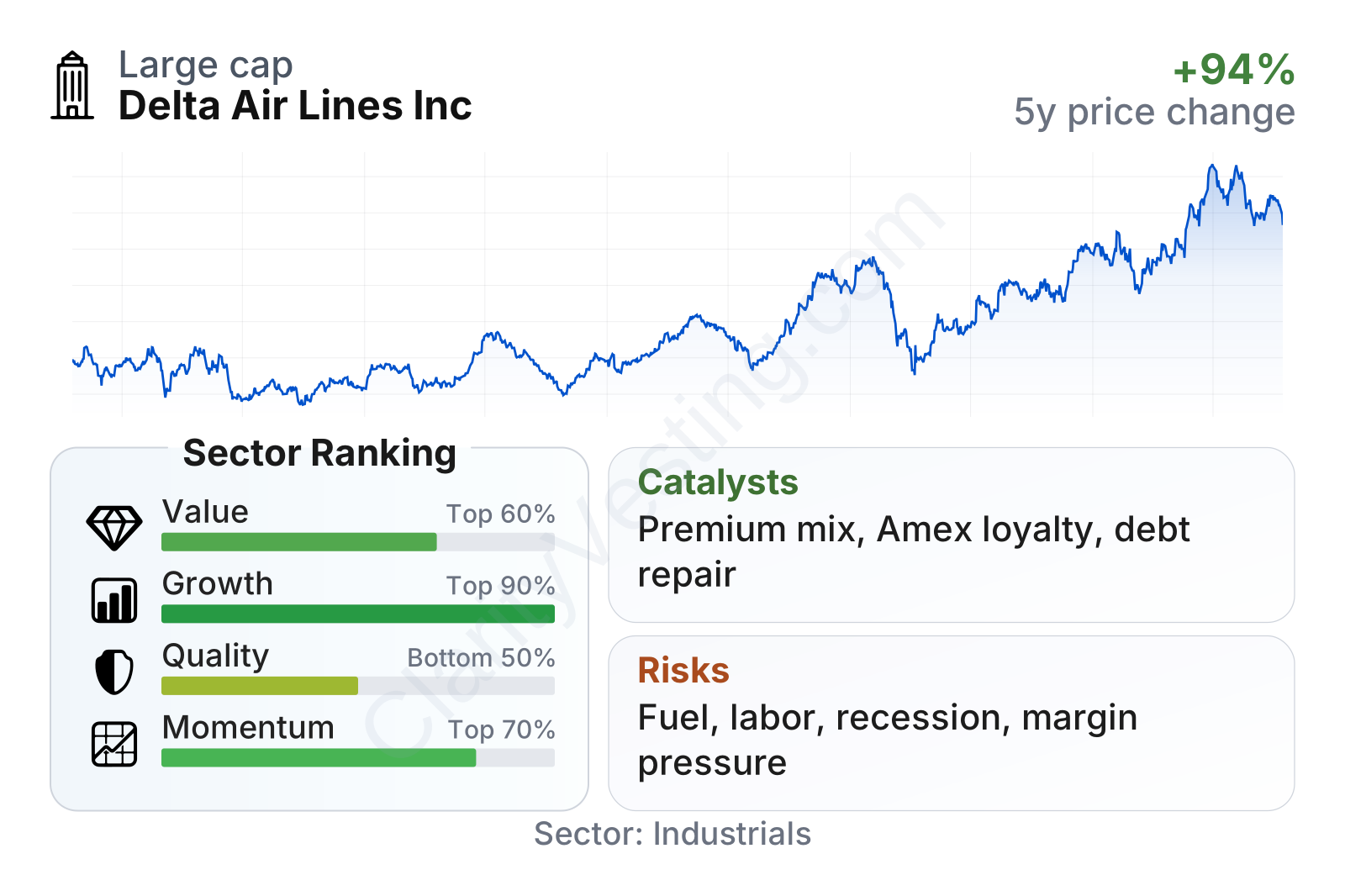
Delta is a large airline by market value, but its share price has remained noticeably volatile, which is normal for the sector. On valuation, earnings and cash-flow-based measures look relatively moderate versus the broader industrial sector median, while growth and momentum rank much higher. The weaker area is operating quality, not because the company lacks scale, but because airline margins and asset intensity naturally limit returns compared with stronger industrial niches. Even so, free cash flow generation is standing out, and debt metrics have improved materially from the post-pandemic period.
Growth
Commercial aviation remains a growing sector over the long run, supported by rising travel demand, premium travel, loyalty spending, and limited industry capacity growth in some markets. Growth in airlines is rarely smooth, but the long-term demand base is real: business travel has stabilized, leisure demand remains important, and international flying continues to normalize in many corridors. For Delta, the attractive part is not just industry demand, but where it is positioned inside that demand.
Delta’s strategy is centered on premium products, operational reliability, and loyalty monetization. That approach makes sense for future growth because it reduces dependence on the lowest-fare customer. A traveler flying in premium cabins, using airport lounges, and spending on a co-branded credit card is worth more than a standard economy-only customer. This helps explain why Delta has focused heavily on segmentation rather than simply adding more seats. Its partnership with American Express is especially important because it turns customer loyalty into a high-margin revenue stream that is less cyclical than ticket sales alone.
Recent revenue growth has reaccelerated after a slower stretch in 2024 and parts of 2025. The pace now sits well above the sector median, suggesting Delta is benefiting from a mix of pricing, network strength, and demand recovery rather than only capacity expansion. Over a five-year view, revenue per share growth has also been strong, which points to a business that has rebuilt its earnings power meaningfully since the pandemic disruption.
Cash generation is another major positive. Free cash flow moved from negative territory during the recovery phase to several billions of dollars on a trailing basis. That gives Delta more flexibility to reduce debt, invest in fleet and customer experience, and support shareholder returns without relying too heavily on new borrowing. For an airline, this is an important sign of progress because the business is capital-intensive and exposed to external shocks.
Another potential catalyst is industry capacity discipline. Aircraft delivery constraints and engine issues across the aerospace supply chain have limited how quickly airlines can add seats. For Delta, that can be helpful when demand is healthy because constrained capacity often supports fares and premium pricing. At the company level, recent investor communications have also emphasized continued strength in premium, loyalty, and international demand, which are some of the most profitable parts of the network.
Risks
This article is for informational purposes only and does not constitute financial advice. Some content is AI-generated. See Disclaimer


