Stock Analysis · Dah Sing Financial Holdings Limited (DAHSF)
Overview
Dah Sing Financial Holdings Limited is a Hong Kong-based financial group centered on banking, insurance, and related financial services. Its main operating arm is Dah Sing Bank, a long-established local bank serving retail customers, small and medium-sized businesses, and corporate clients. The group also has insurance operations and a stake in a general insurance business, giving it a broader financial-services profile than a pure regional bank.
For a long-term reader, the business is easiest to understand as a traditional deposit-taking and lending institution with added income from fee-based services and insurance. In practical terms, it collects deposits, makes loans, earns interest on that spread, and supplements that income through wealth management, cards, foreign exchange, trade finance, and insurance-related activities.
The revenue mix in banking groups can shift materially from year to year because interest rates, funding costs, treasury results, and accounting presentation all influence reported totals. Based on the company’s recent annual reporting structure, the largest earnings drivers are approximately:
- Net interest income: the core source of banking earnings, generated from mortgages, commercial lending, consumer finance, and treasury assets funded by deposits. This is typically the largest contributor and appears to account for the majority of underlying banking income.
- Net fee and commission income: fees from wealth management, securities, bancassurance distribution, trade finance, cards, and other banking services. This is a secondary but meaningful source of revenue.
- Trading and treasury-related income: foreign exchange, investment income, and mark-to-market or treasury activities. This can be volatile from one year to another.
- Insurance and associate contributions: earnings from life insurance operations and the group’s interest in general insurance activities. These are smaller than core banking but still relevant to the overall profit profile.
Dah Sing is not a global banking giant. It is a smaller, locally focused financial institution, which can be an advantage in niche relationships and customer familiarity, but also means its growth path depends heavily on conditions in Hong Kong and nearby regional markets.
The operating profile has been uneven in recent years, which is typical for banks exposed to shifting rates and credit conditions. Even so, the broad direction points to recovery in revenue and profit after weaker periods, with 2025 showing a stronger earnings outcome than earlier years.
Key Figures
| Metric | Value | Sector ⓘ |
|---|---|---|
| Date | Oct 17, 2026 | |
| Context | ||
| Sector | Financial Services | |
| Industry | Banks - Regional | |
| Market Cap ⓘ | $1.07B | |
| Beta ⓘ | 0.46 | |
Value (Cheapness) | ||
| P/E Ratio ⓘ | 6.07 | 12.26 |
| P/B Ratio ⓘ | 0.00 | 1.23 |
| FCF Yield ⓘ | 698.87% | 10.40% |
| Dividend Yield ⓘ | 78.44% | 3.02% |
| EBIT / EV ⓘ | N/A | 8.14% |
| PEG ⓘ | N/A | |
Growth (Business expansion) | ||
| Revenue Growth ⓘ | 3.00% | 9.35% |
| RPS Growth (5Y CAGR) ⓘ | 91.75% | 12.19% |
| EPS Growth (5Y CAGR) ⓘ | -31.59% | -9.53% |
| BVPS Growth (5Y CAGR) ⓘ | 64.50% | 4.99% |
| Margin Growth (5Y Trend) ⓘ | -3.92% | -3.86% |
| FCF Growth (5Y CAGR) ⓘ | 6.62% | 4.81% |
| DPS Growth (5Y CAGR) ⓘ | 106.35% | 8.79% |
Quality (Business durability) | ||
| ROIC (Latest) ⓘ | N/A | 9.49% |
| ROE (Latest) ⓘ | 12.42% | 13.90% |
| ROA (Latest) ⓘ | 1.49% | 1.55% |
| ROIC (5Y Median) ⓘ | 5.01% | 7.86% |
| ROE (5Y Median) ⓘ | 6.63% | 12.17% |
| ROA (5Y Median) ⓘ | 0.60% | 1.30% |
| Net Debt / EBIT (Latest) ⓘ | N/A | 0.96 |
| Net Debt / EBIT (5Y Median) ⓘ | -5.74 | 0.73 |
| Net Debt / EBITDA (Latest) ⓘ | 0.27 | 0.92 |
| Operating Margin (Latest) ⓘ | N/A | 22.30% |
| Operating Margin (5Y Median) ⓘ | 25.61% | 24.63% |
| Debt to Equity (Latest) ⓘ | 23.57% | 58.56% |
| Profit Margin (Latest) ⓘ | 32.03% | 26.57% |
| Free Cash Flow (Latest) ⓘ | $7.45B | |
Momentum (Price trend) | ||
| 3Y Return ⓘ | +94.40% | +88.33% |
| 12M Return (excl. last month) ⓘ | +10.81% | +19.38% |
| 6M Return ⓘ | +10.81% | +4.75% |
| Price vs. 200-Day MA ⓘ | +7.51% | +3.50% |
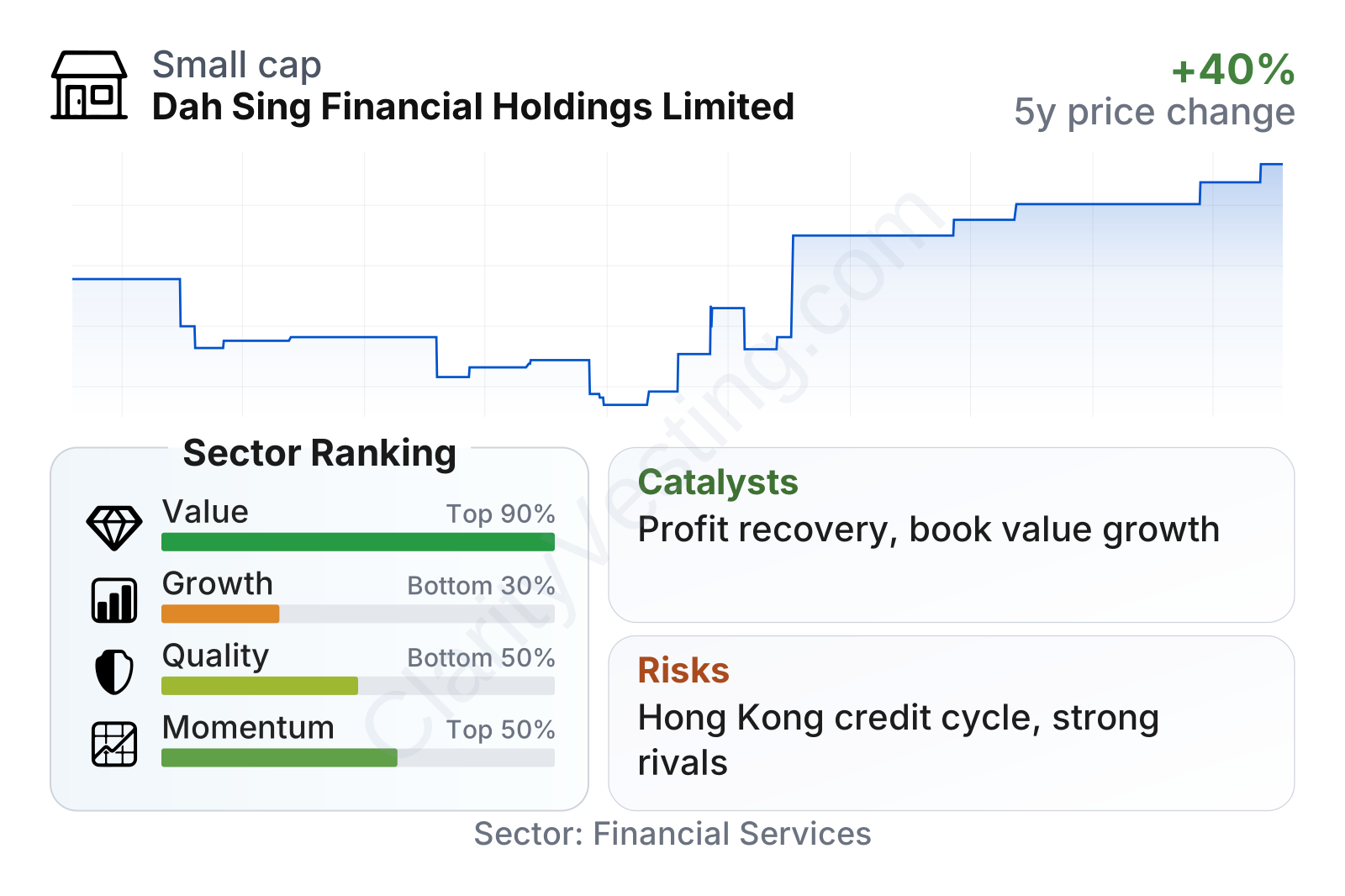
The overall picture is unusual but fairly clear. On valuation measures, the shares screen as very inexpensive relative to the broader regional banking group, with a low earnings multiple and an exceptionally low price-to-book reading. Profitability is mixed: recent return on equity is a little below the sector median, but profit margin is stronger than average and balance-sheet leverage looks relatively conservative, with debt-to-equity around 24% versus a much higher sector median. Growth measures are the weakest part of the profile, reflecting modest recent revenue growth and a difficult five-year earnings record, although book value and dividends have improved sharply. Price performance has also recovered well from the lows, suggesting the market has become somewhat more constructive even while the stock still appears deeply discounted on asset-based metrics.
Growth
Dah Sing operates in a mature sector rather than a high-growth one. Regional banking in Hong Kong is driven less by rapid expansion and more by credit quality, funding discipline, capital strength, and the ability to defend margins across cycles. That means the long-term case depends more on steady compounding of book value, dividends, and normalized earnings than on explosive top-line growth.
The company’s strategy appears sensible for that kind of environment. It remains focused on traditional banking lines where local knowledge matters, while maintaining exposure to fee businesses and insurance that can diversify earnings. For a bank of this size, that combination can help reduce dependence on any single product line, especially when loan growth is soft or net interest margins fluctuate.
A practical catalyst is any improvement in Hong Kong credit demand and business sentiment. If loan growth picks up while funding costs stabilize, core banking income can improve without requiring major strategic change. Another support is the company’s capital and asset backing. For banks, growth in book value per share is an important signal because it reflects retained earnings and balance-sheet capacity over time.
Book value per share has risen strongly after the earlier dip, which supports the idea that the franchise has been rebuilding underlying value even though earnings growth has not been smooth. The latest jump is unusually large and should be read carefully in the context of reporting and balance-sheet movements, but the broader direction is still favorable.
Recent company reporting has also pointed to stronger profit generation and resilient capital levels. For a regional bank, that matters because it creates room to maintain dividends, absorb credit costs, and continue lending through weaker parts of the cycle. There is no obvious transformational catalyst here, but there is a credible path to gradual improvement if Hong Kong banking conditions remain stable.
Risks
This article is for informational purposes only and does not constitute financial advice. Some content is AI-generated. See Disclaimer


