Stock Analysis · Danaos Corporation (DAC)
Overview
Danaos Corporation is a Greek shipping company focused mainly on container vessels. In simple terms, it owns large ships that transport containers for global trade and leases those ships to major liner companies under multi-year charter contracts. That business model makes Danaos closer to a vessel owner and less like a consumer-facing transportation brand. The company has also expanded beyond containers through investments in dry bulk vessels and, more recently, renewable energy-related activities, but container shipping remains the core of the business.
The main revenue source is vessel chartering. Based on recent company reporting, Danaos generates the overwhelming majority of its operating revenue from contracted container ship charters, with a smaller contribution from dry bulk shipping. Exact percentages can move from quarter to quarter, but the current business mix is best understood as follows:
- Container vessel charters: about 90% to 95% of revenue. This includes long-term leasing of containerships to global liner operators, which pay fixed daily rates during the charter period.
- Dry bulk vessel charters: about 5% to 10% of revenue. This activity comes from ships carrying commodities such as iron ore, coal, and grain, usually with more exposure to market rate swings than the core container business.
- Other income: limited. This can include management-related or incidental items, but it is not a major earnings driver.
Danaos stands out because much of its business is already contracted in advance. That gives better visibility than many shipping companies that rely heavily on spot rates. The company’s financial flow also shows a business with very high operating profitability, relatively contained overhead, and manageable financing costs compared with its earnings base, even though profits have normalized from the extraordinary peak years in container shipping.
Over the last several years, revenue climbed sharply during the container shipping boom and has since remained at a high level rather than collapsing. Operating income and net income have eased from peak conditions, but margins are still unusually strong for an industrial company, which reflects the value of long-term charter coverage and disciplined cost control.
Key Figures
| Metric | Value | Sector ⓘ |
|---|---|---|
| Date | Oct 17, 2026 | |
| Context | ||
| Sector | Industrials | |
| Industry | Marine Shipping | |
| Market Cap ⓘ | $3.01B | |
| Beta ⓘ | 0.86 | |
Value (Cheapness) | ||
| P/E Ratio ⓘ | 5.58 | 22.10 |
| P/B Ratio ⓘ | 0.73 | 1.97 |
| FCF Yield ⓘ | 5.89% | 6.38% |
| Dividend Yield ⓘ | 2.36% | 1.94% |
| EBIT / EV ⓘ | 20.05% | 4.79% |
| PEG ⓘ | 0.12 | |
Growth (Business expansion) | ||
| Revenue Growth ⓘ | 4.70% | 9.30% |
| RPS Growth (5Y CAGR) ⓘ | 13.92% | 7.81% |
| EPS Growth (5Y CAGR) ⓘ | -21.46% | -13.06% |
| BVPS Growth (5Y CAGR) ⓘ | 19.29% | 6.14% |
| Margin Growth (5Y Trend) ⓘ | -111.64% | 0.88% |
| FCF Growth (5Y CAGR) ⓘ | 45.26% | 11.01% |
| DPS Growth (5Y CAGR) ⓘ | 23.04% | 9.48% |
Quality (Business durability) | ||
| ROIC (Latest) ⓘ | 8.89% | 10.84% |
| ROA (Latest) ⓘ | 10.75% | 5.41% |
| ROIC (5Y Median) ⓘ | 18.75% | 9.38% |
| ROA (5Y Median) ⓘ | 15.92% | 4.95% |
| Net Debt / EBIT (Latest) ⓘ | 0.36 | 2.08 |
| Net Debt / EBIT (5Y Median) ⓘ | 0.41 | 2.27 |
| Net Debt / EBITDA (Latest) ⓘ | 0.26 | 1.39 |
| Net Debt / Assets ⓘ | 3.72% | 19.28% |
| EBITDA / Interest ⓘ | 16.49 | 9.58 |
| Operating Margin (Latest) ⓘ | 53.01% | 10.50% |
| Operating Margin (5Y Median) ⓘ | 61.30% | 10.29% |
| Debt to Equity (Latest) ⓘ | 29.84% | 65.48% |
| Profit Margin (Latest) ⓘ | 51.26% | 6.67% |
| Free Cash Flow (Latest) ⓘ | $177.14M | |
Momentum (Price trend) | ||
| 3Y Return ⓘ | +181.72% | +61.68% |
| 12M Return (excl. last month) ⓘ | +72.59% | +12.58% |
| 6M Return ⓘ | +42.92% | 0.00% |
| Price vs. 200-Day MA ⓘ | +32.41% | +0.02% |
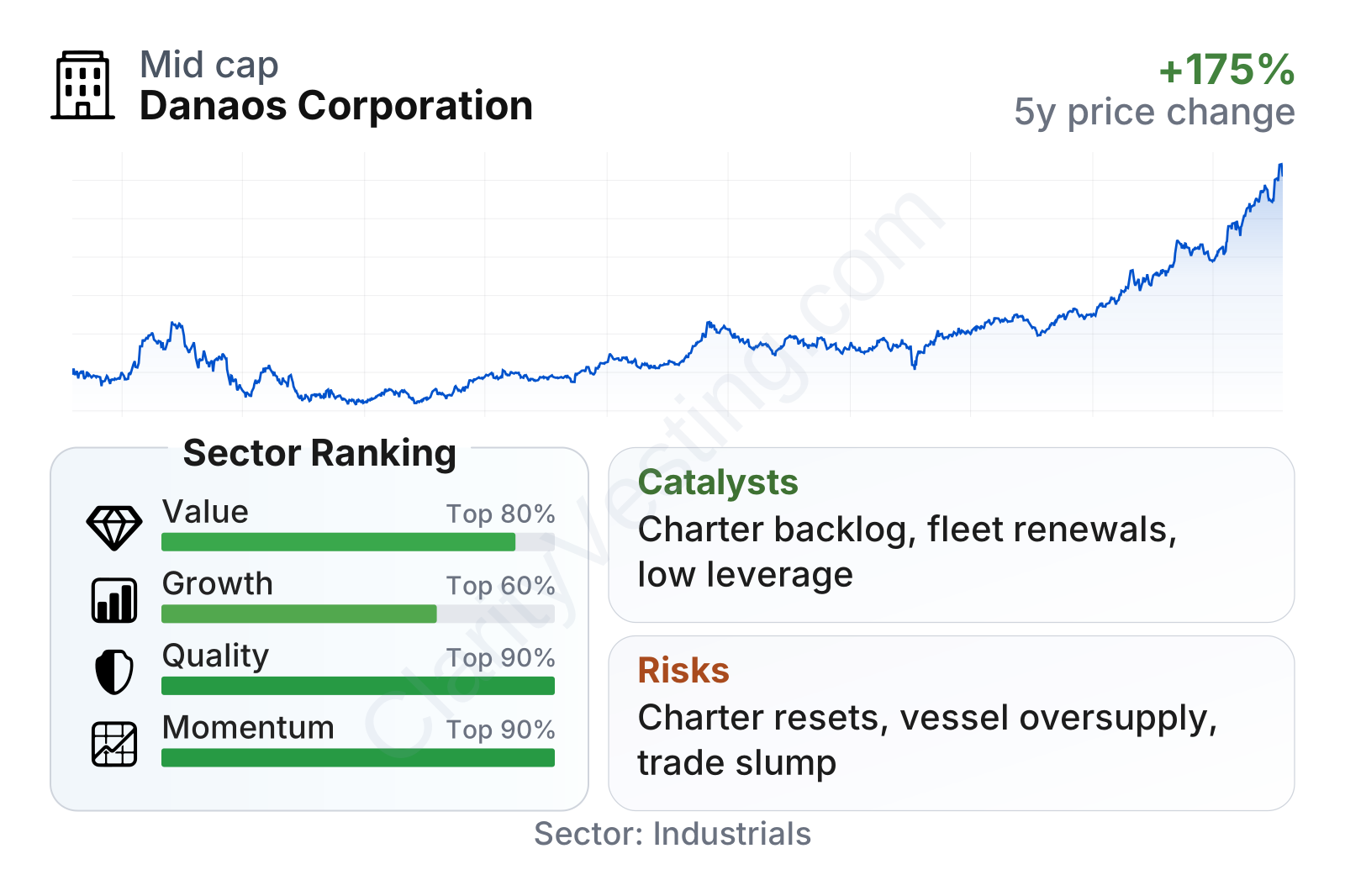
The overall picture is unusual: Danaos combines very strong quality metrics with low valuation multiples. Profitability, balance sheet strength, and cash generation all compare well with the broader industrial sector, while valuation ratios remain far below sector norms. Growth is more mixed: long-term revenue, book value, free cash flow, and dividends have advanced well, but earnings growth has become less impressive after the shipping upcycle cooled. Share-price momentum has been strong, which suggests the market has started to recognize some of that disconnect.
Growth
Long-term growth for Danaos depends first on the health of global container trade. This is a cyclical industry, but it remains essential to world commerce. Over time, more goods moving between Asia, Europe, and North America creates demand for vessels. Even when trade growth is not spectacular, ship supply, port congestion, and charter availability can have a major effect on earnings. For Danaos, the key advantage is that it is not relying only on short-term freight conditions; it has built a portfolio of contracted charters that can support revenue visibility across multiple years.
The company’s strategy appears coherent for this type of business. Danaos used the exceptionally profitable 2021-2023 period to strengthen its balance sheet, lock in charters, and preserve financial flexibility. That matters because shipping companies often struggle when the cycle turns down, but Danaos entered the current period with much lower leverage than many peers. It has also been renewing and selectively expanding its fleet, including newer and larger containerships that are more relevant to customer needs and environmental standards.
Revenue growth has clearly normalized. After extremely high year-over-year gains during the shipping boom, the company moved into a much lower growth phase, with some quarters slightly negative and more recent quarters back to modest positive growth. That pattern is not surprising for a company coming off exceptional charter-market conditions. What matters more is that revenue has held up relatively well instead of falling sharply.
Cash generation has been volatile, which is common in shipping because vessel acquisitions and timing of payments can heavily affect free cash flow. Even so, the broader trend over several years remains constructive. Danaos has shown an ability to generate substantial cash, fund dividends, reduce debt, and still keep optionality for fleet investment. That flexibility is an important growth support because it allows the company to act when assets become attractive.
One important catalyst is the company’s contracted revenue backlog from existing charters, which offers visibility not usually associated with shipping. Another is fleet positioning: modern containerships with fuel-efficiency advantages may remain in demand as customers face stricter environmental requirements. A further positive factor is Danaos’ financial capacity to pursue additional vessel deals or other capital allocation moves without depending heavily on external financing.
Recent company updates have also highlighted continued vessel acquisitions and charter coverage, which point to an effort to extend earnings visibility beyond the peak cycle rather than simply harvesting short-term profits. That does not guarantee growth, but it improves the company’s ability to navigate weaker markets while still participating if charter demand remains firm.
Risks
This article is for informational purposes only and does not constitute financial advice. Some content is AI-generated. See Disclaimer


