Stock Analysis · Cytokinetics Inc (CYTK)
Overview
Cytokinetics is a biotechnology company focused on muscle biology. In simple terms, it develops medicines designed to improve the way muscles contract, especially in serious heart and neuromuscular diseases. The company’s most important current program is aficamten, an investigational treatment for hypertrophic cardiomyopathy, a condition in which the heart muscle becomes abnormally thick and can make it harder for the heart to pump blood. Cytokinetics is also advancing other drug candidates, including programs in heart failure and amyotrophic lateral sclerosis.
This is not yet a traditional pharmaceutical business with a broad base of recurring product sales. Cytokinetics remains largely a development-stage company, so revenue can swing sharply depending on licensing, collaboration, milestone, and other agreement-related payments rather than steady commercial demand.
Based on its recent annual profile, the company’s revenue sources are concentrated in collaboration and licensing-related activity rather than marketed drug sales.
- Collaboration and license revenue: approximately 100% of recent revenue. This mainly reflects payments tied to research partnerships, upfront fees, milestones, amortization of prior agreement payments, and related arrangements.
- Product revenue: 0% disclosed as a meaningful recurring source in the latest available period, because the company has not yet built a broad commercial product business.
- Other revenue: not meaningful based on publicly available filings.
That structure matters for long-term analysis. If aficamten or another lead program reaches commercialization, Cytokinetics could move from a partnership-funded model to a product-based one, which would materially change both the scale and the quality of revenue.
The financial profile shows a business still spending heavily on research and corporate buildout, with revenue far smaller than operating costs. One notable recent change is that revenue rebounded in 2025 after an unusually weak 2023 and 2024 period, but losses and interest costs remained very large.
Key Figures
| Metric | Value | Sector ⓘ |
|---|---|---|
| Date | Oct 24, 2026 | |
| Context | ||
| Sector | Healthcare | |
| Industry | Biotechnology | |
| Market Cap ⓘ | $8.74B | |
| Beta ⓘ | 0.41 | |
Value (Cheapness) | ||
| P/E Ratio ⓘ | N/A | 25.42 |
| P/B Ratio ⓘ | N/A | 3.08 |
| FCF Yield ⓘ | -6.65% | 3.12% |
| Dividend Yield ⓘ | N/A | 1.85% |
| EBIT / EV ⓘ | -9.01% | 0.56% |
| PEG ⓘ | -0.42 | |
Growth (Business expansion) | ||
| Revenue Growth ⓘ | -57.10% | 7.50% |
| RPS Growth (5Y CAGR) ⓘ | -5.42% | 8.60% |
| EPS Growth (5Y CAGR) ⓘ | -5.89% | -17.73% |
| BVPS Growth (5Y CAGR) ⓘ | N/A | 3.72% |
| Margin Growth (5Y Trend) ⓘ | N/A | -0.57% |
| FCF Growth (5Y CAGR) ⓘ | N/A | 0.96% |
| DPS Growth (5Y CAGR) ⓘ | N/A | 6.69% |
Quality (Business durability) | ||
| ROIC (Latest) ⓘ | -110.70% | 3.17% |
| ROA (Latest) ⓘ | -53.20% | 2.98% |
| ROIC (5Y Median) ⓘ | -99.74% | 4.56% |
| ROA (5Y Median) ⓘ | -52.97% | 1.87% |
| Net Debt / EBIT (Latest) ⓘ | N/A | 1.34 |
| Net Debt / EBIT (5Y Median) ⓘ | N/A | 1.86 |
| Net Debt / EBITDA (Latest) ⓘ | N/A | 1.00 |
| Net Debt / Assets ⓘ | 52.75% | 5.06% |
| EBITDA / Interest ⓘ | N/A | 9.55 |
| Operating Margin (Latest) ⓘ | -1175.80% | 9.25% |
| Operating Margin (5Y Median) ⓘ | -891.60% | 7.33% |
| Debt to Equity (Latest) ⓘ | -732.36% | 26.68% |
| Profit Margin (Latest) ⓘ | N/A | 3.34% |
| Free Cash Flow (Latest) ⓘ | -$580.71M | |
Momentum (Price trend) | ||
| 3Y Return ⓘ | +95.51% | +51.61% |
| 12M Return (excl. last month) ⓘ | +40.08% | +19.90% |
| 6M Return ⓘ | -5.92% | +10.10% |
| Price vs. 200-Day MA ⓘ | -11.14% | +6.44% |
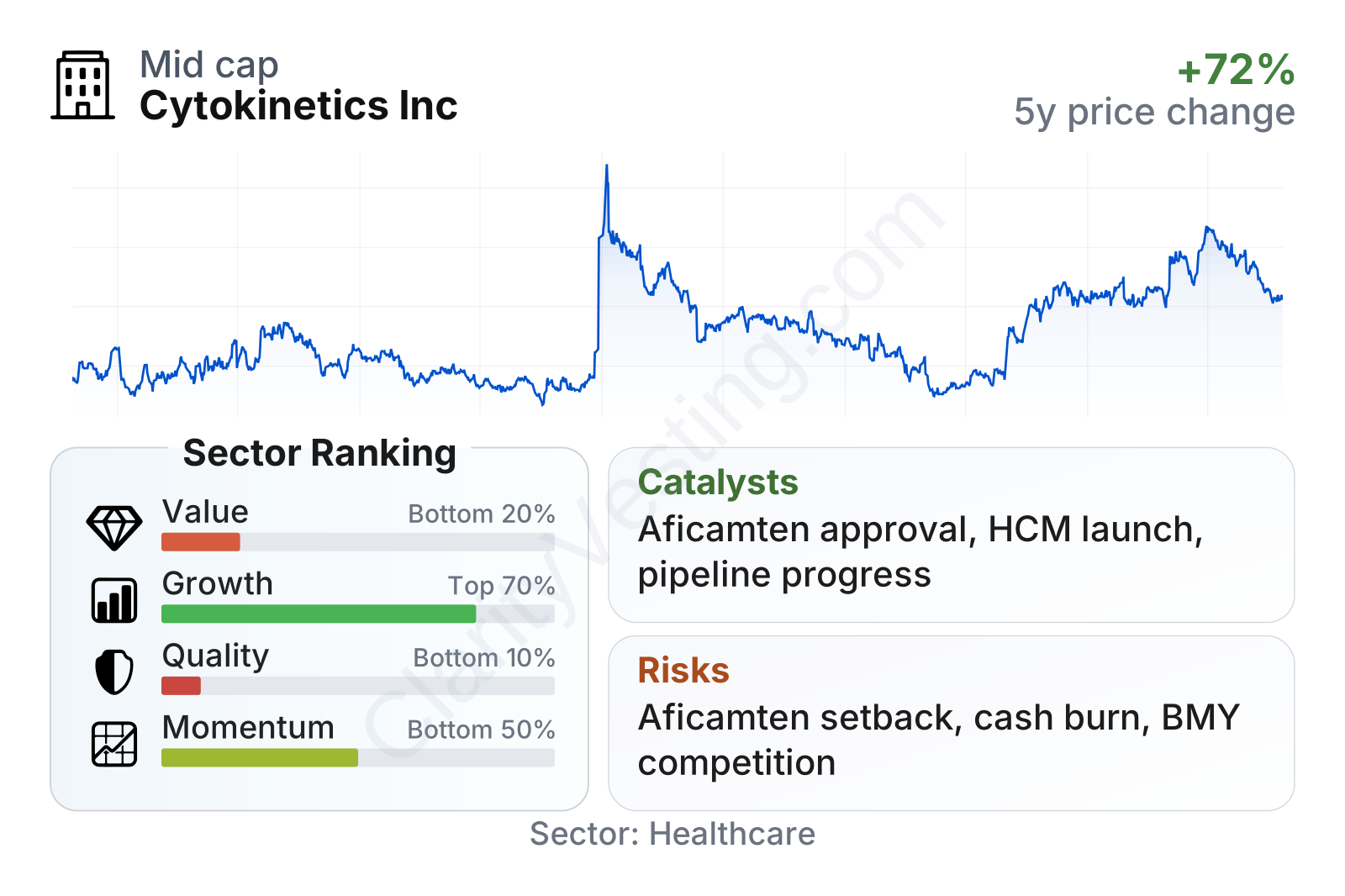
Cytokinetics is now a large biotech by market value, but its operating profile still looks like an unprofitable development company rather than a mature drug maker. The stock has delivered a very strong multiyear share-price gain, yet the factor breakdown remains mixed: valuation ranks weakly, quality is very weak because of losses and negative returns on capital, while growth and momentum sit closer to the middle of the healthcare group.
The low beta suggests the shares have not moved in lockstep with the broader market, but that should not be confused with low business risk. In biotechnology, company-specific events such as trial data, regulatory decisions, and financing needs often matter much more than market swings.
Growth
Cytokinetics operates in a part of healthcare that can be very attractive over the long run. Cardiovascular disease remains one of the world’s largest treatment markets, and rare or specialized heart conditions can support premium pricing if a drug shows clear clinical value. A company with a differentiated therapy in this field can move from minimal revenue to meaningful commercial scale relatively quickly once approval and launch begin.
The strategic logic is clear: build expertise in muscle biology, focus on serious diseases with significant unmet need, and push a lead asset toward approval while keeping follow-on programs alive. For Cytokinetics, the central growth question is not whether today’s revenue is expanding smoothly. It is whether the pipeline can convert years of research spending into a first major commercial product.
Reported revenue growth has been extremely volatile, which is typical when partnership accounting drives the top line. The pattern includes very large jumps and steep declines, so recent changes in revenue are not a reliable picture of underlying demand. For this company, clinical and regulatory progress is more important than short-term sales trends.
Cash flow remains deeply negative and has worsened over time, reflecting the cost of clinical development, organizational expansion, and preparation for possible commercialization. That is a warning sign from a balance-sheet perspective, but it also shows that management is funding a transition from research-focused biotech to a potential launch-stage company.
The main catalyst remains aficamten. Public company updates have highlighted regulatory progress and preparations tied to potential commercialization in obstructive hypertrophic cardiomyopathy. If approved and adopted by specialists, this drug could become the company’s first major recurring revenue engine. A second important growth driver is the broader pipeline, including additional cardiovascular opportunities that could extend the company beyond a single-asset profile.
Recent company communications also point to continued execution around late-stage development and launch readiness. For a long-term view, this matters because the biggest value shift in biotech often happens when a company moves from proving a drug works to proving it can become a durable commercial franchise.
Risks
This article is for informational purposes only and does not constitute financial advice. Some content is AI-generated. See Disclaimer


