Stock Analysis · CEMEX S.A.B. de C.V (CXMSF)
Overview
CEMEX S.A.B. de C.V. is a global building materials company best known for producing cement, ready-mix concrete, and aggregates. These are basic inputs used in roads, housing, commercial buildings, industrial sites, and large infrastructure projects. The company operates across the Americas, Europe, the Middle East, Africa, and Asia, with a footprint that gives it exposure to both mature construction markets and faster-growing urbanization trends.
CEMEX makes most of its money by selling heavy construction materials rather than from complex financial activities or one-off businesses. Based on its recent annual reporting structure, revenue is mainly generated from the following operating lines:
- Cement: approximately 45% to 50% of revenue. This is the company’s core product and is used in nearly every major construction category.
- Ready-mix concrete: approximately 30% to 35% of revenue. This includes concrete delivered directly to construction sites for residential, commercial, and civil works.
- Aggregates: approximately 10% to 15% of revenue. Aggregates include crushed stone, sand, and gravel used in concrete, asphalt, and road building.
- Urbanization Solutions and other businesses: approximately 5% to 10% of revenue. This includes paving solutions, mortar, admixtures, waste management, and other value-added construction services.
Geographically, the United States and Mexico are especially important to CEMEX, with the U.S. standing out as a major earnings driver because of infrastructure and nonresidential construction demand. The company has also been reshaping its portfolio in recent years by focusing more on higher-return markets, operational efficiency, and lower-carbon products.
The long-term pattern in its business mix is fairly clear: revenue has remained large and resilient, while profitability and cash generation have become more important than pure volume growth. That matters in a cyclical industry where pricing discipline and plant efficiency often shape results more than headline sales alone.
The business has recently shown a stronger conversion of revenue into operating income and free cash flow than earlier in the period, even though input costs and regional demand have not moved in a straight line. That points to better pricing and cost control, which are central drivers for a materials producer.
Key Figures
| Metric | Value | Sector ⓘ |
|---|---|---|
| Date | Oct 03, 2026 | |
| Context | ||
| Sector | Basic Materials | |
| Industry | Building Materials | |
| Market Cap ⓘ | $14.00B | |
| Beta ⓘ | 0.83 | |
Value (Cheapness) | ||
| P/E Ratio ⓘ | 24.25 | 17.61 |
| P/B Ratio ⓘ | 1.16 | 1.77 |
| FCF Yield ⓘ | 13.23% | 5.87% |
| Dividend Yield ⓘ | N/A | 2.06% |
| EBIT / EV ⓘ | 113.58% | 6.43% |
| PEG ⓘ | 0.10 | |
Growth (Business expansion) | ||
| Revenue Growth ⓘ | 12.20% | 11.30% |
| RPS Growth (5Y CAGR) ⓘ | 5.38% | 4.46% |
| EPS Growth (5Y CAGR) ⓘ | N/A | -13.11% |
| BVPS Growth (5Y CAGR) ⓘ | 129.93% | 5.51% |
| Margin Growth (5Y Trend) ⓘ | 7.17% | -1.57% |
| FCF Growth (5Y CAGR) ⓘ | 0.43% | 0.55% |
| DPS Growth (5Y CAGR) ⓘ | 55.44% | 6.02% |
Quality (Business durability) | ||
| ROIC (Latest) ⓘ | 126.32% | 9.31% |
| ROA (Latest) ⓘ | 1.65% | 4.94% |
| ROIC (5Y Median) ⓘ | 3.56% | 7.91% |
| ROA (5Y Median) ⓘ | 12.70% | 3.93% |
| Net Debt / EBIT (Latest) ⓘ | 0.26 | 1.40 |
| Net Debt / EBIT (5Y Median) ⓘ | 4.12 | 1.70 |
| Net Debt / EBITDA (Latest) ⓘ | 0.13 | 0.91 |
| Net Debt / Assets ⓘ | 21.98% | 13.69% |
| EBITDA / Interest ⓘ | 4.76 | 11.93 |
| Operating Margin (Latest) ⓘ | 141.06% | 13.07% |
| Operating Margin (5Y Median) ⓘ | 7.70% | 11.86% |
| Debt to Equity (Latest) ⓘ | 54.80% | 40.43% |
| Profit Margin (Latest) ⓘ | 2.83% | 6.57% |
| Free Cash Flow (Latest) ⓘ | $1.85B | |
Momentum (Price trend) | ||
| 3Y Return ⓘ | +53.09% | +65.06% |
| 12M Return (excl. last month) ⓘ | +25.62% | +36.05% |
| 6M Return ⓘ | -11.33% | +1.89% |
| Price vs. 200-Day MA ⓘ | +9.26% | +1.03% |
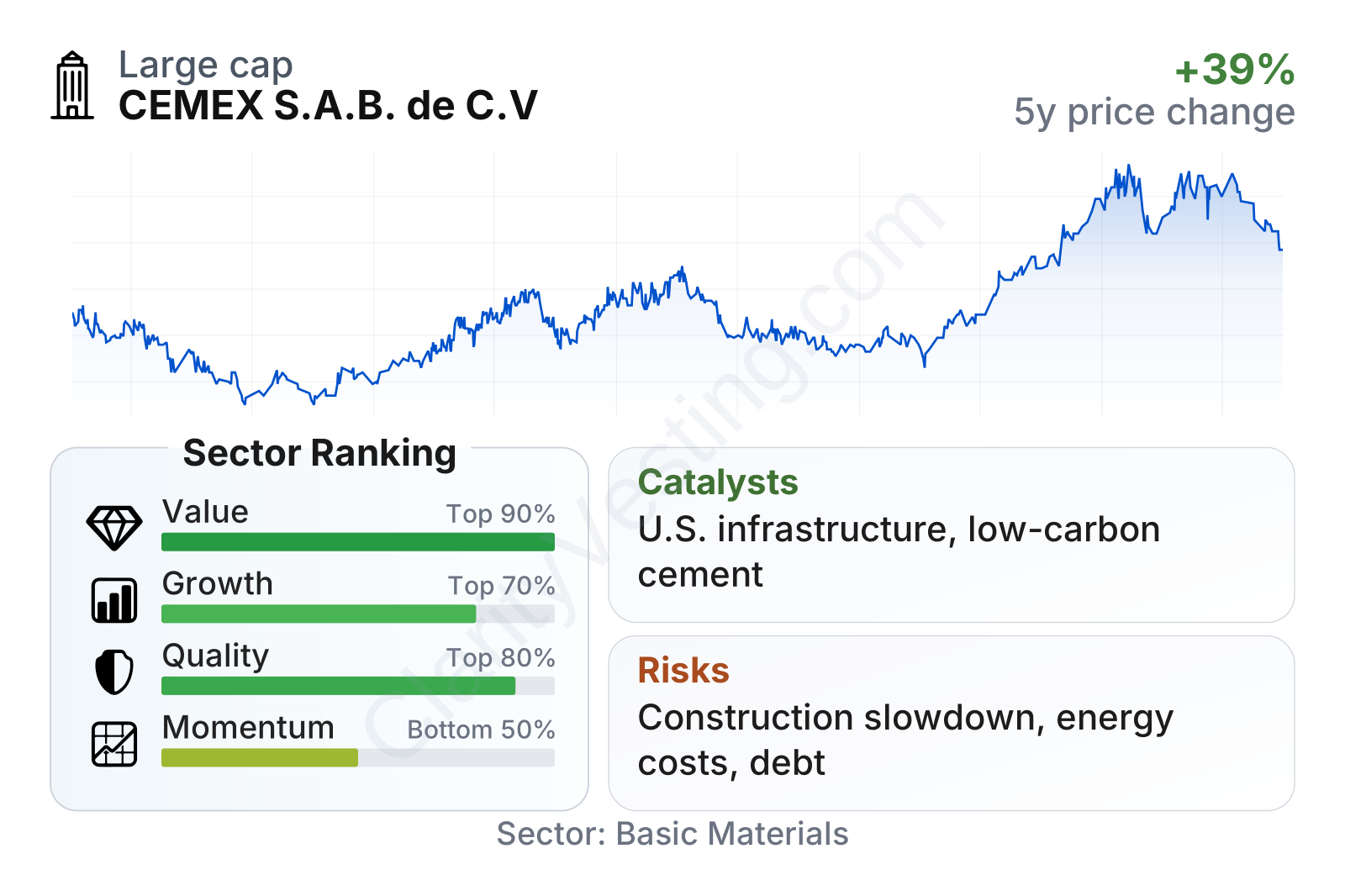
CEMEX is a large-cap building materials company with lower-than-market share-price volatility, but the stock’s recent trading pattern has been uneven. On fundamentals, the picture is more interesting than the recent momentum suggests: value metrics look strong overall, especially free cash flow yield and enterprise-value-based earnings measures, while growth and quality rank above much of the sector. The weaker area is market momentum, which indicates the stock has not been consistently rewarded despite improving operating performance.
Growth
CEMEX operates in a sector that should remain relevant for decades because cement and aggregates are essential to housing, logistics networks, data centers, energy projects, and public infrastructure. This is not a high-tech growth industry, but it can still grow steadily through urban expansion, replacement of aging infrastructure, and large public works programs. In that context, CEMEX’s position is attractive because it combines scale with exposure to several regions rather than relying on one single market.
The company’s strategy appears consistent with the realities of the sector. Instead of chasing volume at any price, management has emphasized margin expansion, disciplined capital allocation, asset optimization, and higher-value products. That approach makes sense in cement, where plants are expensive to build, transportation limits competition locally, and returns often improve more from pricing and utilization than from aggressive expansion.
Revenue growth has been positive overall, though not perfectly smooth from period to period. That is normal for a cyclical materials business affected by weather, project timing, regional demand, and energy costs. The broader trend over the last several years still shows that CEMEX has been able to rebuild sales after weaker periods and maintain a five-year revenue-per-share growth rate that is slightly ahead of the sector median.
Cash generation is one of the stronger parts of the current profile. Trailing free cash flow is high in absolute terms and the free cash flow yield stands well above the sector median. For a capital-intensive company, that is significant because it creates room for debt reduction, selective acquisitions, plant modernization, and shareholder distributions when conditions allow. It also helps explain why some valuation measures look more favorable than the headline earnings multiple.
A meaningful catalyst is the continued demand tied to U.S. infrastructure and industrial construction, including roads, logistics facilities, manufacturing capacity, and energy-related projects. Another potential growth driver is the shift toward lower-carbon cement and circular construction solutions. As governments and large customers place more weight on emissions intensity, established producers with scale, technical capabilities, and local distribution networks can gain an advantage.
Recent company communications have also highlighted portfolio moves and capital spending aimed at strengthening operations in core markets. Those initiatives are important because they can improve plant utilization and regional pricing power even without dramatic changes in global construction activity.
Risks
This article is for informational purposes only and does not constitute financial advice. Some content is AI-generated. See Disclaimer


