Stock Analysis · Cemex SAB de CV (CX)
Overview
Cemex is a global building materials company best known for producing cement, ready-mix concrete, and aggregates such as sand, gravel, and crushed stone. These materials are the basic ingredients used in roads, bridges, homes, industrial facilities, and commercial buildings. The company operates across the Americas, Europe, the Middle East, Africa, and Asia, with especially important positions in Mexico, the United States, and parts of Europe.
Its business is relatively easy to understand: Cemex extracts raw materials, manufactures cement and clinker, mixes concrete close to construction sites, and sells aggregates and related urbanization products. Demand is tied to construction activity, infrastructure spending, industrial production, and housing. Because cement is heavy and expensive to transport over long distances, local plant networks and distribution reach matter a lot.
Based on the company’s recent reporting structure, revenue mainly comes from a few core categories:
- Ready-mix concrete: approximately 35% to 40% of revenue. This includes concrete delivered directly to construction projects and is a major downstream product for residential, commercial, and infrastructure work.
- Cement: approximately 30% to 35% of revenue. This includes bagged and bulk cement sold to builders, distributors, and industrial customers.
- Aggregates: approximately 10% to 15% of revenue. This covers crushed stone, sand, and gravel used in roads, foundations, and concrete production.
- Urbanization solutions and other businesses: approximately 15% to 20% of revenue. This includes paving products, precast materials, asphalt-related solutions in some markets, and other construction services or product lines.
Geographically, Cemex is diversified, but North America is especially important because the United States and Mexico are among its largest earnings contributors. That matters because those markets benefit from long-term infrastructure needs, manufacturing reshoring, and continuing construction demand, even if activity can be uneven from one year to the next.
The company’s revenue has stayed in the large global-scale range over the last several years, while earnings have been more volatile. One visible pattern is that gross profit has held up better than net income, showing that taxes, financing costs, and operating swings still have a meaningful effect on what ultimately reaches the bottom line.
Key Figures
| Metric | Value | Sector ⓘ |
|---|---|---|
| Date | Oct 17, 2026 | |
| Context | ||
| Sector | Basic Materials | |
| Industry | Building Materials | |
| Market Cap ⓘ | $14.07B | |
| Beta ⓘ | 0.81 | |
Value (Cheapness) | ||
| P/E Ratio ⓘ | 81.25 | 16.90 |
| P/B Ratio ⓘ | 0.11 | 1.65 |
| FCF Yield ⓘ | 12.90% | 5.76% |
| Dividend Yield ⓘ | N/A | 2.13% |
| EBIT / EV ⓘ | 7.14% | 6.30% |
| PEG ⓘ | 0.11 | |
Growth (Business expansion) | ||
| Revenue Growth ⓘ | 12.20% | 11.10% |
| RPS Growth (5Y CAGR) ⓘ | 84.46% | 4.49% |
| EPS Growth (5Y CAGR) ⓘ | -11.20% | -13.47% |
| BVPS Growth (5Y CAGR) ⓘ | 92.24% | 5.51% |
| Margin Growth (5Y Trend) ⓘ | -2.91% | -1.54% |
| FCF Growth (5Y CAGR) ⓘ | 4.04% | 0.37% |
| DPS Growth (5Y CAGR) ⓘ | 172.30% | 6.08% |
Quality (Business durability) | ||
| ROIC (Latest) ⓘ | 6.77% | 9.26% |
| ROA (Latest) ⓘ | 1.69% | 4.91% |
| ROIC (5Y Median) ⓘ | 7.65% | 7.70% |
| ROA (5Y Median) ⓘ | 3.11% | 3.86% |
| Net Debt / EBIT (Latest) ⓘ | 4.35 | 1.40 |
| Net Debt / EBIT (5Y Median) ⓘ | 4.54 | 1.70 |
| Net Debt / EBITDA (Latest) ⓘ | 1.75 | 0.95 |
| Net Debt / Assets ⓘ | 22.02% | 13.69% |
| EBITDA / Interest ⓘ | 7.62 | 12.34 |
| Operating Margin (Latest) ⓘ | 8.42% | 13.20% |
| Operating Margin (5Y Median) ⓘ | 9.81% | 11.80% |
| Debt to Equity (Latest) ⓘ | 54.90% | 40.56% |
| Profit Margin (Latest) ⓘ | 2.83% | 6.43% |
| Free Cash Flow (Latest) ⓘ | $1.81B | |
Momentum (Price trend) | ||
| 3Y Return ⓘ | +59.07% | +68.89% |
| 12M Return (excl. last month) ⓘ | +12.39% | +30.21% |
| 6M Return ⓘ | -19.03% | -4.16% |
| Price vs. 200-Day MA ⓘ | -18.54% | -1.27% |
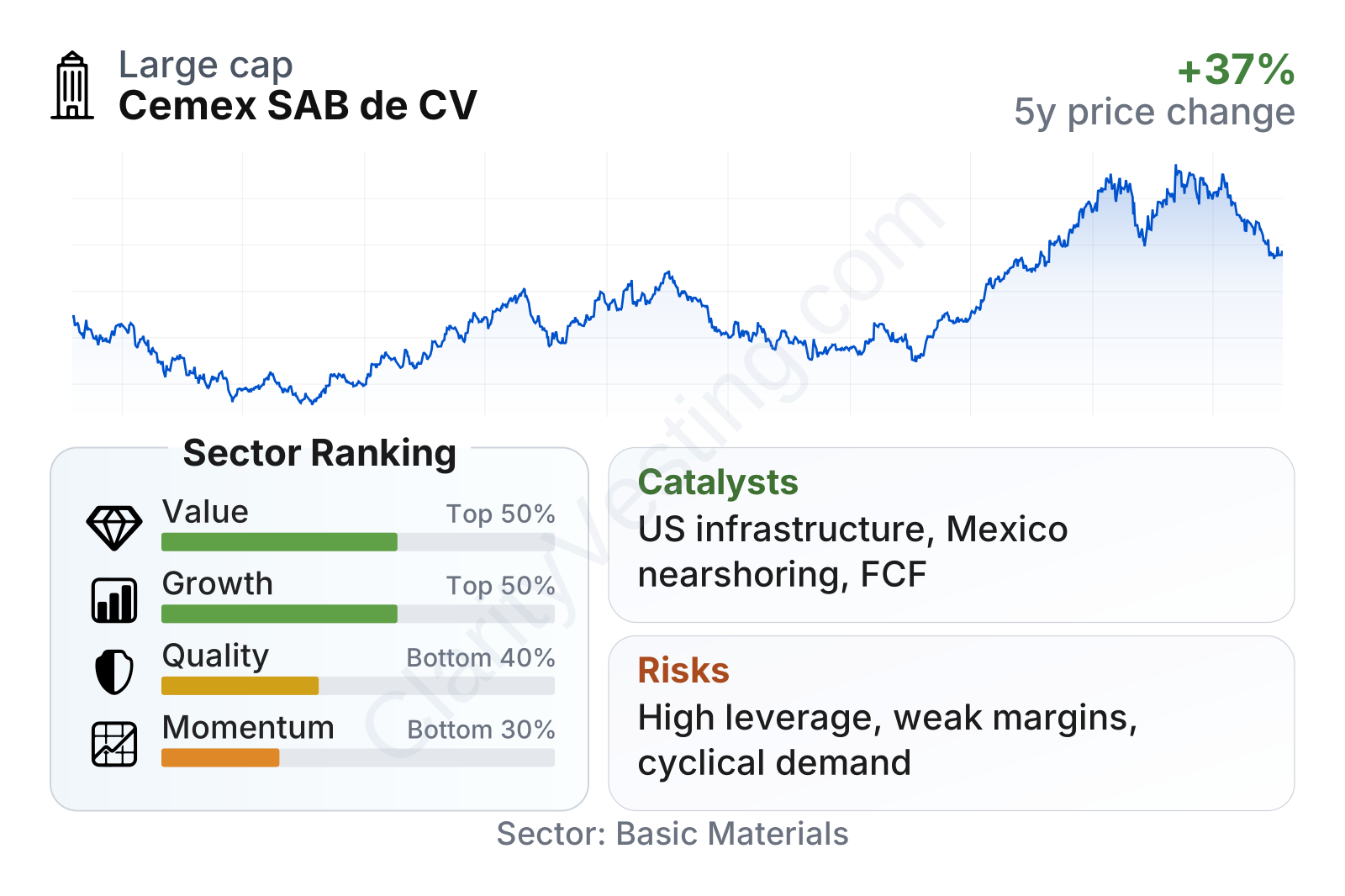
Cemex is a large building materials company with a stock that has recovered strongly from its 2022 lows and has trended higher into 2026. In the factor snapshot, the business looks mixed: value and growth metrics rank in the upper half of the sector, while quality and momentum rank below average. That combination fits a company with improving cash generation and revenue growth, but also with lower profitability and heavier leverage than many peers.
A few details stand out. Free cash flow yield is noticeably stronger than the sector median, which suggests the business is generating meaningful cash relative to its market value. At the same time, the P/E ratio sits above the sector median, showing that earnings-based valuation looks less conservative than cash-flow-based measures. The very low price-to-book ratio should be treated carefully in a capital-intensive global industrial company, especially one with a history of restructurings, foreign currency effects, and large asset balances.
Growth
The long-term sector outlook is supported by basic construction needs rather than fast-changing technology. Cement and concrete are essential materials for infrastructure, logistics facilities, manufacturing plants, urban development, and housing. That makes Cemex part of a sector with durable demand, even if short-term activity depends heavily on economic cycles, interest rates, and public spending.
Cemex’s strategy appears sensible for this kind of industry. Management has focused on pricing discipline, cost efficiency, cleaner and lower-carbon products, and portfolio optimization rather than chasing volume at any cost. In a mature industrial business, that can be more valuable than rapid expansion because margins and cash conversion often matter more than headline sales growth.
Revenue growth has not been smooth, but the recent direction is encouraging. After a period of contraction in 2024 and early 2025, year-over-year growth turned positive again and moved back into a low-double-digit range by 2026. That suggests some combination of pricing resilience, improving demand, and easier comparisons. It also places the company slightly ahead of the sector median on the latest growth reading.
Cash generation is another important part of the growth case. Free cash flow has been volatile, which is common in construction materials because working capital and capital spending can move sharply, but the more recent trend points to improvement. Trailing free cash flow has climbed back above earlier weak periods, giving Cemex more flexibility to reduce debt, invest in plants, fund decarbonization initiatives, and return capital.
There are also structural catalysts behind the business. The United States remains one of the most important opportunities because large infrastructure programs, industrial relocation, data center construction, and logistics investments all require cement and aggregates. Mexico can also benefit from manufacturing expansion and cross-border supply chain shifts. In addition, Cemex has been developing lower-carbon cement and circularity solutions, which could strengthen its position as customers and regulators place more weight on emissions.
Recent company communications have continued to emphasize decarbonization projects, operational efficiency, and shareholder return capacity supported by cash generation. For a mature materials producer, that is significant: growth does not need to come only from new markets, but also from better pricing, a cleaner product mix, and improved returns from existing assets.
Risks
This article is for informational purposes only and does not constitute financial advice. Some content is AI-generated. See Disclaimer


