Stock Analysis · Casella Waste Systems Inc (CWST)
Overview
Casella Waste Systems is a regional waste and recycling company focused mainly on the Northeastern United States. It provides the basic services that cities, businesses, and households need every day: collecting trash, transporting it, processing recyclables, and disposing of waste in landfills. The company has also expanded into resource solutions, which includes services such as recycling brokerage, organics processing, and specialized environmental offerings for commercial customers.
Its business is relatively easy to understand: waste has to be picked up regularly, handled safely, and disposed of in permitted facilities. That creates recurring demand, and the most valuable part of the model is often control of disposal assets such as landfills, transfer stations, and recycling infrastructure. Casella has spent years building a denser regional network through acquisitions and internal expansion, which helps it capture more waste volumes inside its own system.
Based on recent company reporting, Casella’s revenue mix is led by its solid waste operations, with resource solutions as a smaller but still meaningful contributor.
- Solid Waste operations: about 80% to 85% of revenue. This includes collection, transfer, disposal, landfill activity, hauling, and recycling services tied to the company’s core route network and facilities.
- Resource Solutions: about 15% to 20% of revenue. This segment includes recycling brokerage, commodity-related services, organics, and other environmental service offerings that are less tied to household collection routes.
Over the past several years, revenue has climbed sharply, but the flow from sales down to net income has become tighter. Rising operating costs, higher interest expense, and acquisition integration have limited the bottom-line conversion even as the top line expanded.
The business has clearly become much larger, with revenue more than doubling since 2021. At the same time, interest costs and operating expenses have also risen, which helps explain why strong sales growth has not translated into equally strong earnings growth.
Key Figures
| Metric | Value | Sector ⓘ |
|---|---|---|
| Date | Oct 03, 2026 | |
| Context | ||
| Sector | Industrials | |
| Industry | Waste Management | |
| Market Cap ⓘ | $5.10B | |
| Beta ⓘ | 0.74 | |
Value (Cheapness) | ||
| P/E Ratio ⓘ | N/A | 22.45 |
| P/B Ratio ⓘ | 3.24 | 1.98 |
| FCF Yield ⓘ | 2.07% | 6.31% |
| Dividend Yield ⓘ | N/A | 1.96% |
| EBIT / EV ⓘ | 1.07% | 4.81% |
| PEG ⓘ | 3.29 | |
Growth (Business expansion) | ||
| Revenue Growth ⓘ | 16.90% | 9.10% |
| RPS Growth (5Y CAGR) ⓘ | 13.75% | 7.75% |
| EPS Growth (5Y CAGR) ⓘ | -14.93% | -13.59% |
| BVPS Growth (5Y CAGR) ⓘ | 31.71% | 6.22% |
| Margin Growth (5Y Trend) ⓘ | -5.53% | 0.72% |
| FCF Growth (5Y CAGR) ⓘ | 9.26% | 10.98% |
| DPS Growth (5Y CAGR) ⓘ | N/A | 9.48% |
Quality (Business durability) | ||
| ROIC (Latest) ⓘ | 2.15% | 10.92% |
| ROA (Latest) ⓘ | 0.17% | 5.41% |
| ROIC (5Y Median) ⓘ | 3.40% | 9.21% |
| ROA (5Y Median) ⓘ | 1.27% | 4.94% |
| Net Debt / EBIT (Latest) ⓘ | 19.38 | 2.07 |
| Net Debt / EBIT (5Y Median) ⓘ | 10.99 | 2.28 |
| Net Debt / EBITDA (Latest) ⓘ | 3.43 | 1.43 |
| Net Debt / Assets ⓘ | 39.90% | 19.27% |
| EBITDA / Interest ⓘ | 6.42 | 9.53 |
| Operating Margin (Latest) ⓘ | 3.75% | 10.50% |
| Operating Margin (5Y Median) ⓘ | 6.19% | 10.27% |
| Debt to Equity (Latest) ⓘ | 91.45% | 65.48% |
| Profit Margin (Latest) ⓘ | 0.29% | 6.62% |
| Free Cash Flow (Latest) ⓘ | $105.67M | |
Momentum (Price trend) | ||
| 3Y Return ⓘ | +5.31% | +58.56% |
| 12M Return (excl. last month) ⓘ | -6.40% | +15.63% |
| 6M Return ⓘ | +1.27% | +4.19% |
| Price vs. 200-Day MA ⓘ | -12.14% | +0.93% |
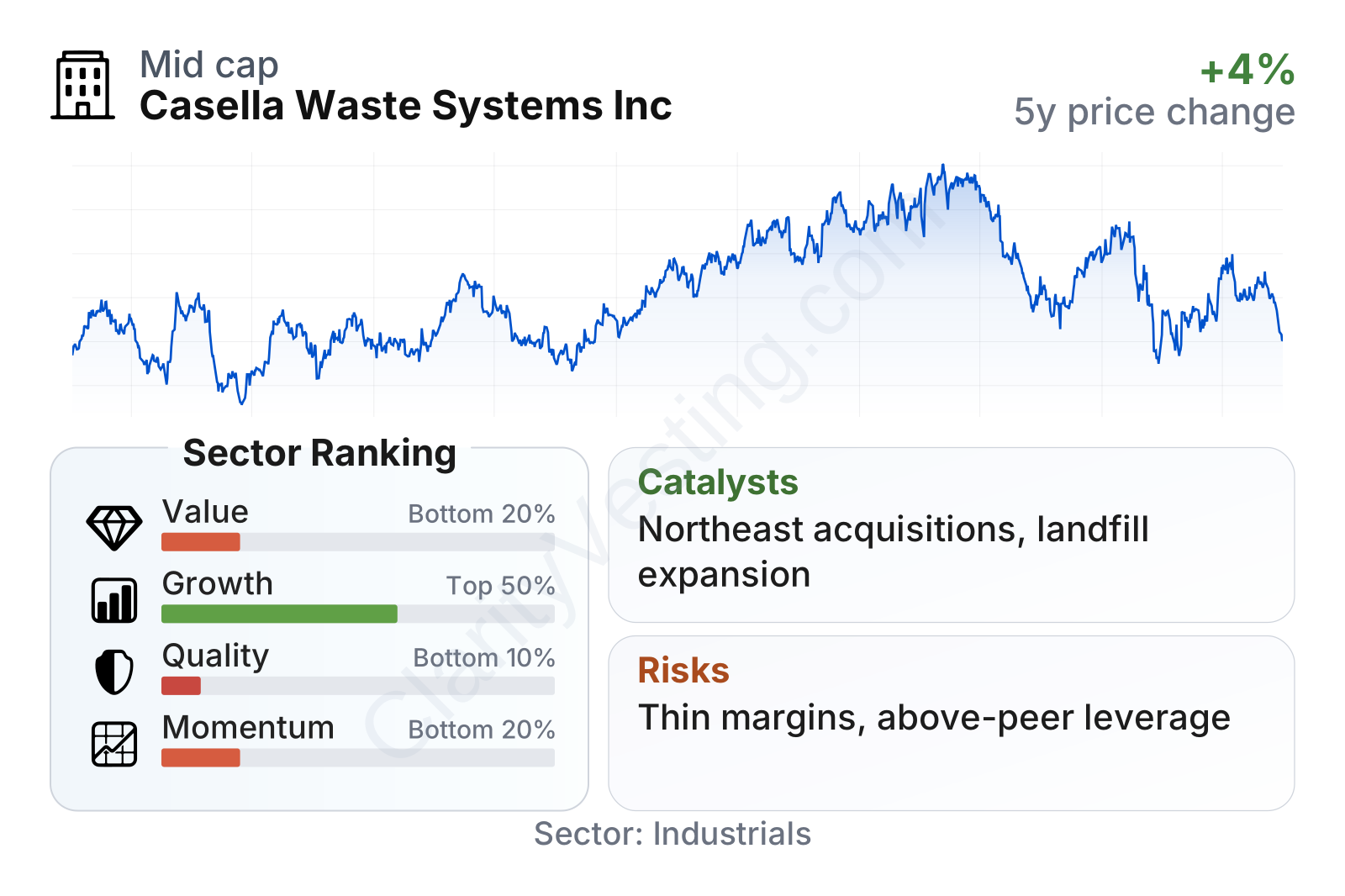
Casella is now a mid-sized public company with a market value above $5 billion and a relatively low beta, meaning its share price has historically moved less than the broader market. The table points to a mixed profile: growth is better than many industrial peers, but value, profitability, and balance-sheet quality rank weakly. In simple terms, the market has been willing to pay up for expansion, while current earnings efficiency has lagged behind that growth narrative.
The stock chart shows a business that has generally trended upward over several years, but with meaningful swings. More recently, price momentum has been softer than the broader industrial sector, which fits with the pressure seen in margins and earnings.
Growth
Waste management is generally considered a durable long-term sector. Waste volumes tend to follow population, economic activity, and construction trends, while environmental rules make disposal infrastructure harder to replicate. That combination can support steady pricing over time, especially for companies that own strategic assets in regions with limited landfill capacity.
Casella’s strategy fits that industry structure well. The company continues to grow through three main levers: acquiring smaller local operators, increasing prices across collection and disposal services, and expanding the amount of waste processed within its own network. This “internalization” matters because every ton handled through company-owned transfer stations, recycling sites, and landfills can improve economics versus sending that volume to third parties.
Revenue growth has consistently been healthy and has often exceeded the broader sector median. Even though growth has cooled from some of the strongest post-acquisition periods, the recent pace still points to a company expanding faster than many industrial peers.
Free cash flow has also improved over time, which is important because this is a capital-intensive business. Better cash generation gives Casella more room to fund tuck-in acquisitions, invest in landfills and recycling infrastructure, and gradually support balance-sheet flexibility. The recent trend is positive, even if cash flow yield remains modest compared with many other companies in the sector.
A notable catalyst for future expansion is the company’s acquisition-driven regional consolidation strategy. In fragmented local waste markets, smaller operators may lack scale, disposal access, or capital for environmental compliance. Casella can often bring those businesses into its network, improve routing density, and route more waste to owned facilities. Additional support for growth comes from municipal outsourcing, recycling and organics services, and pricing power in constrained disposal markets.
Recent company updates have also highlighted continued acquisition activity and infrastructure investment, including landfill development and facility upgrades. For a long-term business model, those projects matter because permitted disposal capacity can become more valuable over time as regulation tightens and siting new assets remains difficult.
Risks
This article is for informational purposes only and does not constitute financial advice. Some content is AI-generated. See Disclaimer