Stock Analysis · China Water Affairs Group Limited (CWAFF)
Overview
China Water Affairs Group Limited is a water utility and water infrastructure operator focused mainly on mainland China. Its core business is supplying tap water to cities and counties, operating water plants and pipeline networks, and expanding or upgrading those systems. In simple terms, the company earns most of its money from treating water, transporting it, and charging customers and local authorities for access and usage. It also has related businesses in sewage treatment, drainage, property development tied to its projects, and equipment or environmental services.
Based on the company’s recent annual disclosures, revenue is centered on a few main activities.
- Urban water supply operations: approximately 70% to 80% of revenue. This includes residential, commercial, and industrial water sales as well as connection and service income linked to water networks.
- Environmental protection and sewage treatment: approximately 10% to 20%. This covers wastewater treatment and related environmental utility services.
- Property and other businesses: approximately 5% to 10%. This usually includes construction-related property activities, equipment, and other ancillary operations.
The business model has a useful defensive feature: water demand is usually steadier than demand in many cyclical industries. At the same time, this is not a pure regulated monopoly in the same way as some Western water utilities. China Water Affairs grows by winning concessions, expanding service areas, investing in treatment and pipeline assets, and improving usage per connection.
One important recent business trend is that revenue has been moving lower for several years, while profitability has also narrowed. Even so, the company still generates meaningful operating profit and remains solidly cash generative, which matters because utilities are capital-intensive and debt-funded.
The operating picture shows a business that still keeps healthy gross and operating margins, but with pressure from shrinking revenue, higher financing costs over the last few years, and lower net income than its earlier peak. That combination makes China Water Affairs look more like a mature utility working through a slower phase than a fast-expanding infrastructure operator.
Key Figures
| Metric | Value | Sector ⓘ |
|---|---|---|
| Date | Oct 17, 2026 | |
| Context | ||
| Sector | Utilities | |
| Industry | Utilities - Regulated Water | |
| Market Cap ⓘ | $1.01B | |
| Beta ⓘ | 0.52 | |
Value (Cheapness) | ||
| P/E Ratio ⓘ | 7.75 | 17.28 |
| P/B Ratio ⓘ | 0.21 | 1.51 |
| FCF Yield ⓘ | 396.81% | 0.65% |
| Dividend Yield ⓘ | 41.94% | 3.77% |
| EBIT / EV ⓘ | N/A | 5.01% |
| PEG ⓘ | N/A | |
Growth (Business expansion) | ||
| Revenue Growth ⓘ | -9.70% | 6.10% |
| RPS Growth (5Y CAGR) ⓘ | -5.41% | 3.87% |
| EPS Growth (5Y CAGR) ⓘ | -9.69% | -11.30% |
| BVPS Growth (5Y CAGR) ⓘ | -21.96% | 4.23% |
| Margin Growth (5Y Trend) ⓘ | -5.59% | 3.57% |
| FCF Growth (5Y CAGR) ⓘ | N/A | -8.84% |
| DPS Growth (5Y CAGR) ⓘ | -3.26% | 4.84% |
Quality (Business durability) | ||
| ROIC (Latest) ⓘ | 9.86% | 6.53% |
| ROA (Latest) ⓘ | 2.46% | 3.20% |
| ROIC (5Y Median) ⓘ | 8.12% | 5.95% |
| ROA (5Y Median) ⓘ | 2.47% | 2.75% |
| Net Debt / EBIT (Latest) ⓘ | 4.29 | 7.13 |
| Net Debt / EBIT (5Y Median) ⓘ | 4.87 | 7.23 |
| Net Debt / EBITDA (Latest) ⓘ | 2.96 | 4.31 |
| Net Debt / Assets ⓘ | 31.24% | 38.42% |
| EBITDA / Interest ⓘ | 6.19 | 4.58 |
| Operating Margin (Latest) ⓘ | 27.05% | 20.83% |
| Operating Margin (5Y Median) ⓘ | 30.86% | 20.08% |
| Debt to Equity (Latest) ⓘ | 176.75% | 137.69% |
| Profit Margin (Latest) ⓘ | 9.54% | 11.37% |
| Free Cash Flow (Latest) ⓘ | $4.02B | |
Momentum (Price trend) | ||
| 3Y Return ⓘ | +6.58% | +52.37% |
| 12M Return (excl. last month) ⓘ | -14.00% | +8.84% |
| 6M Return ⓘ | -6.30% | -3.95% |
| Price vs. 200-Day MA ⓘ | -1.23% | -0.79% |
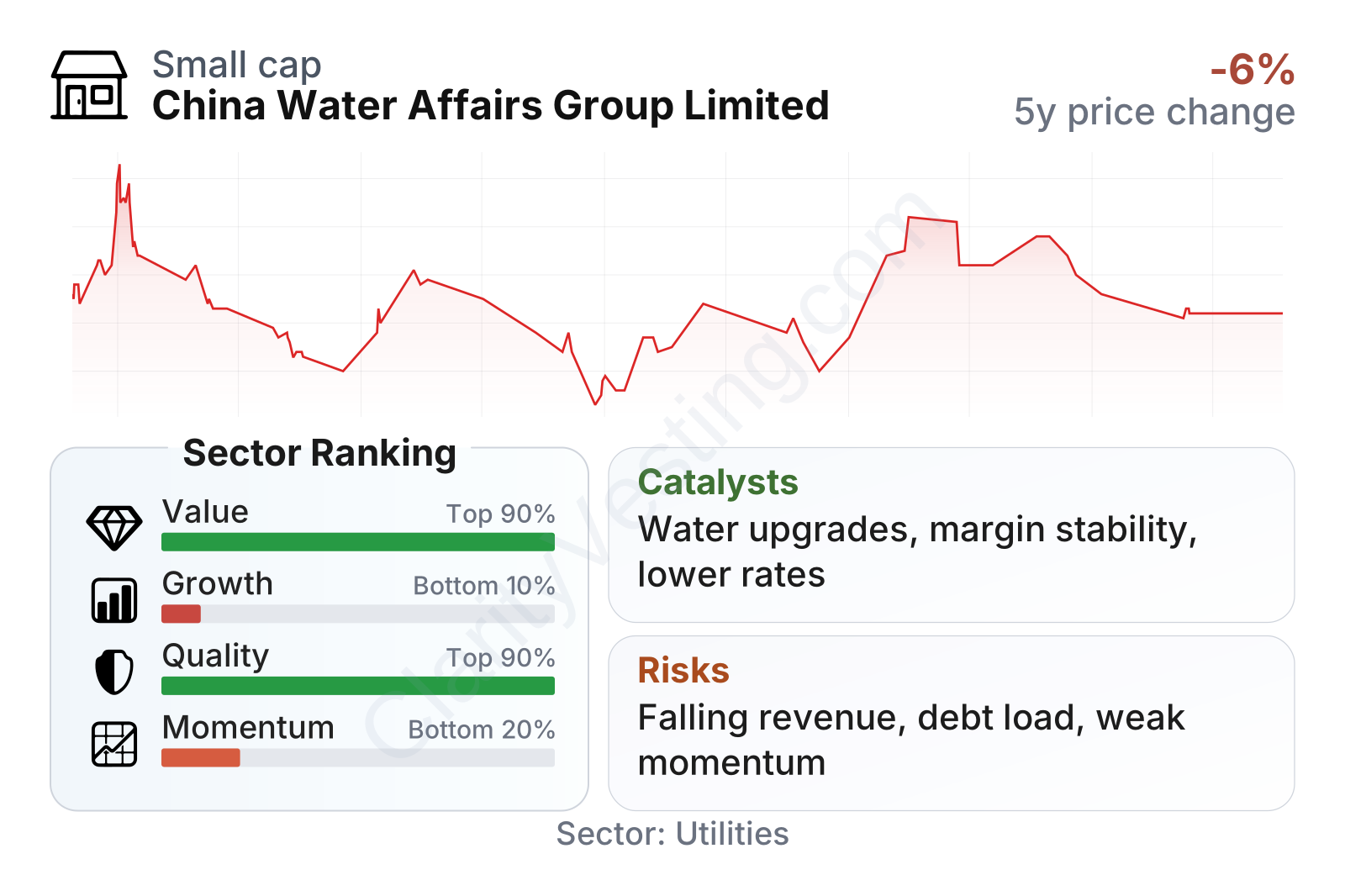
On broad metrics, the company stands out for low valuation multiples, above-sector operating profitability, and better-than-sector debt servicing capacity. Its earnings multiple is well below the utility sector median, and its price-to-book ratio is especially low, suggesting the market is applying a large discount to the balance sheet and future growth outlook. Free cash flow yield is also notably strong, while the trailing dividend yield is unusually high.
The weak area is growth. Revenue declined about 10% year over year, five-year revenue per share has trended down by roughly 5% annually, and operating margins have softened from earlier levels even though they remain above sector norms. Share price performance has also lagged most peers over one year and three years, which matches the market’s caution toward the company.
In size, China Water Affairs is a smaller listed utility by global standards, with a low-beta stock profile. That lower beta suggests the share price has historically moved less aggressively than the broader market, although that does not remove company-specific risk.
Growth
The long-term sector backdrop is still constructive. Water treatment, distribution, leakage reduction, wastewater treatment, and municipal environmental services remain essential needs in China. Aging networks, urbanization quality upgrades, industrial water standards, and stricter environmental requirements all support continued infrastructure spending over time. Those themes are favorable for established operators with local relationships and operating know-how.
China Water Affairs’ strategy also makes industrial sense. The company has historically built scale through water supply concessions, network expansion, and integrated utility services. It has also pushed into direct drinking water and smart water management, areas that can potentially improve revenue quality and customer stickiness rather than relying only on volume growth.
The challenge is that the recent numbers do not yet show a clear growth revival. Revenue per share peaked earlier in the period and has declined for three consecutive fiscal years. That suggests either slower project additions, weaker construction-related activity, pressure in ancillary businesses, or a broader shift from expansion toward consolidation and efficiency. For a long-term business case to strengthen, stabilization in top-line performance would matter more than simply maintaining margins.
A realistic catalyst would be a shift in focus from expansion to optimization: improving collection, reducing water losses, lifting utilization of existing assets, and lowering finance costs. Because utilities use heavy upfront investment, even moderate improvements in efficiency and funding costs can have a visible effect on earnings. Another possible tailwind is policy support for public utility resilience and environmental protection, which can create room for network upgrades and wastewater investment.
Recent company updates have also highlighted continued dividend distribution and ongoing utility operations rather than a dramatic strategic reset. That points to continuity and resilience, but not to an obvious near-term breakthrough. The most meaningful upside driver appears to be operational normalization rather than a single transformative event.
Risks
This article is for informational purposes only and does not constitute financial advice. Some content is AI-generated. See Disclaimer


