Stock Analysis · Curtiss-Wright Corporation (CW)
Overview
Curtiss-Wright Corporation is an industrial company focused on highly engineered products and services for aerospace, defense, naval, power generation, and selected industrial markets. In simple terms, it sells critical components, electronics, sensors, valves, actuators, and specialized systems that are often used in demanding environments where reliability matters more than low price. A large part of its business is tied to U.S. defense programs, military aircraft, naval platforms, and nuclear-related applications, which tends to create long product cycles and recurring aftermarket demand.
The company reports results through three main segments. Based on its recent annual reporting, revenue is spread across these activities in a fairly balanced way, with defense and aerospace exposure running through all of them.
- Naval & Power: approximately 35% to 40% of revenue. This includes products and services for naval defense platforms, nuclear power systems, valves, pumps, and other mission-critical equipment.
- Aerospace & Industrial: approximately 30% to 35% of revenue. This segment serves commercial aerospace, defense aerospace, and general industrial customers with sensors, controls, surface technologies, and related components.
- Defense Electronics: approximately 25% to 30% of revenue. This business provides embedded computing, rugged electronics, flight test instrumentation, and other electronic systems used in defense and aerospace platforms.
At a customer level, defense is the dominant end market. Public filings indicate that defense-related work represents a majority of sales, while commercial aerospace, power, and broader industrial uses make up the rest. That mix gives Curtiss-Wright a profile that is less cyclical than a typical industrial supplier, although it also increases dependence on government budgets and large long-cycle programs.
The business has also become more profitable over time. Revenue has risen steadily in recent years, but the more striking change is margin expansion: a larger share of each sales dollar is now turning into operating profit and net income than it did a few years ago.
The long-term pattern points to disciplined execution. Sales have moved up from roughly $2.5 billion in 2021 to about $3.5 billion in 2025, while net income has increased even faster, suggesting that pricing, product mix, and operating efficiency have all improved.
Key Figures
| Metric | Value | Sector ⓘ |
|---|---|---|
| Date | Oct 24, 2026 | |
| Context | ||
| Sector | Industrials | |
| Industry | Aerospace & Defense | |
| Market Cap ⓘ | $18.29B | |
| Beta ⓘ | 0.88 | |
Value (Cheapness) | ||
| P/E Ratio ⓘ | 34.23 | 22.29 |
| P/B Ratio ⓘ | 6.62 | 1.98 |
| FCF Yield ⓘ | 3.42% | 6.26% |
| Dividend Yield ⓘ | 0.20% | 1.92% |
| EBIT / EV ⓘ | 3.52% | 4.83% |
| PEG ⓘ | 2.00 | |
Growth (Business expansion) | ||
| Revenue Growth ⓘ | 5.40% | 9.30% |
| RPS Growth (5Y CAGR) ⓘ | 10.84% | 7.76% |
| EPS Growth (5Y CAGR) ⓘ | -3.19% | -13.17% |
| BVPS Growth (5Y CAGR) ⓘ | 10.61% | 6.13% |
| Margin Growth (5Y Trend) ⓘ | 3.39% | 0.74% |
| FCF Growth (5Y CAGR) ⓘ | 12.43% | 10.79% |
| DPS Growth (5Y CAGR) ⓘ | 6.93% | 9.41% |
Quality (Business durability) | ||
| ROIC (Latest) ⓘ | 16.06% | 10.75% |
| ROA (Latest) ⓘ | 10.25% | 5.41% |
| ROIC (5Y Median) ⓘ | 11.91% | 9.37% |
| ROA (5Y Median) ⓘ | 7.82% | 4.95% |
| Net Debt / EBIT (Latest) ⓘ | 0.92 | 2.04 |
| Net Debt / EBIT (5Y Median) ⓘ | 1.53 | 2.27 |
| Net Debt / EBITDA (Latest) ⓘ | 0.79 | 1.39 |
| Net Debt / Assets ⓘ | 12.31% | 19.27% |
| EBITDA / Interest ⓘ | 20.12 | 9.58 |
| Operating Margin (Latest) ⓘ | 20.05% | 10.49% |
| Operating Margin (5Y Median) ⓘ | 18.08% | 10.30% |
| Debt to Equity (Latest) ⓘ | 41.48% | 64.82% |
| Profit Margin (Latest) ⓘ | 14.81% | 6.67% |
| Free Cash Flow (Latest) ⓘ | $625.29M | |
Momentum (Price trend) | ||
| 3Y Return ⓘ | +146.96% | +67.77% |
| 12M Return (excl. last month) ⓘ | +10.53% | +12.05% |
| 6M Return ⓘ | -31.26% | 0.00% |
| Price vs. 200-Day MA ⓘ | -26.57% | +0.67% |
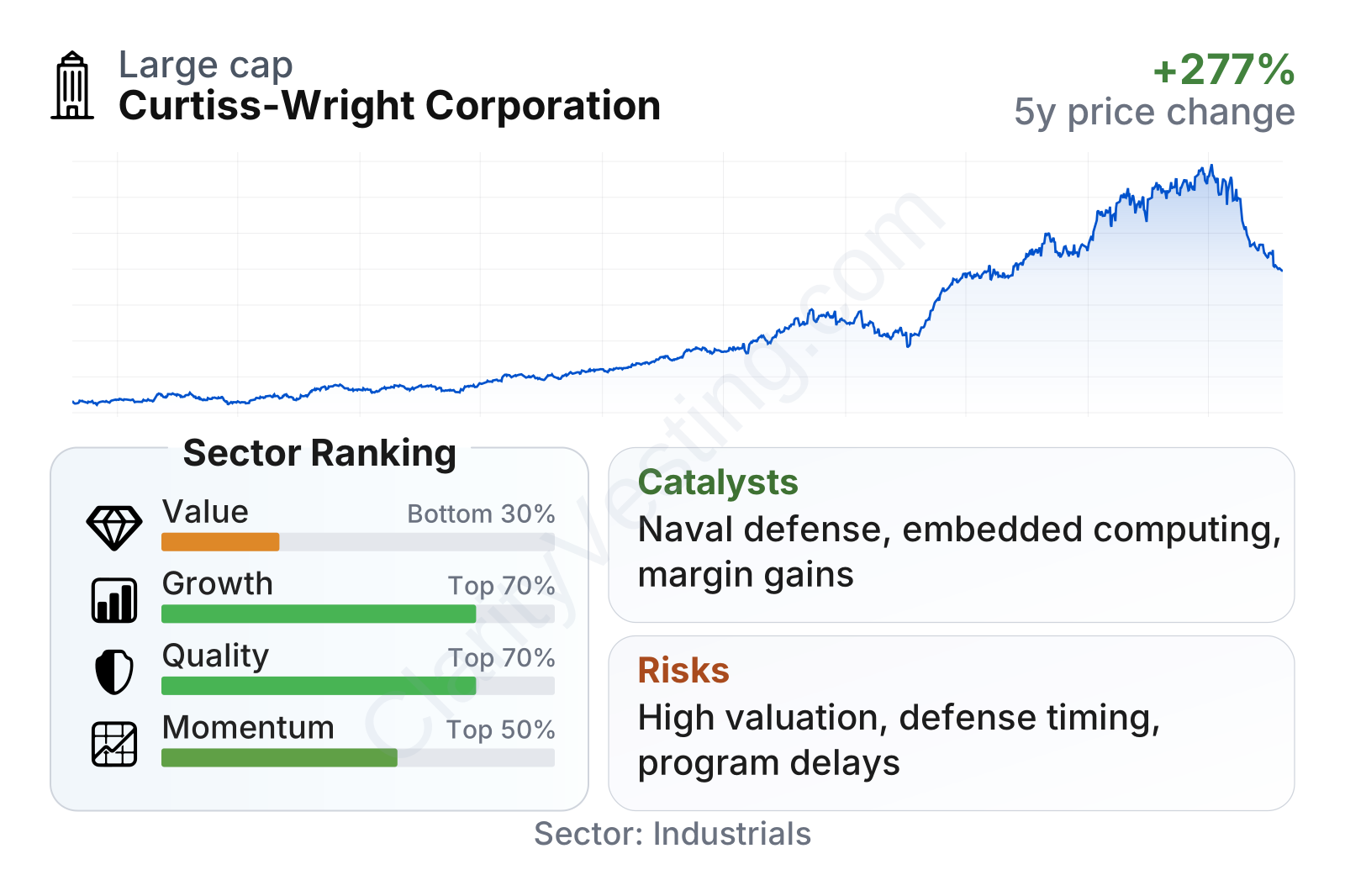
Curtiss-Wright is now a large industrial and defense supplier with a market value around $20 billion. The table shows a business that scores well on quality and reasonably well on growth, while looking much less attractive on pure valuation metrics. Profitability stands out: returns on assets are well above the sector median, margins are stronger than many peers, and leverage remains moderate. Momentum is mixed, with very strong multi-year share performance but a weaker shorter-term trend after a major run-up.
Growth
Curtiss-Wright operates in markets that still have favorable structural support. Defense spending remains elevated across the U.S. and allied countries, especially in naval systems, electronics, modernization, and mission-critical hardware. Nuclear power and naval nuclear applications also provide a durable niche, while commercial aerospace continues to recover through higher aircraft production and aftermarket activity. These are not speculative markets; they are end markets where product qualification can take years and replacement demand often lasts decades.
The company’s strategy is sensible for long-term expansion because it focuses on specialized products with high performance requirements rather than commodity manufacturing. That matters because specialized parts can support better margins, longer customer relationships, and lower competitive pressure. Management has also used acquisitions over time to deepen positions in technical niches, while still showing organic growth and improving profitability.
Recent revenue growth has remained positive, although not at the pace of the broader sector median in the latest period. Even so, the longer pattern is constructive: several quarters showed double-digit year-over-year gains before growth moderated to the mid-single-digit range more recently. That suggests the business is still expanding, but from a stronger base and after a period of especially fast execution.
Cash generation adds another positive layer. Free cash flow has climbed steadily over the past several years and is now near $600 million on a trailing basis. For a long-term business assessment, that is important because cash supports acquisitions, debt reduction, share repurchases, and dividend growth without depending on external financing.
A meaningful catalyst is the company’s exposure to naval defense, embedded computing, and other electronics tied to modernization programs. These areas benefit from sustained platform upgrades and rising demand for more computing power, sensing, and secure systems on military assets. Another catalyst is the company’s improving margin profile, which means earnings can outpace revenue if management continues shifting toward higher-value products and disciplined cost control.
Recent company updates have also pointed to healthy order activity and continuing strength in defense demand. That does not guarantee uninterrupted growth, but it supports the view that Curtiss-Wright is participating in markets with visible multi-year program support rather than short-lived demand spikes.
Risks
This article is for informational purposes only and does not constitute financial advice. Some content is AI-generated. See Disclaimer