Stock Analysis · Chevron Corp (CVX)
Overview
Chevron is one of the world’s largest integrated energy companies. In simple terms, it operates across most of the oil and gas value chain: it explores for crude oil and natural gas, produces them, transports them, refines crude into fuels, sells gasoline and other petroleum products, and also makes chemicals through joint ventures. This integrated structure matters because different parts of the business can perform differently depending on commodity prices, refining margins, and demand conditions.
The company reports results mainly through two large operating segments: Upstream and Downstream. Upstream includes oil and natural gas exploration and production. Downstream includes refining, marketing, lubricants, and fuels. Chevron also has a smaller but strategically important portfolio in lower-carbon activities such as renewable fuels, hydrogen, carbon capture, and lithium, though these are still modest compared with the core hydrocarbon business.
Based on Chevron’s recent annual reporting structure, the main sources of revenue can be summarized as follows:
- Refined products sales and marketing: approximately 70% to 80%. This includes gasoline, diesel, jet fuel, lubricants, and other refined products sold through wholesale and retail channels.
- Crude oil and natural gas production: approximately 20% to 30%. This includes sales from producing fields in the United States and internationally, especially in the Permian Basin, Gulf of Mexico, Kazakhstan, and other major assets.
- Other businesses: less than 10%. This includes chemicals-related earnings, power, shipping, and emerging energy activities. In Chevron’s reporting, some of these contributions appear more clearly in earnings than in top-line revenue.
One important point for readers without a financial background: for integrated oil companies, the largest revenue source is not always the largest profit source. Refining and fuel sales generate very large revenue because volumes are huge, but upstream production often drives profitability more strongly when oil and gas prices are high.
Chevron’s recent financial flow also shows a familiar pattern for large energy companies: revenue has come down from the extraordinary 2022 peak, but the business has remained solidly profitable, with gross profit holding up better than total sales. That suggests Chevron’s scale and portfolio quality still provide resilience even after the energy price spike cooled.
Key Figures
| Metric | Value | Sector ⓘ |
|---|---|---|
| Date | Oct 24, 2026 | |
| Context | ||
| Sector | Energy | |
| Industry | Oil & Gas Integrated | |
| Market Cap ⓘ | $442.75B | |
| Beta ⓘ | 0.52 | |
Value (Cheapness) | ||
| P/E Ratio ⓘ | 21.72 | 15.40 |
| P/B Ratio ⓘ | 2.43 | 1.71 |
| FCF Yield ⓘ | 6.10% | 8.24% |
| Dividend Yield ⓘ | 3.11% | 3.52% |
| EBIT / EV ⓘ | 7.43% | 7.45% |
| PEG ⓘ | 0.90 | |
Growth (Business expansion) | ||
| Revenue Growth ⓘ | 53.50% | 26.85% |
| RPS Growth (5Y CAGR) ⓘ | 5.23% | 6.78% |
| EPS Growth (5Y CAGR) ⓘ | -21.86% | -14.41% |
| BVPS Growth (5Y CAGR) ⓘ | 7.68% | 6.08% |
| Margin Growth (5Y Trend) ⓘ | -3.00% | 0.55% |
| FCF Growth (5Y CAGR) ⓘ | -5.83% | 2.75% |
| DPS Growth (5Y CAGR) ⓘ | 6.64% | 16.79% |
Quality (Business durability) | ||
| ROIC (Latest) ⓘ | 9.59% | 11.30% |
| ROA (Latest) ⓘ | 6.27% | 6.00% |
| ROIC (5Y Median) ⓘ | 10.30% | 10.35% |
| ROA (5Y Median) ⓘ | 6.81% | 5.46% |
| Net Debt / EBIT (Latest) ⓘ | 0.89 | 1.64 |
| Net Debt / EBIT (5Y Median) ⓘ | 0.63 | 1.82 |
| Net Debt / EBITDA (Latest) ⓘ | 0.51 | 1.08 |
| Net Debt / Assets ⓘ | 8.65% | 17.29% |
| EBITDA / Interest ⓘ | 38.95 | 9.53 |
| Operating Margin (Latest) ⓘ | 15.37% | 16.21% |
| Operating Margin (5Y Median) ⓘ | 14.53% | 20.55% |
| Debt to Equity (Latest) ⓘ | 19.53% | 52.27% |
| Profit Margin (Latest) ⓘ | 9.83% | 8.79% |
| Free Cash Flow (Latest) ⓘ | $27.01B | |
Momentum (Price trend) | ||
| 3Y Return ⓘ | +54.11% | +68.93% |
| 12M Return (excl. last month) ⓘ | +35.52% | +42.90% |
| 6M Return ⓘ | +24.13% | +9.18% |
| Price vs. 200-Day MA ⓘ | +20.21% | +9.87% |
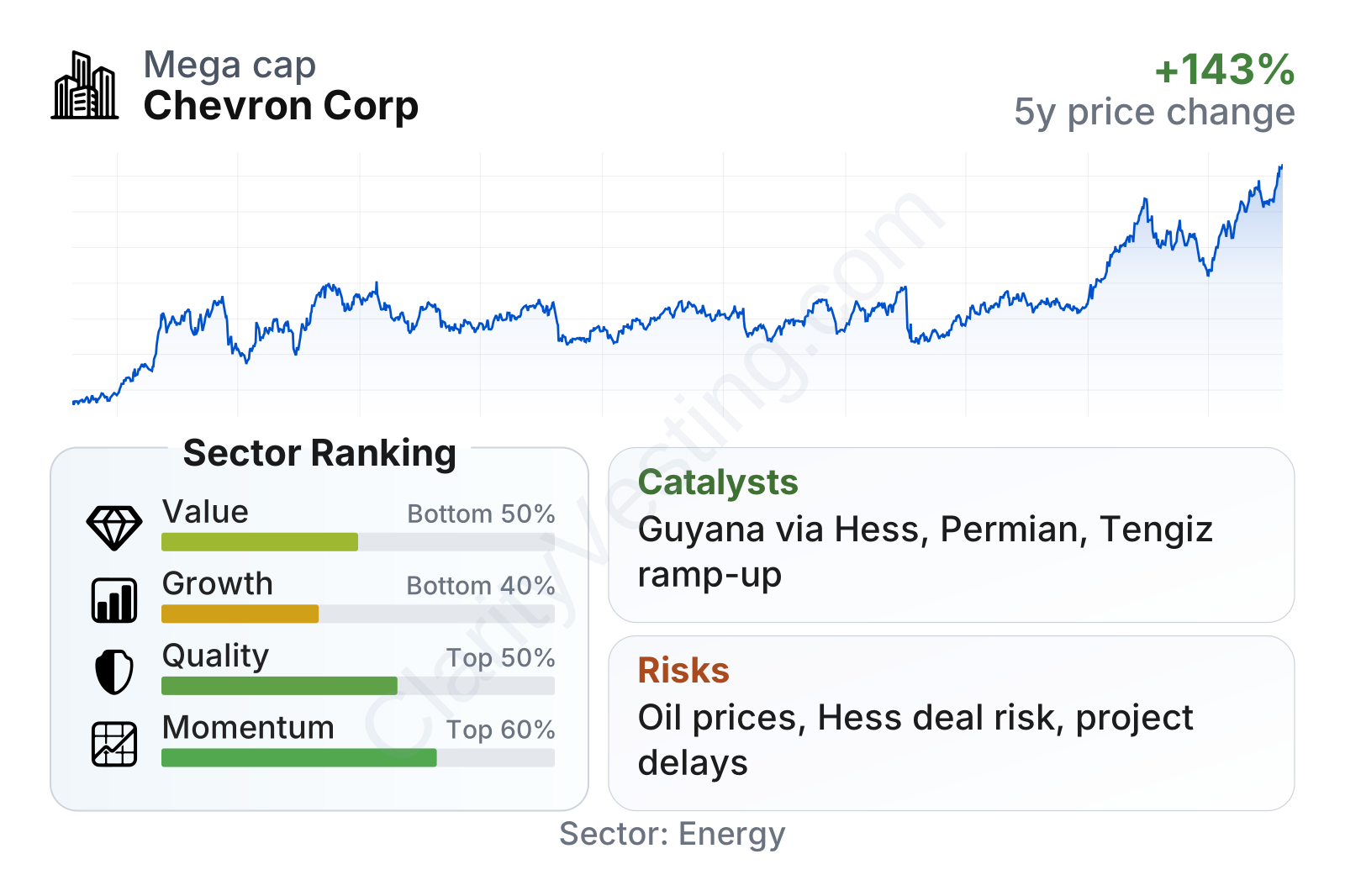
Chevron is a very large energy company with a market value around the $400 billion range, which places it among the global heavyweights in the sector. Its share price has been much less volatile than many energy peers, reflected in a beta near 0.5. On quality, the picture is strong: profitability remains healthy, debt is low, and interest coverage is exceptionally comfortable. Growth metrics are more mixed because Chevron is coming off a difficult comparison with the unusually strong earnings and cash generation seen during the 2022 energy upswing. On valuation, the stock screens around the middle to lower end of the sector on attractiveness, meaning the market is not assigning a clear bargain multiple despite the balance-sheet strength.
Growth
Chevron operates in a sector that is mature rather than structurally high-growth. Global demand for oil and gas is still substantial, especially for transportation, petrochemicals, industrial use, and liquefied natural gas, but long-term growth is not expected to resemble that of software or healthcare innovation. For Chevron, future expansion depends less on broad sector growth and more on project quality, production efficiency, and disciplined capital allocation.
The clearest growth engine is the company’s upstream portfolio, especially low-cost barrels. Chevron has emphasized the Permian Basin in the United States, one of the world’s most attractive shale regions, and major long-life projects such as Tengiz in Kazakhstan. These assets matter because they can generate returns across a wide range of commodity prices. Chevron has also worked to keep capital spending disciplined, which is important in an industry with a long history of overspending during good times.
Another major strategic catalyst is the pending integration of Hess, assuming completion and full operational execution. That transaction would deepen Chevron’s position in Guyana, one of the most important new oil provinces globally, while also adding Bakken production and other assets. Guyana is especially attractive because it combines low development costs, large discovered resources, and multi-decade production potential.
Chevron is also investing in newer areas such as renewable fuels, carbon capture, hydrogen, and lithium. These activities are still small compared with its core business, so they do not yet drive the investment case, but they may help the company stay relevant as the energy system evolves. In practice, the near- to medium-term growth outlook still depends much more on traditional oil and gas projects than on low-carbon ventures.
Recent revenue growth has been uneven, which is normal for a commodity-linked business. After the post-pandemic surge and the exceptional energy-price environment in 2022, Chevron went through a period of contraction as prices normalized. More recently, growth has turned positive again, helped by a friendlier comparison base and improving operating conditions. That rebound is encouraging, but it should still be viewed as cyclical rather than purely structural.
Free cash flow remains a central strength even though it has come down sharply from prior highs. The current level is still sizable in absolute dollars, which gives Chevron room to fund projects, support shareholder distributions, and preserve financial flexibility. For a long-term view, that cash-generating ability is more important than any single quarter’s production number.
Recent company updates have also pointed to major project progress, especially around Tengiz Future Growth Project and production optimization across core upstream assets. For Chevron, these developments are meaningful because a handful of large projects can materially influence production volumes and unit costs for years.
Risks
This article is for informational purposes only and does not constitute financial advice. Some content is AI-generated. See Disclaimer


