Stock Analysis · CVS Health Corp (CVS)
Overview
CVS Health is a large healthcare company that combines three major activities under one umbrella: health insurance, pharmacy benefit management, and consumer-facing healthcare services. Through Aetna, it offers medical, pharmacy, dental, and related insurance products. Through CVS Caremark, it manages prescription drug benefits for employers, health plans, and government programs. Through its retail pharmacies, mail-order operations, specialty pharmacy, and healthcare delivery assets such as MinuteClinic and Oak Street Health, it also dispenses medications and provides care directly to patients.
This mix matters because CVS is not dependent on a single healthcare niche. It touches multiple parts of the patient journey: insurance coverage, prescription management, and local care access. That gives the company broad scale, but it also means results can be affected by several moving parts at once, especially insurance costs and pharmacy reimbursement pressure.
Based on recent annual reporting, CVS generates revenue from three main operating segments, ranked from largest to smallest:
- Pharmacy & Consumer Wellness: approximately 32% of revenue. This includes retail pharmacy sales, front-store merchandise, specialty pharmacy dispensing tied to the retail network, and related consumer health activities.
- Health Services: approximately 31% of revenue. This primarily includes pharmacy benefit management, specialty pharmacy services, claims processing, and other services sold to employers, insurers, and government-related customers.
- Health Care Benefits: approximately 37% of revenue. This includes insurance premiums from commercial plans, Medicare Advantage, Medicaid, and other health benefit products under Aetna.
That revenue mix shows a fairly balanced enterprise rather than a single-engine business. Over the past several years, total revenue has continued to rise, but a very large share of that revenue is absorbed by medical claims, drug costs, and operating expenses. In other words, CVS is a scale business where small changes in margins can have an outsized effect on profit.
The overall pattern is clear: revenue has expanded strongly since 2021, but profitability has been much less steady. Gross profit has not kept pace with total sales, and interest expense has also moved higher, which helps explain why rising sales have not translated into equally strong earnings growth.
Key Figures
| Metric | Value | Sector ⓘ |
|---|---|---|
| Date | Oct 03, 2026 | |
| Context | ||
| Sector | Healthcare | |
| Industry | Healthcare Plans | |
| Market Cap ⓘ | $109.59B | |
| Beta ⓘ | 0.58 | |
Value (Cheapness) | ||
| P/E Ratio ⓘ | 22.97 | 24.06 |
| P/B Ratio ⓘ | 1.37 | 3.08 |
| FCF Yield ⓘ | 10.73% | 3.07% |
| Dividend Yield ⓘ | 3.05% | 2.05% |
| EBIT / EV ⓘ | 5.16% | 0.63% |
| PEG ⓘ | 0.21 | |
Growth (Business expansion) | ||
| Revenue Growth ⓘ | 7.10% | 7.50% |
| RPS Growth (5Y CAGR) ⓘ | 9.53% | 8.70% |
| EPS Growth (5Y CAGR) ⓘ | -13.21% | -18.20% |
| BVPS Growth (5Y CAGR) ⓘ | 1.22% | 3.95% |
| Margin Growth (5Y Trend) ⓘ | -3.16% | -0.58% |
| FCF Growth (5Y CAGR) ⓘ | -16.09% | 0.88% |
| DPS Growth (5Y CAGR) ⓘ | 7.85% | 6.80% |
Quality (Business durability) | ||
| ROIC (Latest) ⓘ | 6.86% | 3.29% |
| ROA (Latest) ⓘ | 1.93% | 3.02% |
| ROIC (5Y Median) ⓘ | 4.84% | 4.75% |
| ROA (5Y Median) ⓘ | 1.87% | 1.93% |
| Net Debt / EBIT (Latest) ⓘ | 7.31 | 1.33 |
| Net Debt / EBIT (5Y Median) ⓘ | 7.11 | 1.83 |
| Net Debt / EBITDA (Latest) ⓘ | 4.85 | 0.99 |
| Net Debt / Assets ⓘ | 25.60% | 5.33% |
| EBITDA / Interest ⓘ | 4.32 | 9.63 |
| Operating Margin (Latest) ⓘ | 2.14% | 9.25% |
| Operating Margin (5Y Median) ⓘ | 2.52% | 7.80% |
| Debt to Equity (Latest) ⓘ | 95.74% | 28.99% |
| Profit Margin (Latest) ⓘ | 1.18% | 3.60% |
| Free Cash Flow (Latest) ⓘ | $11.76B | |
Momentum (Price trend) | ||
| 3Y Return ⓘ | +37.09% | +37.48% |
| 12M Return (excl. last month) ⓘ | +37.66% | +20.85% |
| 6M Return ⓘ | +19.30% | +9.73% |
| Price vs. 200-Day MA ⓘ | -1.94% | +4.69% |
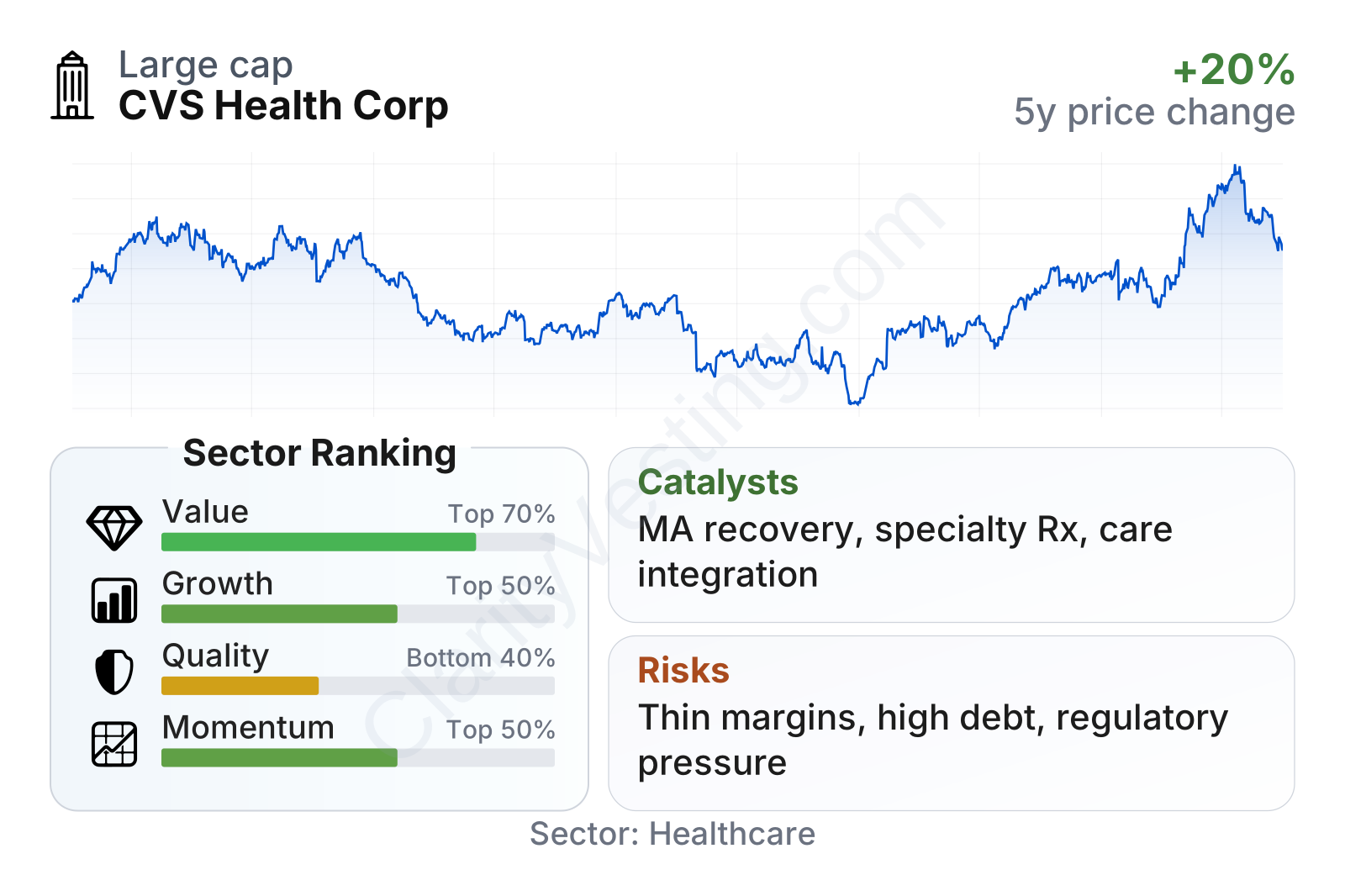
CVS is a very large healthcare company with a stock that has recently rebounded sharply after a volatile multi-year period. In the latest snapshot, valuation measures look broadly moderate relative to the healthcare sector, while cash generation stands out more positively than most peers. Growth indicators are mixed: revenue has held up reasonably well, but earnings and margin trends have been less consistent. Quality metrics are the weakest area, mainly because leverage is elevated and profitability remains thin for a business of this size.
Growth
Healthcare remains a structurally growing sector in the United States because of aging demographics, rising use of chronic-care treatments, and the ongoing shift toward managed care and coordinated delivery models. CVS is positioned to benefit from these long-term trends because it already operates at scale in insurance, pharmacy services, specialty medications, and neighborhood care access.
The company’s strategy is built around integration. In practical terms, CVS is trying to use its insurance arm, pharmacy network, drug benefit platform, and primary care assets to manage patient costs more efficiently and keep more healthcare spending inside its own ecosystem. That logic makes strategic sense: if CVS can guide members toward lower-cost settings, improve medication adherence, and manage chronic conditions earlier, it can potentially support both revenue growth and medical cost control.
Recent revenue growth has remained positive, generally in the mid-single-digit to high-single-digit range after a stronger period above 10% in earlier years. That suggests CVS is still expanding, but at a more normalized pace. For a company of this scale, steady growth in that range is still meaningful, especially when combined with strong positions in government-related healthcare programs and prescription volumes.
Cash generation has been more uneven. Free cash flow fell sharply from the very strong levels seen a few years ago, then started to recover. Even after that decline, the latest trailing figure remains substantial in absolute dollars, which is important because CVS needs cash to fund dividends, debt reduction, store investments, and healthcare platform expansion. A key question for long-term analysis is whether the recent recovery in cash flow becomes durable rather than temporary.
Several catalysts support the growth case. Medicare Advantage and other government-backed health plans remain important demand pools, even if they come with margin pressure. Specialty pharmacy is also a favorable area because more complex and high-cost drugs continue to gain share of overall pharmaceutical spending. In addition, the company’s efforts to build out value-based care and primary care services could become more important over time if they improve patient retention and help lower total medical costs.
Recent company communications have also emphasized operational improvement, benefit design discipline, and efforts to restore earnings quality after a difficult period in insurance profitability. That does not remove near-term pressure, but it does point to a clearer focus on execution rather than pure expansion.
Risks
This article is for informational purposes only and does not constitute financial advice. Some content is AI-generated. See Disclaimer