Stock Analysis · CVR Energy Inc (CVI)
Overview
CVR Energy is a U.S. energy company centered on petroleum refining, fuel marketing, and nitrogen fertilizer production. In simple terms, it buys crude oil, turns it into transportation fuels and other refined products, sells those products into regional markets, and also produces ammonia and urea ammonium nitrate fertilizer used by farmers. The company operates mainly through two businesses: refining and renewables on one side, and nitrogen fertilizer on the other. Its refineries are located in the Mid-Continent region, which gives it exposure to inland crude supplies and fuel demand in central U.S. markets.
The refining business is the economic core of the company. It generates most revenue because fuels such as gasoline and diesel are high-volume products, even though profits can swing sharply with refining margins. The fertilizer segment is smaller by sales but can matter a lot for earnings and cash flow when agricultural markets are favorable. Based on recent annual filings, the revenue mix is heavily tilted toward refining and marketing.
Main revenue sources are approximately:
- Petroleum refining and marketing: about 85% to 90%. This includes gasoline, diesel, jet fuel, distillates, propane, and other refined petroleum products sold through wholesale channels and branded distribution.
- Nitrogen fertilizer: about 10% to 15%. This mainly includes ammonia and UAN solutions sold into agricultural markets.
- Renewables and other activities: a small share. This includes renewable diesel-related activity and smaller corporate or intercompany items that do not drive the overall revenue picture.
One important point for long-term readers is that revenue size alone does not tell the whole story here. The refining segment brings in the most sales, but profitability depends on the spread between crude input costs and selling prices for refined products. That means earnings can move much more than revenue from year to year.
The business has shown exactly that pattern over the last several years: revenue stayed in the multibillion-dollar range, while profit moved from very strong levels in 2022 and 2023 to much thinner levels in 2024 and 2025. Costs of goods sold absorb most of every sales dollar, so small shifts in fuel margins have a large impact on final earnings.
Key Figures
| Metric | Value | Sector ⓘ |
|---|---|---|
| Date | Oct 17, 2026 | |
| Context | ||
| Sector | Energy | |
| Industry | Oil & Gas Refining & Marketing | |
| Market Cap ⓘ | $6.35B | |
| Beta ⓘ | 0.90 | |
Value (Cheapness) | ||
| P/E Ratio ⓘ | 94.21 | 15.44 |
| P/B Ratio ⓘ | 20.35 | 1.73 |
| FCF Yield ⓘ | 5.45% | 8.20% |
| Dividend Yield ⓘ | 0.97% | 3.59% |
| EBIT / EV ⓘ | 5.23% | 7.46% |
| PEG ⓘ | 0.71 | |
Growth (Business expansion) | ||
| Revenue Growth ⓘ | 55.50% | 26.90% |
| RPS Growth (5Y CAGR) ⓘ | -0.28% | 6.90% |
| EPS Growth (5Y CAGR) ⓘ | N/A | -15.73% |
| BVPS Growth (5Y CAGR) ⓘ | 13.72% | 6.07% |
| Margin Growth (5Y Trend) ⓘ | 0.06% | 0.58% |
| FCF Growth (5Y CAGR) ⓘ | -28.74% | 1.86% |
| DPS Growth (5Y CAGR) ⓘ | N/A | 16.79% |
Quality (Business durability) | ||
| ROIC (Latest) ⓘ | 11.64% | 11.40% |
| ROA (Latest) ⓘ | 1.71% | 6.06% |
| ROIC (5Y Median) ⓘ | 12.82% | 10.30% |
| ROA (5Y Median) ⓘ | 0.67% | 5.42% |
| Net Debt / EBIT (Latest) ⓘ | 3.24 | 1.64 |
| Net Debt / EBIT (5Y Median) ⓘ | 6.36 | 1.83 |
| Net Debt / EBITDA (Latest) ⓘ | 1.43 | 1.08 |
| Net Debt / Assets ⓘ | 26.04% | 17.29% |
| EBITDA / Interest ⓘ | 7.37 | 9.64 |
| Operating Margin (Latest) ⓘ | 3.87% | 16.27% |
| Operating Margin (5Y Median) ⓘ | 2.58% | 20.39% |
| Debt to Equity (Latest) ⓘ | 342.67% | 54.76% |
| Profit Margin (Latest) ⓘ | 0.81% | 8.82% |
| Free Cash Flow (Latest) ⓘ | $346.00M | |
Momentum (Price trend) | ||
| 3Y Return ⓘ | +126.98% | +67.38% |
| 12M Return (excl. last month) ⓘ | +59.48% | +49.19% |
| 6M Return ⓘ | +106.92% | +7.07% |
| Price vs. 200-Day MA ⓘ | +85.50% | +9.56% |
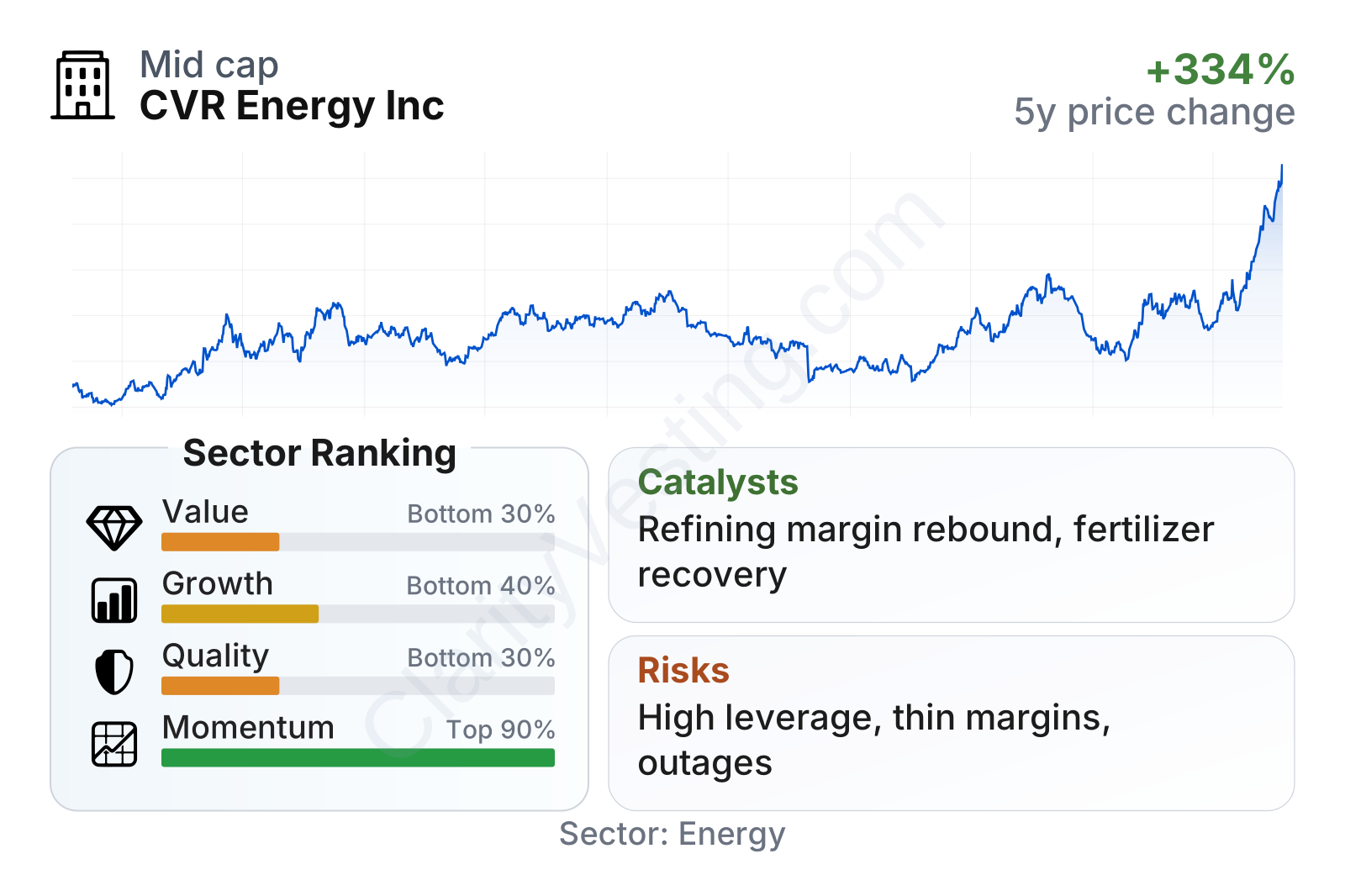
CVR Energy is a mid-sized energy company with a stock that has been volatile but strong over multi-year periods. The market-based picture is better than the operating-quality picture. Momentum is relatively solid, but value, growth, and quality rankings sit in the weaker part of the energy sector. The most notable pressure points are a high debt burden, thin profitability, and valuation ratios that look demanding when compared with current earnings.
The stock price history reflects how cyclical the company is. Shares climbed sharply from 2021 into 2024, dropped hard during weaker refining conditions, and then recovered again. That kind of movement is common for refiners, where earnings can change quickly with commodity spreads rather than steady volume growth.
Growth
CVR Energy operates in sectors that are important, but not classic long-duration growth markets. Traditional refining is mature in the United States, with demand tied more to economic activity, driving patterns, and fuel market balances than to structural expansion. Nitrogen fertilizer has more direct exposure to crop economics and global supply conditions. That gives the company some diversification, but it does not fully change the cyclical nature of the business.
Its strategy still has logic. A refiner with advantaged inland assets can benefit when crude sourcing is favorable and local fuel markets are tight. The fertilizer business adds a second earnings engine that follows different industry drivers than gasoline and diesel. The company has also pursued renewable fuel initiatives, which matter because low-carbon compliance markets and biofuel credits can create additional value if execution improves.
Recent revenue growth has turned positive again after a long stretch of declines. The latest year-over-year readings show a rebound, including a very strong recent quarter. That suggests the business is recovering from a weak comparison period rather than entering a smooth long-term expansion phase. Over a five-year view, revenue per share has been roughly flat, which fits the profile of a cyclical operator rather than a compounding growth company.
Cash generation tells a similar story. Free cash flow was strong in earlier periods, then turned negative, and has since moved back into positive territory. That rebound matters because refiners need cash to maintain plants, manage turnarounds, support distributions, and handle volatile working capital. A more durable recovery in free cash flow would likely depend on better refining margins, steadier utilization, and disciplined capital spending.
A relevant catalyst for future results is the company’s exposure to changing crack spreads and regional refining economics. If Mid-Continent margins improve, earnings can recover quickly. On the fertilizer side, stronger nitrogen pricing or favorable farm demand can support profitability independently of fuel markets. Recent company updates have also kept attention on operating reliability, refinery utilization, and renewable fuel economics, all of which can materially affect results.
Risks
This article is for informational purposes only and does not constitute financial advice. Some content is AI-generated. See Disclaimer


