Stock Analysis · CVB Financial Corporation (CVBF)
Overview
CVB Financial Corporation is the parent company of Citizens Business Bank, a California-focused regional bank serving small and midsize businesses, professionals, entrepreneurs, nonprofit organizations, and individual customers. Its business is centered on traditional banking: gathering deposits, making loans, and earning a spread between what it earns on assets and what it pays on funding. The company also provides treasury management, equipment and vehicle lending, commercial real estate lending, and wealth-related services through trust and investment support.
For a bank like CVB Financial, revenue is best understood through net interest income and noninterest income. In recent years, the company’s revenue base has remained heavily tied to lending and deposit spread income, with fee income playing a smaller supporting role.
- Net interest income: approximately 85% to 90% of total revenue. This is the core engine of the business and comes from interest earned on commercial loans, commercial real estate loans, equipment finance, lease financing, and investment securities, minus interest paid on deposits and other borrowings.
- Noninterest income: approximately 10% to 15% of total revenue. This includes service charges on deposit accounts, trust and investment-related fees, loan fees, and other banking service income.
That mix matters for long-term analysis because it shows CVB Financial is primarily a plain-vanilla regional bank rather than a diversified financial conglomerate. The benefit is simplicity and a business model that is easier to follow. The trade-off is that earnings are more exposed to loan demand, deposit pricing, and interest-rate cycles than banks with larger fee businesses. Over the last several years, revenue expanded meaningfully through the higher-rate environment, but profit conversion has been pressured by rising funding costs.
The revenue trend has been solid since 2021, but the flow to net income has been less smooth. Interest expense rose sharply in 2023 and 2024 as deposits became more expensive, and that reduced some of the benefit from higher asset yields. Even so, operating margins have stayed strong for a regional bank, showing a business that still converts a large share of revenue into profit.
Key Figures
| Metric | Value | Sector ⓘ |
|---|---|---|
| Date | Oct 24, 2026 | |
| Context | ||
| Sector | Financial Services | |
| Industry | Banks - Regional | |
| Market Cap ⓘ | $3.91B | |
| Beta ⓘ | 0.67 | |
Value (Cheapness) | ||
| P/E Ratio ⓘ | 15.55 | 12.46 |
| P/B Ratio ⓘ | 0.99 | 1.25 |
| FCF Yield ⓘ | 14.63% | 9.82% |
| Dividend Yield ⓘ | 3.61% | 2.94% |
| EBIT / EV ⓘ | 6.95% | 8.11% |
| PEG ⓘ | 1.47 | |
Growth (Business expansion) | ||
| Revenue Growth ⓘ | 42.00% | 9.10% |
| RPS Growth (5Y CAGR) ⓘ | 8.18% | 12.31% |
| EPS Growth (5Y CAGR) ⓘ | -7.53% | -6.97% |
| BVPS Growth (5Y CAGR) ⓘ | 2.37% | 5.02% |
| Margin Growth (5Y Trend) ⓘ | -19.84% | -4.00% |
| FCF Growth (5Y CAGR) ⓘ | 3.34% | 4.71% |
| DPS Growth (5Y CAGR) ⓘ | 3.13% | 8.92% |
Quality (Business durability) | ||
| ROIC (Latest) ⓘ | 6.84% | 9.18% |
| ROE (Latest) ⓘ | 7.59% | 13.93% |
| ROA (Latest) ⓘ | 1.12% | 1.57% |
| ROIC (5Y Median) ⓘ | 7.64% | 7.80% |
| ROE (5Y Median) ⓘ | 10.39% | 12.15% |
| ROA (5Y Median) ⓘ | 1.36% | 1.28% |
| Net Debt / EBIT (Latest) ⓘ | -0.01 | 1.02 |
| Net Debt / EBIT (5Y Median) ⓘ | 3.13 | 0.72 |
| Net Debt / EBITDA (Latest) ⓘ | -0.01 | 0.88 |
| Operating Margin (Latest) ⓘ | 39.23% | 22.30% |
| Operating Margin (5Y Median) ⓘ | 47.39% | 24.50% |
| Debt to Equity (Latest) ⓘ | 34.78% | 59.34% |
| Profit Margin (Latest) ⓘ | 36.14% | 26.42% |
| Free Cash Flow (Latest) ⓘ | $572.50M | |
Momentum (Price trend) | ||
| 3Y Return ⓘ | +68.91% | +95.73% |
| 12M Return (excl. last month) ⓘ | +17.30% | +17.30% |
| 6M Return ⓘ | +15.24% | +6.07% |
| Price vs. 200-Day MA ⓘ | +11.33% | +5.36% |
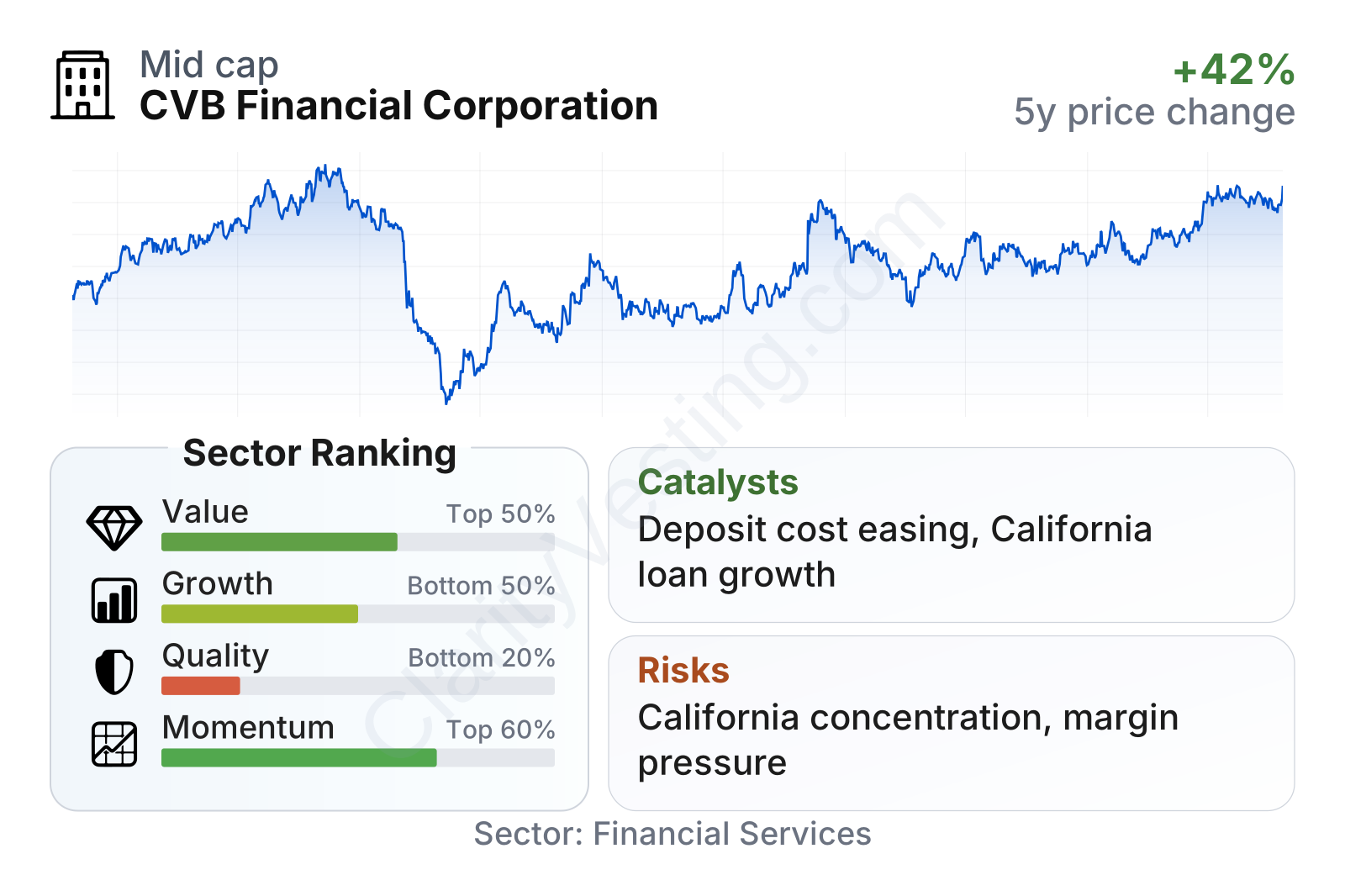
CVB Financial is a mid-sized regional bank with a relatively low beta of 0.65, which suggests the shares have tended to move less than the broader market. On valuation, the picture is mixed: the earnings multiple sits somewhat above the sector median, while the price-to-book ratio remains below the sector median. The dividend yield is also above the sector median, which adds support to the total-return profile. The weaker side of the table is growth and quality relative to peers: profitability ratios such as return on equity and return on assets are below sector medians, and the long-term growth profile has been modest. In short, the company looks stronger on balance-sheet conservatism, margins, and income generation than on fast expansion or peer-leading returns.
Growth
CVB Financial operates in regional banking, a mature sector rather than a high-growth one. That does not mean growth is absent, but it usually comes from a mix of loan growth, deposit gathering, selective acquisitions, and better pricing rather than from rapid disruption-led expansion. For CVB Financial, the long-term case depends more on steady compounding and disciplined underwriting than on explosive market-share gains.
The company’s strategy is sensible for that kind of business. Citizens Business Bank has built its franchise around relationship banking in California, especially with business customers that value service, local decision-making, and treasury capabilities. That can support durable deposits and repeat lending relationships. California remains one of the largest state economies in the country, so even a conservative lender has access to a deep market in commercial banking, real estate, and business services.
Earnings per share show the challenge clearly. Results peaked in the 2022 to 2023 period, then softened as deposit costs rose and margins tightened, with only a partial recovery afterward. That pattern is common across regional banks after the sharp interest-rate shift, but it also shows that CVB Financial has not yet turned revenue growth into sustained earnings acceleration. The latest run rate points more toward stabilization than breakout growth.
Book value per share has moved upward again after a dip earlier in the cycle. For banks, that is an important sign because book value reflects the equity cushion that supports lending and absorbs stress. The pace of growth has not been especially fast, but the direction has been constructive. If the bank can continue growing book value while maintaining conservative credit standards, that would strengthen the long-term picture even without rapid revenue expansion.
The main catalysts are fairly specific. A better deposit-cost environment could help expand net interest margin. Commercial loan growth in California could support higher earning assets. The bank’s focus on business clients also gives it room to deepen fee relationships in treasury management and related services. Recent company updates have also emphasized capital strength, liquidity, and continued dividend distributions, which point to a franchise that is operating from a position of stability rather than repair.
Risks
This article is for informational purposes only and does not constitute financial advice. Some content is AI-generated. See Disclaimer


