Stock Analysis · Cousins Properties Incorporated (CUZ)
Overview
Cousins Properties Incorporated is a real estate investment trust, or REIT, focused mainly on Class A office buildings in fast-growing Sun Belt cities. Its portfolio is concentrated in markets such as Atlanta, Austin, Charlotte, Tampa, Phoenix, and other large business hubs in the Southern U.S. The company develops, owns, leases, and manages office properties, with an emphasis on newer buildings in submarkets that attract large corporate tenants.
For a long-term reader, the simplest way to think about Cousins is that it earns money by owning premium office real estate and collecting rent from tenants that want well-located, modern workplaces. Compared with more diversified REITs, Cousins is much more exposed to the health of the office market, especially in Sun Belt cities.
The main revenue sources are heavily concentrated in rental operations. Based on the company’s reporting structure and recent annual disclosures, the mix is approximately:
- Rental property revenue: about 90% to 95% — base rent, expense reimbursements, parking, and other property-level income from office buildings.
- Tenant-related and other real estate income: about 3% to 7% — items tied to operating properties, ancillary services, and miscellaneous building income.
- Development, management, and other income: about 1% to 3% — smaller sources outside recurring rent, depending on the timing of projects and transactions.
The business remains straightforward: occupancy, rental rates, development returns, and financing costs are the main drivers of results. Revenue has risen over the past several years, but profitability has been pressured as interest expense and operating costs have climbed faster than the top line. That makes asset quality and balance-sheet discipline especially important for this company.
The long-term pattern shows revenue moving higher, but a much smaller share has been reaching the bottom line. Interest expense has increased materially since 2021, while operating income and net income have trended down, which helps explain why headline growth has not fully translated into stronger earnings.
Key Figures
| Metric | Value | Sector ⓘ |
|---|---|---|
| Date | Oct 10, 2026 | |
| Context | ||
| Sector | Real Estate | |
| Industry | REIT - Office | |
| Market Cap ⓘ | $4.53B | |
| Beta ⓘ | 1.18 | |
Value (Cheapness) | ||
| P/E Ratio ⓘ | N/A | 17.21 |
| P/B Ratio ⓘ | 1.02 | 0.86 |
| FCF Yield ⓘ | -2.00% | 7.55% |
| Dividend Yield ⓘ | 4.63% | 4.84% |
| EBIT / EV ⓘ | 1.67% | 3.81% |
| PEG ⓘ | 1.31 | |
Growth (Business expansion) | ||
| Revenue Growth ⓘ | 11.60% | 5.30% |
| RPS Growth (5Y CAGR) ⓘ | 3.81% | 6.02% |
| EPS Growth (5Y CAGR) ⓘ | -7.76% | -11.37% |
| BVPS Growth (5Y CAGR) ⓘ | -2.60% | 0.61% |
| Margin Growth (5Y Trend) ⓘ | -41.68% | 0.40% |
| FCF Growth (5Y CAGR) ⓘ | -23.26% | 5.35% |
| DPS Growth (5Y CAGR) ⓘ | 1.02% | 5.05% |
Quality (Business durability) | ||
| ROIC (Latest) ⓘ | 1.35% | 5.69% |
| ROE (Latest) ⓘ | 0.14% | 7.56% |
| ROA (Latest) ⓘ | 0.07% | 2.85% |
| ROIC (5Y Median) ⓘ | 2.69% | 4.21% |
| ROE (5Y Median) ⓘ | 1.82% | 6.03% |
| ROA (5Y Median) ⓘ | 1.09% | 2.44% |
| Net Debt / EBIT (Latest) ⓘ | 26.47 | 7.66 |
| Net Debt / EBIT (5Y Median) ⓘ | 13.23 | 8.42 |
| Net Debt / EBITDA (Latest) ⓘ | 6.58 | 5.27 |
| Net Debt / Assets ⓘ | 41.21% | 37.76% |
| EBITDA / Interest ⓘ | 3.22 | 4.10 |
| Operating Margin (Latest) ⓘ | 13.60% | 35.18% |
| Operating Margin (5Y Median) ⓘ | 23.58% | 37.31% |
| Debt to Equity (Latest) ⓘ | 83.09% | 88.87% |
| Profit Margin (Latest) ⓘ | 0.63% | 19.61% |
| Free Cash Flow (Latest) ⓘ | -$90.49M | |
Momentum (Price trend) | ||
| 3Y Return ⓘ | +69.21% | +30.71% |
| 12M Return (excl. last month) ⓘ | +2.56% | +6.58% |
| 6M Return ⓘ | +25.53% | -1.74% |
| Price vs. 200-Day MA ⓘ | +5.82% | -3.29% |
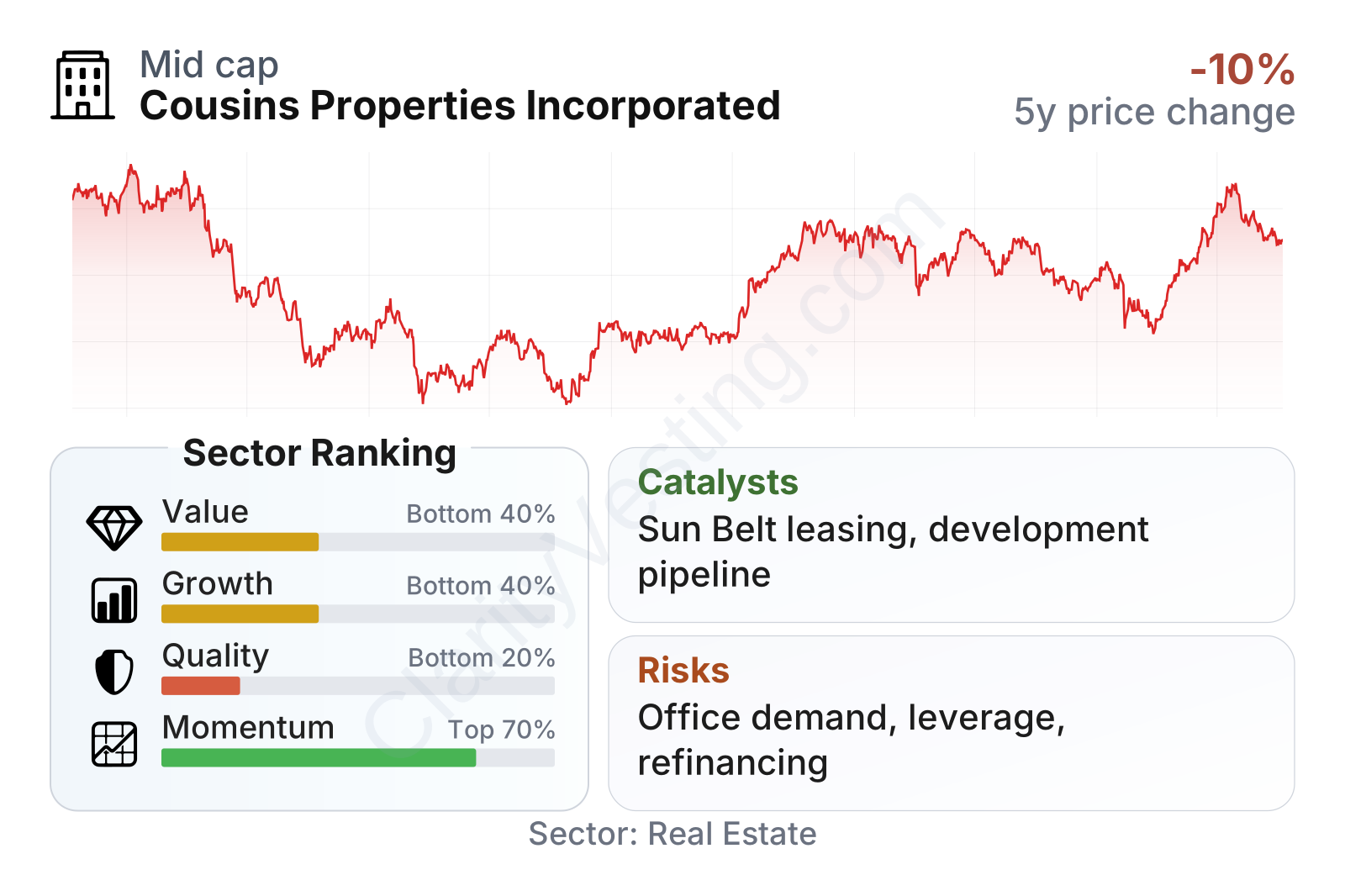
Cousins is a mid-sized REIT with a stock-market value in the mid-single-digit billions and share-price volatility slightly above the broader market. The broader profile is mixed: recent share-price momentum has improved, but value, growth quality, and profitability measures rank below many real estate peers. Revenue growth has been better than the sector median in the latest year, yet returns on assets and equity are very low, free cash flow is negative, and leverage has become less comfortable than it was a few years ago.
The stock-price history also reflects how sensitive office landlords are to interest rates and sentiment around remote work. After a deep decline from 2022 into 2023, the shares recovered meaningfully, including a strong move in the most recent year. That rebound suggests the market has become less pessimistic, but the company still needs to prove that higher rents, leasing, and development gains can overcome financing pressure.
Growth
Cousins operates in a sector that is both challenged and selective. Office real estate as a whole is not currently a broad growth area in the way industrial, data centers, or cell towers are. However, the company’s niche — high-quality office buildings in Sun Belt markets — has a clearer long-term logic than the average office landlord. Population growth, corporate relocations, and business expansion in cities such as Austin, Charlotte, Tampa, and Atlanta can support demand for better-located space even while weaker office buildings struggle.
The strategy makes sense if the office market continues to split into winners and losers. Cousins has focused on newer properties, central business districts, and trophy assets that tend to attract larger and more creditworthy tenants. In that environment, landlords with older or lower-quality buildings often face more pressure than owners of premium space.
Revenue per share has moved steadily upward over the last five years, which is encouraging because it shows the portfolio has been expanding its income base even without dramatic dilution. The pace has not been exceptional versus the broader real estate sector, but it does suggest that acquisitions, development completions, and leasing have added to the company’s earning capacity over time.
The dividend per share has been broadly stable, hovering in a narrow range with only limited growth. That steadiness can matter for a REIT, but it also shows that the company has not had enough cash-flow strength recently to support a more aggressive payout increase. In other words, the income component looks durable, while the growth component has been modest.
A meaningful catalyst is Cousins’ exposure to markets that have continued to attract jobs and residents from higher-cost regions. Another potential tailwind is the gradual normalization of office usage for premium buildings, especially among large employers that still want in-person collaboration in flagship locations. Development deliveries and major lease signings can also create visible jumps in rent collections once buildings move from construction into stabilized operations.
Recent company updates have also emphasized leasing progress, portfolio quality, and balance-sheet flexibility as key themes. For an office REIT, those are important signals: long lease terms with large tenants can improve cash-flow visibility, and disciplined capital allocation matters more when the financing environment is less forgiving.
Risks
This article is for informational purposes only and does not constitute financial advice. Some content is AI-generated. See Disclaimer