Stock Analysis · Etn. Fr. Colruyt NV (CUYTF)
Overview
Etn. Fr. Colruyt NV is a Belgian food retail group best known for its Colruyt Lowest Prices supermarkets. The company operates mainly in Belgium, with additional activities in Luxembourg and France. Its business is centered on everyday consumer spending: food retail, wholesale supply for independent store operators, and a smaller set of non-food and energy activities. That makes Colruyt part of the consumer defensive sector, where demand is usually steadier than in many other industries because households keep buying groceries even in weaker economic periods.
The group’s revenue base is still dominated by food distribution. Based on the latest annual reporting structure, the business mix is approximately the following:
- Retail food in Belgium and Luxembourg: about 80% to 85%. This includes Colruyt supermarkets as well as other food banners such as OKay, Bio-Planet, and related retail concepts.
- Retail food in France: about 10% to 15%. This mainly reflects the group’s French supermarket operations, which remain much smaller than the home market business.
- Wholesale and foodservice-related activities: about 3% to 6%. This includes supplies to affiliated or independent stores and professional customers.
- Non-food and other activities: generally below 5%. This includes selected non-food retail and energy-related operations, depending on the reporting perimeter in the latest year.
That concentration in grocery retail is important for long-term analysis. It gives the company recurring sales, but it also means profitability depends heavily on price competition, cost control, and execution in a low-margin industry.
Over the last several years, revenue has generally moved upward, but the profit structure has been more volatile. Sales rose from a little over €9 billion a few years ago to above €10 billion more recently, while operating profit and net income have fluctuated much more sharply. This points to a business that can grow through scale and pricing, yet remains sensitive to margin pressure and one-off items.
The revenue base has expanded over time, but the path from sales to final profit is not smooth. The business keeps a very large share of revenue tied up in merchandise costs, which is normal for supermarkets, and even small changes in gross margin can have a meaningful effect on earnings.
Key Figures
| Metric | Value | Sector ⓘ |
|---|---|---|
| Date | Oct 17, 2026 | |
| Context | ||
| Sector | Consumer Defensive | |
| Industry | Grocery Stores | |
| Market Cap ⓘ | $5.31B | |
| Beta ⓘ | 0.32 | |
Value (Cheapness) | ||
| P/E Ratio ⓘ | 13.75 | 17.88 |
| P/B Ratio ⓘ | 1.38 | 1.29 |
| FCF Yield ⓘ | 9.74% | 12.39% |
| Dividend Yield ⓘ | 4.11% | 2.85% |
| EBIT / EV ⓘ | N/A | 6.43% |
| PEG ⓘ | 1.64 | |
Growth (Business expansion) | ||
| Revenue Growth ⓘ | 1.70% | 4.10% |
| RPS Growth (5Y CAGR) ⓘ | 6.10% | 6.18% |
| EPS Growth (5Y CAGR) ⓘ | N/A | -13.59% |
| BVPS Growth (5Y CAGR) ⓘ | 10.09% | 3.20% |
| Margin Growth (5Y Trend) ⓘ | -1.09% | -0.15% |
| FCF Growth (5Y CAGR) ⓘ | 107.38% | 4.10% |
| DPS Growth (5Y CAGR) ⓘ | -1.65% | 6.79% |
Quality (Business durability) | ||
| ROIC (Latest) ⓘ | 20.12% | 12.34% |
| ROA (Latest) ⓘ | 9.79% | 6.30% |
| ROIC (5Y Median) ⓘ | 9.23% | 10.49% |
| ROA (5Y Median) ⓘ | 5.17% | 5.44% |
| Net Debt / EBIT (Latest) ⓘ | 0.33 | 1.96 |
| Net Debt / EBIT (5Y Median) ⓘ | 0.90 | 2.35 |
| Net Debt / EBITDA (Latest) ⓘ | 0.16 | 1.38 |
| Net Debt / Assets ⓘ | 4.23% | 21.51% |
| EBITDA / Interest ⓘ | 23.28 | 9.46 |
| Operating Margin (Latest) ⓘ | 3.93% | 8.87% |
| Operating Margin (5Y Median) ⓘ | 3.96% | 9.53% |
| Debt to Equity (Latest) ⓘ | 26.39% | 72.35% |
| Profit Margin (Latest) ⓘ | 2.87% | 5.40% |
| Free Cash Flow (Latest) ⓘ | $517.46M | |
Momentum (Price trend) | ||
| 3Y Return ⓘ | -1.65% | +20.92% |
| 12M Return (excl. last month) ⓘ | -10.72% | +2.13% |
| 6M Return ⓘ | -10.72% | +1.26% |
| Price vs. 200-Day MA ⓘ | -2.78% | +1.39% |
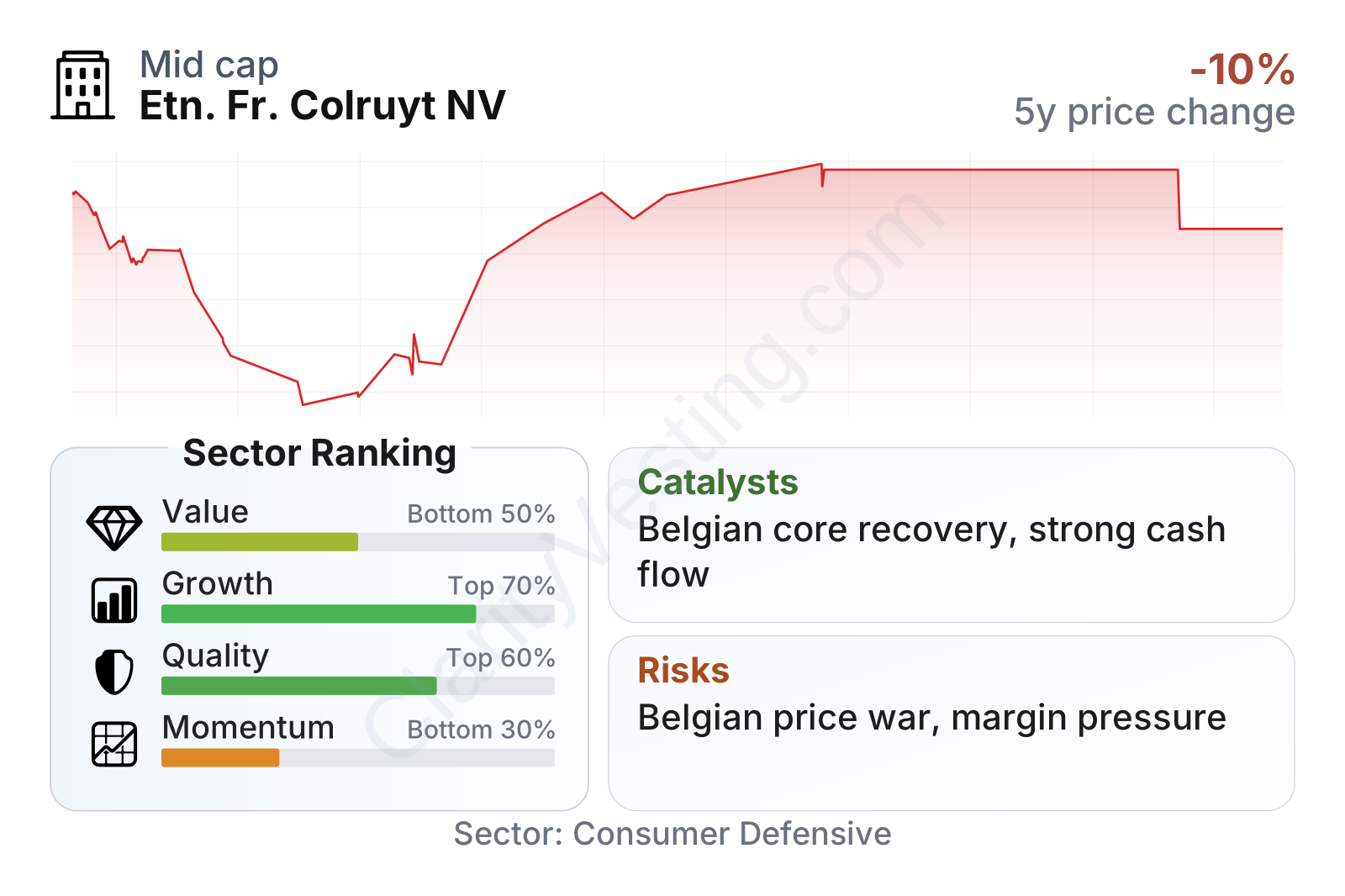
Colruyt looks like a mid-sized listed grocery retailer with unusually low share-price volatility. Its beta is well below 1, which means the stock has historically moved less than the broader market. On valuation, earnings are priced below the sector median on a P/E basis, while the price-to-book ratio is closer to the middle of the pack. The dividend yield stands above the sector median, which supports total return potential, although dividend growth has not been strong in recent years.
On business quality, the balance sheet is one of the stronger aspects. Debt levels are low relative to earnings and assets, and interest coverage is high. Returns on capital and assets are solid versus many sector peers, even though operating and net margins remain thin, which is typical in food retail. Growth indicators are mixed: long-term revenue per share has been broadly in line with the sector, book value has compounded well, and free cash flow has improved sharply over five years, but recent yearly revenue growth has been modest and margin trends have weakened.
Price performance has been soft. The stock has lagged the sector over the last year and over three years, and it is trading below its longer-term moving average. That does not say much about the business on its own, but it does show the market has become more cautious about the near-term outlook.
Growth
Colruyt operates in a sector that is mature rather than fast-growing. Grocery retail benefits from recurring demand, but long-term expansion usually comes from gaining market share, improving store productivity, widening adjacent services, and managing private-label positioning effectively. In other words, this is not a business where growth typically comes from a technological breakthrough. It comes from disciplined execution.
The company’s strategy still makes industrial sense. Colruyt has long been associated with a value-focused proposition, and that can remain relevant when consumers are cautious about household budgets. In a high-cost environment, many shoppers trade down, compare prices more actively, and become more open to private-label products. That backdrop can help established discount-leaning grocers defend traffic and basket size.
Another favorable point is financial flexibility. The company’s low leverage gives it room to keep investing in stores, logistics, digital tools, and selected adjacent activities without relying heavily on debt. In a sector where margins are narrow, balance-sheet strength can become a real strategic advantage because it allows management to absorb short-term pressure while weaker rivals may have less room to maneuver.
There are also some visible catalysts. The first is execution in the core Belgian food retail business, where even small improvements in pricing, sourcing, or operating efficiency can lift profits materially. The second is cash generation: free cash flow is currently strong relative to the company’s size, which can support reinvestment and shareholder distributions. A third potential catalyst is any normalization of margin pressure after a period of cost inflation and intense competition.
Recent reporting also indicates that sales remain resilient even when earnings are under pressure. That matters because it suggests the customer base is still engaged. If management can stabilize margins while protecting volume, earnings could become less volatile than they have been over the last few reporting periods.
Risks
This article is for informational purposes only and does not constitute financial advice. Some content is AI-generated. See Disclaimer


