Stock Analysis · Curaleaf Holdings Inc (CURLF)
Overview
Curaleaf Holdings is one of the largest cannabis operators in the United States. The company grows, processes, and sells cannabis products for both medical and adult-use markets where permitted. Its products include flower, vape cartridges, concentrates, edibles, capsules, tinctures, and wellness-oriented formats sold through its own dispensaries and through wholesale channels. Curaleaf also has an international business, with activities in markets such as Europe.
The business model is vertically integrated in many states, meaning Curaleaf can participate in cultivation, manufacturing, brand development, distribution, and retail. That structure can help protect shelf space for its own brands and capture more economics across the chain, although it also requires more capital and operational discipline.
Based on company disclosures, revenue is primarily generated from cannabis product sales, with the U.S. business overwhelmingly dominant. A practical way to think about the revenue mix is:
- U.S. retail sales: approximately 65% to 75% of revenue. This includes direct sales through company-operated dispensaries to medical and adult-use consumers.
- U.S. wholesale sales: approximately 20% to 30% of revenue. This includes sales of branded and unbranded products to third-party dispensaries and other licensed operators.
- International operations: approximately 5% to 10% of revenue. This includes medical cannabis activities outside the U.S., especially in Europe and other regulated markets.
Over the last several years, the company has built a broad footprint across multiple states rather than relying on a single market. That diversification matters in cannabis because regulation, pricing, and tax burdens can vary sharply from one state to another.
The long-term picture shows a company that reached more than $1.2 billion in annual revenue and has kept gross profit relatively solid, but operating costs, interest expense, and tax pressure have made it difficult to convert that scale into consistent net earnings. The recent improvement in operating income compared with the worst period suggests some progress on cost control, but profitability remains the key issue.
Key Figures
| Metric | Value | Sector ⓘ |
|---|---|---|
| Date | Oct 03, 2026 | |
| Context | ||
| Sector | Healthcare | |
| Industry | Drug Manufacturers - Specialty & Generic | |
| Market Cap ⓘ | $2.72B | |
| Beta ⓘ | 1.64 | |
Value (Cheapness) | ||
| P/E Ratio ⓘ | N/A | 24.06 |
| P/B Ratio ⓘ | 3.13 | 3.08 |
| FCF Yield ⓘ | 2.73% | 3.07% |
| Dividend Yield ⓘ | N/A | 2.05% |
| EBIT / EV ⓘ | 0.18% | 0.63% |
| PEG ⓘ | N/A | |
Growth (Business expansion) | ||
| Revenue Growth ⓘ | 9.50% | 7.50% |
| RPS Growth (5Y CAGR) ⓘ | -0.98% | 8.70% |
| EPS Growth (5Y CAGR) ⓘ | N/A | -18.20% |
| BVPS Growth (5Y CAGR) ⓘ | -21.31% | 3.95% |
| Margin Growth (5Y Trend) ⓘ | -12.74% | -0.58% |
| FCF Growth (5Y CAGR) ⓘ | N/A | 0.88% |
| DPS Growth (5Y CAGR) ⓘ | N/A | 6.80% |
Quality (Business durability) | ||
| ROIC (Latest) ⓘ | 0.40% | 3.29% |
| ROA (Latest) ⓘ | -2.70% | 3.02% |
| ROIC (5Y Median) ⓘ | -0.65% | 4.75% |
| ROA (5Y Median) ⓘ | -8.66% | 1.93% |
| Net Debt / EBIT (Latest) ⓘ | 72.66 | 1.33 |
| Net Debt / EBIT (5Y Median) ⓘ | 20.32 | 1.83 |
| Net Debt / EBITDA (Latest) ⓘ | 2.33 | 0.99 |
| Net Debt / Assets ⓘ | 18.37% | 5.33% |
| EBITDA / Interest ⓘ | 2.15 | 9.63 |
| Operating Margin (Latest) ⓘ | 0.54% | 9.25% |
| Operating Margin (5Y Median) ⓘ | 0.18% | 7.80% |
| Debt to Equity (Latest) ⓘ | N/A | 28.99% |
| Profit Margin (Latest) ⓘ | -2.63% | 3.60% |
| Free Cash Flow (Latest) ⓘ | $74.31M | |
Momentum (Price trend) | ||
| 3Y Return ⓘ | -24.34% | +37.48% |
| 12M Return (excl. last month) ⓘ | -2.02% | +20.85% |
| 6M Return ⓘ | +59.81% | +9.73% |
| Price vs. 200-Day MA ⓘ | +14.75% | +4.69% |
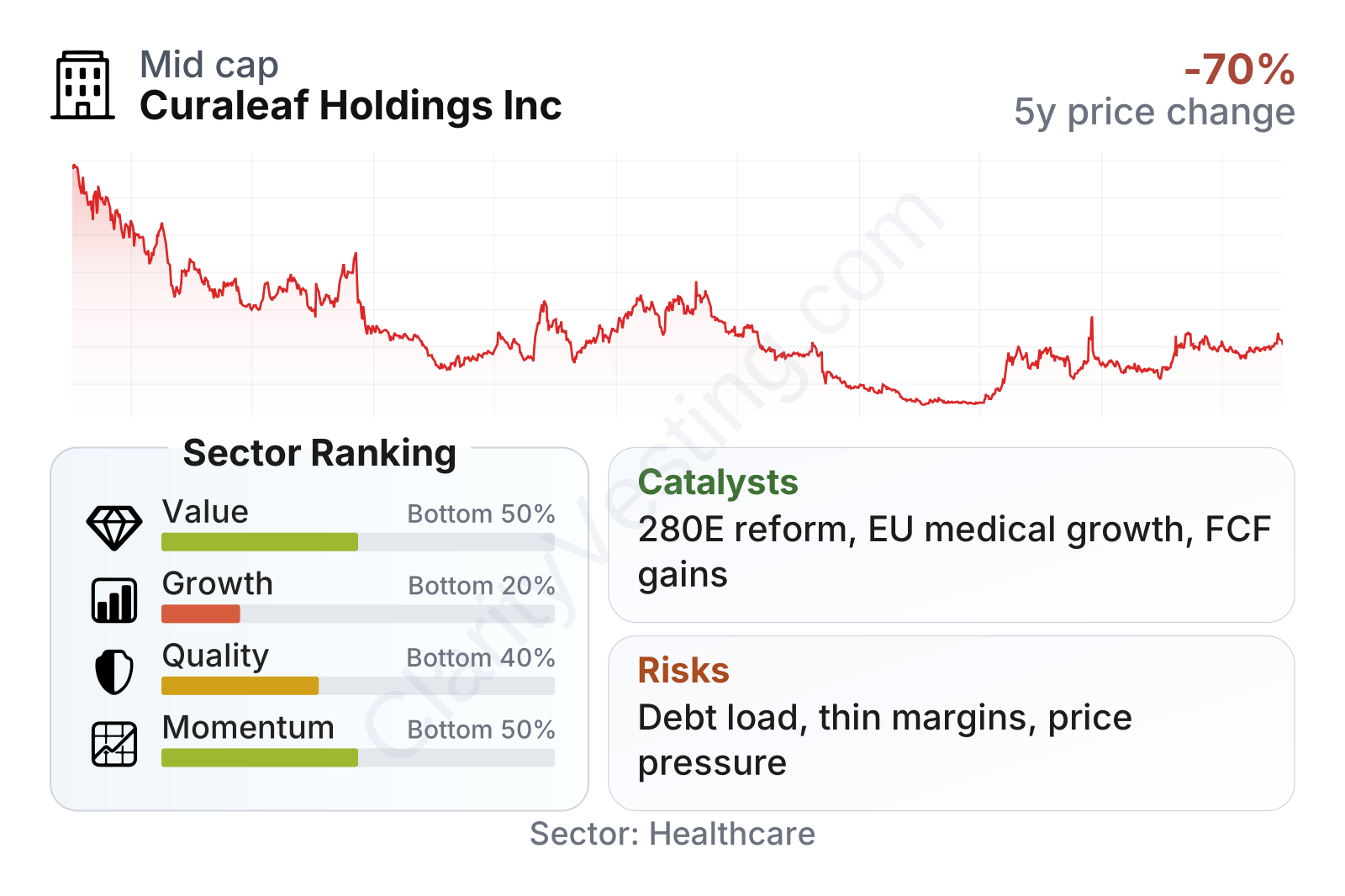
Curaleaf is a mid-sized public company with a stock that has been highly volatile, which is common in cannabis but still notable even by that standard. The recent share-price rebound has been strong over the last six months, yet the longer-term record remains weak compared with much of the healthcare sector. In the factor breakdown, value does not stand out as clearly cheap, quality metrics remain below sector norms, and growth ranks poorly on a five-year basis despite a recent recovery in year-over-year sales. Free cash flow is positive, which is important, but leverage and thin operating returns continue to weigh on the overall picture.
Growth
Cannabis remains a growth industry over the long run, but it is not a simple one. Demand is expanding as more states open adult-use markets, medical programs mature, and consumers shift from illicit channels to regulated products. At the same time, pricing pressure, taxation, and oversupply in some regions have made growth uneven. For Curaleaf, the opportunity comes less from the idea that the sector will rise in a straight line and more from the possibility that a few scaled operators emerge stronger after a difficult shakeout.
Curaleaf’s strategy broadly makes sense for that environment. The company has national scale, established brands, retail access, and cultivation and processing capacity. That combination can support future growth if management continues to streamline operations and direct capital toward markets with better returns. Its international presence also gives it optionality that many U.S.-focused competitors do not have, especially if European medical cannabis markets keep developing.
Revenue momentum weakened through much of 2024 and 2025, but the latest trend shows a return to positive year-over-year growth, reaching close to 10% in the most recent period. That matters because it suggests the business may be stabilizing after a stretch of contraction. Even so, the longer five-year growth profile remains weak on a per-share basis, which means scale alone has not yet translated into durable shareholder value creation.
Cash generation has improved materially versus earlier periods when free cash flow was deeply negative. Curaleaf is now producing positive trailing free cash flow, and that is one of the more encouraging operational shifts in the business. For a cannabis operator facing restricted banking access and expensive capital, internally generated cash is especially valuable. A durable move into consistently positive cash flow would strengthen the company’s flexibility for debt service, selective expansion, and operational upgrades.
The biggest potential catalysts remain regulatory. Any easing of U.S. federal restrictions, tax reform affecting cannabis operators, broader financial access, or state-level market openings could improve margins and financing conditions. International medical cannabis development is another meaningful opportunity. Recent company updates have also emphasized cost discipline, retail optimization, and product innovation, which are practical drivers even without a major federal policy change.
Risks
This article is for informational purposes only and does not constitute financial advice. Some content is AI-generated. See Disclaimer