Stock Analysis · Curbline Properties Corp (CURB)
Overview
Curbline Properties Corp is a retail real estate investment trust, or REIT. Its focus is on convenience-oriented properties, especially small-format retail sites positioned along busy commercial corridors. In practical terms, that means locations designed to capture everyday consumer traffic rather than destination shopping. The business model is straightforward: acquire and manage properties, lease them to tenants, collect rent, and aim to grow cash flow through occupancy, rent increases, and additional property investments.
The company appears to be concentrated in one main line of business rather than several unrelated segments. Based on recent public filings and management materials, revenue is largely generated from rental income tied to its property portfolio, with smaller contributions from other property-related items.
- Rental revenue: approximately 90% to 95% of total revenue. This is the core of the business and includes base rent from tenants occupying the company’s retail properties.
- Recoveries and reimbursements: approximately 3% to 8%. These amounts generally come from tenants repaying part of property operating costs such as maintenance, taxes, insurance, or common-area expenses, depending on lease structure.
- Other property income: generally a low-single remaining share. This can include miscellaneous fees, termination income, or other incidental real estate-related items when disclosed.
The overall financial picture shows a company that has scaled up quickly in recent years. Revenue has risen sharply from 2021 through 2025, while gross profit also expanded strongly. At the same time, expenses have increased as the platform has grown, and profitability has not moved in a straight line from year to year.
The business mix has remained centered on rental income, but the profit path has been uneven. Revenue and gross profit grew substantially over the last five years, while operating expenses and interest costs also moved up as the company expanded. That pattern suggests a REIT that is still building scale rather than one already operating at peak efficiency.
Key Figures
| Metric | Value | Sector ⓘ |
|---|---|---|
| Date | Oct 17, 2026 | |
| Context | ||
| Sector | Real Estate | |
| Industry | REIT - Retail | |
| Market Cap ⓘ | $3.06B | |
| Beta ⓘ | 0.62 | |
Value (Cheapness) | ||
| P/E Ratio ⓘ | 98.41 | 17.38 |
| P/B Ratio ⓘ | 1.39 | 0.85 |
| FCF Yield ⓘ | 4.37% | 7.38% |
| Dividend Yield ⓘ | 2.44% | 4.85% |
| EBIT / EV ⓘ | 1.51% | 3.78% |
| PEG ⓘ | N/A | |
Growth (Business expansion) | ||
| Revenue Growth ⓘ | 52.90% | 5.30% |
| RPS Growth (5Y CAGR) ⓘ | 36.57% | 6.02% |
| EPS Growth (5Y CAGR) ⓘ | 99.23% | -11.37% |
| BVPS Growth (5Y CAGR) ⓘ | 39.92% | 0.45% |
| Margin Growth (5Y Trend) ⓘ | -15.79% | -0.22% |
| FCF Growth (5Y CAGR) ⓘ | 36.18% | 5.40% |
| DPS Growth (5Y CAGR) ⓘ | N/A | 5.02% |
Quality (Business durability) | ||
| ROIC (Latest) ⓘ | 2.25% | 5.69% |
| ROE (Latest) ⓘ | 1.47% | 7.56% |
| ROA (Latest) ⓘ | 1.11% | 2.85% |
| ROIC (5Y Median) ⓘ | N/A | 4.22% |
| ROE (5Y Median) ⓘ | 2.07% | 6.03% |
| ROA (5Y Median) ⓘ | 1.77% | 2.44% |
| Net Debt / EBIT (Latest) ⓘ | 9.33 | 7.59 |
| Net Debt / EBIT (5Y Median) ⓘ | 1.70 | 8.40 |
| Net Debt / EBITDA (Latest) ⓘ | 3.47 | 5.27 |
| Net Debt / Assets ⓘ | 18.30% | 37.76% |
| EBITDA / Interest ⓘ | 5.75 | 4.10 |
| Operating Margin (Latest) ⓘ | 25.43% | 35.29% |
| Operating Margin (5Y Median) ⓘ | 34.74% | 37.31% |
| Debt to Equity (Latest) ⓘ | 32.25% | 88.87% |
| Profit Margin (Latest) ⓘ | 13.10% | 19.61% |
| Free Cash Flow (Latest) ⓘ | $133.65M | |
Momentum (Price trend) | ||
| 3Y Return ⓘ | N/A | +30.75% |
| 12M Return (excl. last month) ⓘ | +33.86% | +4.36% |
| 6M Return ⓘ | -1.06% | -2.52% |
| Price vs. 200-Day MA ⓘ | -4.02% | -2.34% |
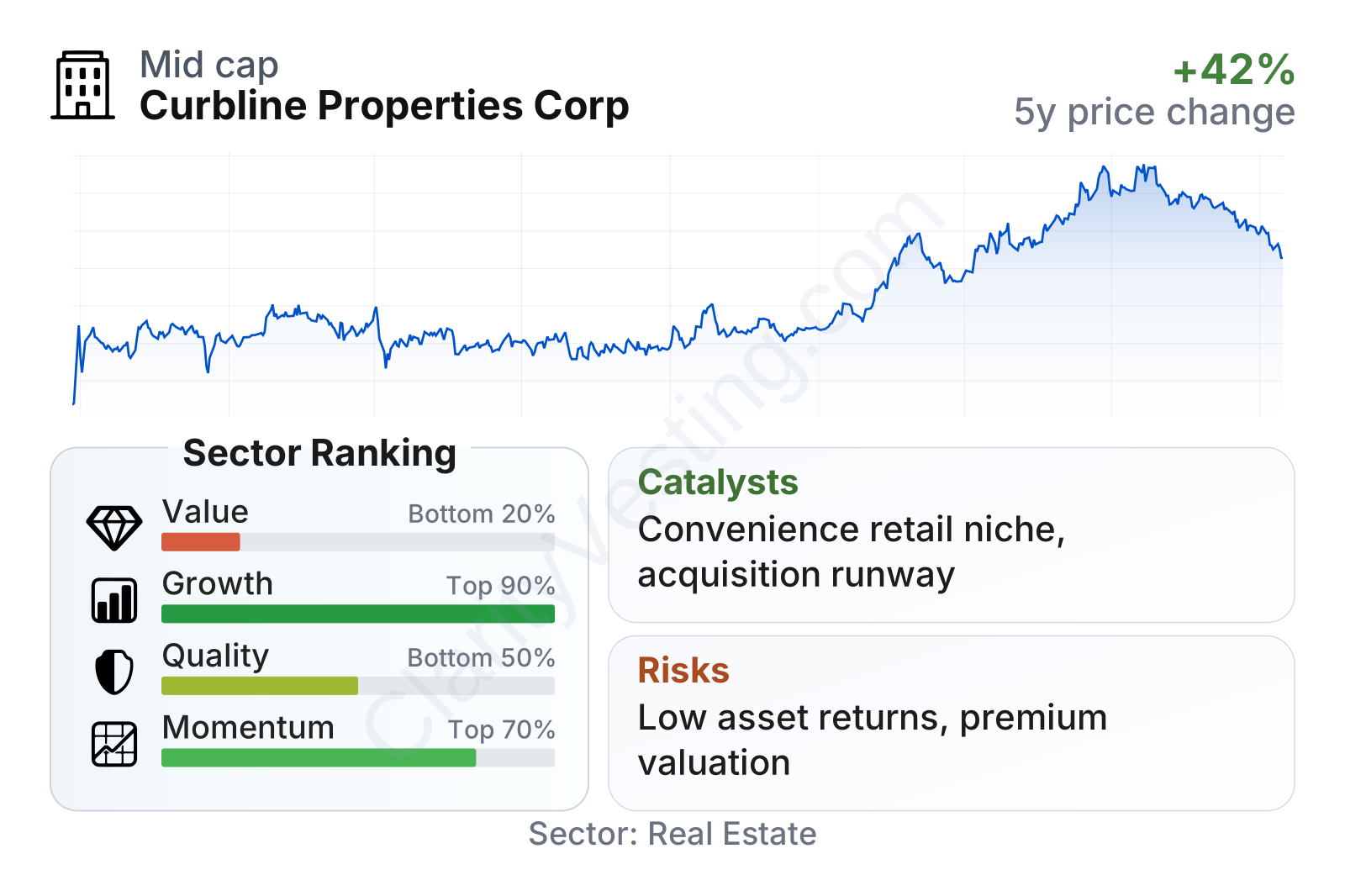
Curbline is a mid-sized REIT with a market value a little above $3 billion and a relatively low beta, which points to lower share-price volatility than the broader market. The factor profile is mixed: growth and recent price momentum rank well against the real estate sector, while value and quality rank weaker. In simple terms, the market is paying up for expansion, but current profitability and return metrics are not yet as strong as many peers.
The recent share-price trend has been positive, with the stock rising materially over the last year. However, the valuation multiples are elevated versus sector norms, especially on earnings, which means expectations already reflect a meaningful part of the company’s growth narrative.
Growth
Curbline operates in a part of retail real estate that has some attractive long-term features. Convenience-oriented retail has generally held up better than many traditional shopping formats because tenants often serve recurring, necessity-based demand. Properties along high-traffic roads can remain relevant even as e-commerce changes other parts of retail, since many purchases still depend on physical access, local visibility, and quick stops.
The company’s strategy also fits that backdrop. A focused portfolio in convenience retail can benefit from tenant demand for compact, efficient locations in dense suburban and urban corridors. For a smaller REIT, specialization can be a growth tool: management can target a narrow property type, build operating expertise, and pursue acquisitions that larger diversified landlords may overlook.
Revenue per share has climbed very quickly over the last five years, indicating that growth has not been driven only by issuing more shares. That is a useful sign for long-term analysis because it suggests the asset base has been expanding in a way that has translated into more revenue on a per-share basis.
The dividend record is still developing. There was no dividend shown in earlier periods, followed by a meaningful payout in 2025. For a REIT, that shift matters because income distribution is part of the sector’s normal structure, but it also means the dividend profile is not yet long-established.
On recent operating momentum, the company stands out. Revenue growth of roughly 53% year over year is far above the sector median, and five-year compound growth in revenue per share, free cash flow, earnings per share, and book value per share has also been unusually strong for a REIT. Those numbers point to a business that is scaling quickly.
A notable catalyst is the company’s position as a pure-play platform in a niche that many public REITs do not directly target. If management continues to add assets, improve occupancy, and secure rent growth, the market may continue to view Curbline as a differentiated vehicle in convenience retail real estate. Public filings and company releases should also be watched for acquisition activity, portfolio expansion, and leasing updates, since those are likely to be the clearest signals of whether the growth case is continuing.
Risks
This article is for informational purposes only and does not constitute financial advice. Some content is AI-generated. See Disclaimer


