Stock Analysis · China Communications Services Corporation Limited (CUCSY)
Overview
China Communications Services Corporation Limited is a Chinese integrated services provider for telecom infrastructure and digital transformation projects. In simple terms, it helps build, maintain, and upgrade communications networks, and it also provides related software, facility management, and industry digital services. The company works not only for telecom carriers, but also for government bodies, utilities, transportation groups, and other enterprise customers that need network, cloud, data, and smart-city related support.
Its business model is closer to an engineering and services platform than to a traditional telecom operator. It does not mainly make money by selling mobile subscriptions to consumers. Instead, it earns revenue from designing networks, constructing and upgrading infrastructure, maintaining systems, and providing operational support and digital solutions.
Based on the company’s recent annual disclosures, revenue is mainly organized into three segments:
- Telecommunications infrastructure services: approximately 50% of revenue. This includes planning, design, engineering, and construction work for communications networks and related infrastructure projects.
- Business process outsourcing services: approximately 35% of revenue. This covers maintenance, network management, facilities management, supply chain, logistics, and other outsourced operational services.
- Applications, content and other services: approximately 15% of revenue. This includes IT applications, system integration, software-related services, digital transformation projects, and value-added solutions for industry clients.
The customer base is also important to understanding the company. The three major Chinese telecom operators remain central clients, but management has for years emphasized expansion into the broader domestic market, especially government and enterprise digitalization. That matters because it reduces reliance on pure carrier capex cycles and gives the company exposure to themes such as data centers, industrial internet, smart infrastructure, and cloud-related network upgrades.
Over the last several years, revenue has been relatively stable to modestly rising overall, while profits have stayed positive. The business appears operationally steady rather than high-growth, with a very large workforce and nationwide execution capability forming the backbone of its scale.
The revenue mix shows a company with very high direct costs and naturally thin margins, which is typical for large engineering and outsourced service businesses. Revenue and gross profit generally expanded from 2021 through 2024 before softening in 2025, while net income remained comparatively resilient. That pattern suggests a business with recurring demand and scale advantages, but not one with much room for execution mistakes.
Key Figures
| Metric | Value | Sector ⓘ |
|---|---|---|
| Date | Oct 03, 2026 | |
| Context | ||
| Sector | Communication Services | |
| Industry | Telecom Services | |
| Market Cap ⓘ | $4.34B | |
| Beta ⓘ | 0.53 | |
Value (Cheapness) | ||
| P/E Ratio ⓘ | 7.26 | 18.20 |
| FCF Yield ⓘ | 150.09% | 14.71% |
| Dividend Yield ⓘ | 6.06% | 2.86% |
| EBIT / EV ⓘ | N/A | 4.85% |
| PEG ⓘ | N/A | |
Growth (Business expansion) | ||
| Revenue Growth ⓘ | -3.20% | 5.50% |
| RPS Growth (5Y CAGR) ⓘ | 2.17% | 4.55% |
| EPS Growth (5Y CAGR) ⓘ | -3.20% | -18.01% |
| Margin Growth (5Y Trend) ⓘ | 0.47% | 1.32% |
| FCF Growth (5Y CAGR) ⓘ | -49.41% | 5.96% |
| DPS Growth (5Y CAGR) ⓘ | 9.10% | 5.09% |
Quality (Business durability) | ||
| ROIC (Latest) ⓘ | N/A | 8.64% |
| ROIC (5Y Median) ⓘ | 4.71% | 8.11% |
| Net Debt / EBIT (Latest) ⓘ | -0.76 | 1.92 |
| Net Debt / EBIT (5Y Median) ⓘ | -9.34 | 2.85 |
| Net Debt / EBITDA (Latest) ⓘ | -0.52 | 1.25 |
| Net Debt / Assets ⓘ | -2.71% | 18.77% |
| EBITDA / Interest ⓘ | N/A | 8.75 |
| Operating Margin (Latest) ⓘ | 1.89% | 15.58% |
| Operating Margin (5Y Median) ⓘ | 1.48% | 13.53% |
| Debt to Equity (Latest) ⓘ | 12.91% | 59.53% |
| Profit Margin (Latest) ⓘ | 2.34% | 8.78% |
| Free Cash Flow (Latest) ⓘ | $6.52B | |
Momentum (Price trend) | ||
| 3Y Return ⓘ | +59.80% | +43.39% |
| 12M Return (excl. last month) ⓘ | -6.21% | +1.92% |
| 6M Return ⓘ | +1.18% | +2.94% |
| Price vs. 200-Day MA ⓘ | +3.47% | +0.74% |
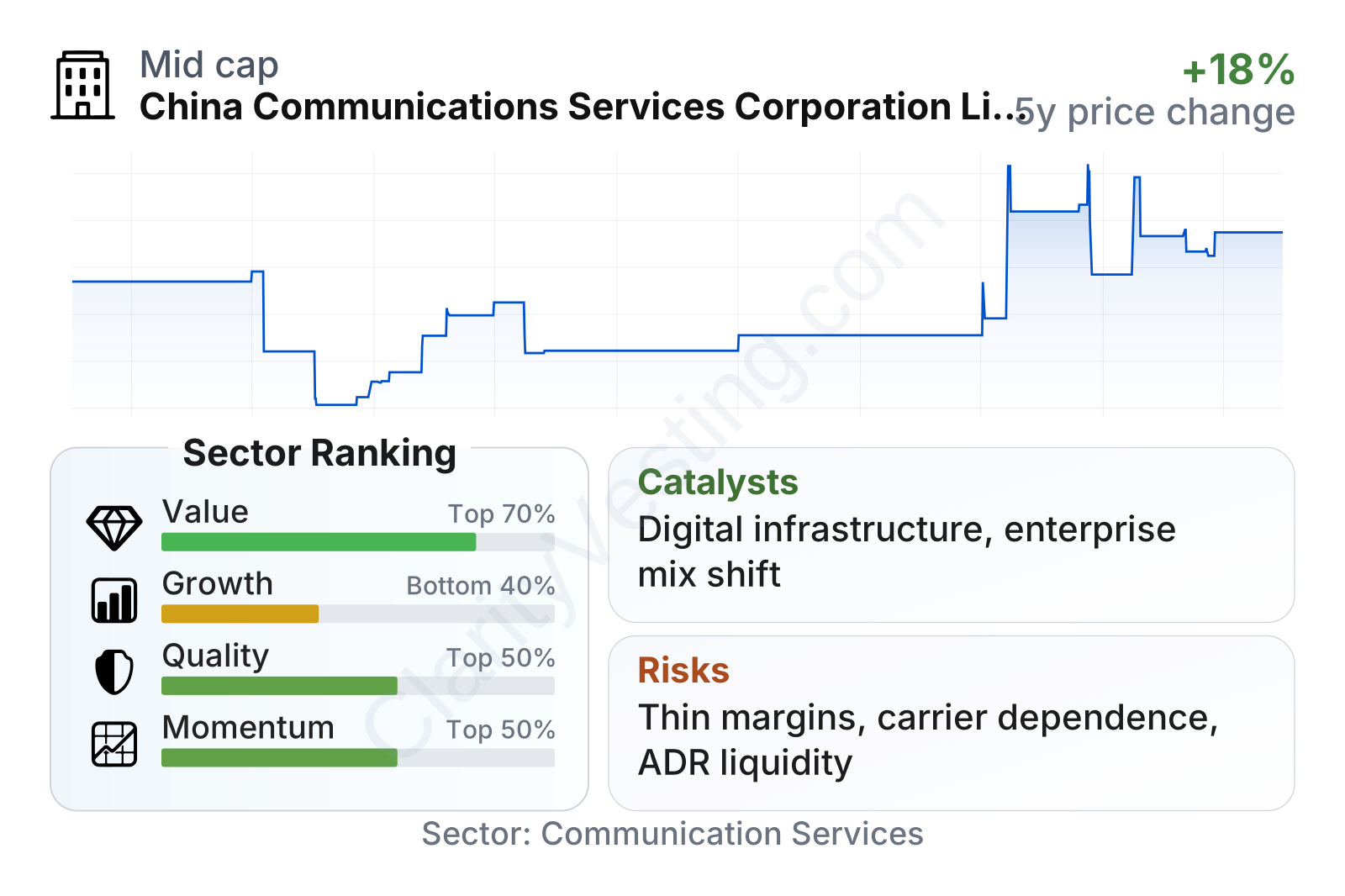
The overall profile is mixed but understandable. On valuation and balance sheet strength, the company stands out positively: the earnings multiple is well below the sector median, dividend yield is above the sector median, and net debt metrics indicate a net cash position rather than heavy leverage. Quality is more middle-of-the-pack because the balance sheet is conservative, but profitability remains structurally low. Growth is the weakest area, with recent revenue pressure and a poor free cash flow growth trend over five years, even though dividend growth has been stronger than the sector median. Share price performance has been respectable over three years, but shorter-term momentum has been less convincing.
Growth
The company operates in a sector that still has long-term relevance. Even when traditional telecom construction matures, communications networks require continuous upgrades, maintenance, cloud connectivity, edge computing support, data center links, and enterprise digital systems. In China, policy support for digital infrastructure, industrial upgrading, smart cities, and computing networks continues to create a broad addressable market for contractors and service providers with nationwide delivery capacity.
Its strategy broadly makes sense for future growth because it is not limited to one narrow activity. The company combines design, construction, maintenance, software integration, and operational outsourcing. That allows it to participate in an infrastructure project from early planning to long-term upkeep, which can deepen customer relationships and improve repeat business. This integrated approach is particularly relevant for government and enterprise digitalization projects, where customers often prefer providers able to manage multiple layers of execution.
A key catalyst is the continuing shift of revenue toward domestic non-telecom operator customers. These projects can include smart transportation, power grid informatization, data center support, digital government platforms, and industrial digital transformation. If this mix keeps broadening, the company could become less dependent on the spending priorities of the major telecom carriers alone.
Another support factor is the still-large need for maintenance and optimization across existing communications networks. Even if headline 5G construction growth slows, the installed base needs ongoing servicing, modernization, and efficiency work. That tends to favor companies with scale, field coverage, and long-standing carrier relationships.
Recent company communications have continued to emphasize “new digital infrastructure,” computing-network integration, and industry digitalization opportunities. Those themes are significant because they align with areas where customers need both physical network work and IT service capability. For a company already embedded in telecom engineering, that creates a logical extension rather than a sharp strategic leap.
Risks
This article is for informational purposes only and does not constitute financial advice. Some content is AI-generated. See Disclaimer