Stock Analysis · Customers Bancorp Inc (CUBI)
Overview
Customers Bancorp is the bank holding company for Customers Bank, a regional bank that combines traditional commercial banking with a more technology-focused operating model. Its core business is lending money, gathering deposits, and providing payment and cash-management services to businesses and consumers. The company has built a noticeable niche in specialized commercial lending and in digital banking relationships, rather than trying to compete as a broad national consumer bank.
For a bank, revenue does not come from selling products in the usual sense. The largest source is typically net interest income, which is the spread between what the bank earns on loans and securities and what it pays on deposits and borrowings. The rest comes from fees tied to banking services.
Based on recent company filings, the revenue mix is centered on interest-based banking income, with a smaller contribution from non-interest income.
- Net interest income: approximately 85% to 90% of total revenue. This includes income from commercial loans, specialty finance, mortgage warehouse lending, securities, and other interest-earning assets, minus interest paid on deposits and other funding sources.
- Non-interest income: approximately 10% to 15% of total revenue. This includes deposit-related fees, treasury and payments services, and other banking fees.
The business mix is also concentrated by loan type rather than by consumer banking. Commercial and industrial lending, multifamily and investor commercial real estate, specialty lending, and mortgage warehouse lending are important categories in the portfolio. That gives the bank exposure to business activity and funding markets more than to everyday retail banking trends.
One notable pattern in recent years is that total revenue stayed fairly strong, but profit was more uneven because funding costs rose sharply as interest rates increased. In other words, the bank has been able to generate business volume, but the cost of money became a much bigger variable.
The flow of revenue and expenses shows that Customers Bancorp has maintained a solid revenue base, but interest expense became far heavier after 2021. Profit recovered from the 2024 dip in 2025, yet earnings remain more sensitive to funding conditions than at many slower-moving regional banks.
Key Figures
| Metric | Value | Sector ⓘ |
|---|---|---|
| Date | Oct 24, 2026 | |
| Context | ||
| Sector | Financial Services | |
| Industry | Banks - Regional | |
| Market Cap ⓘ | $2.58B | |
| Beta ⓘ | 1.53 | |
Value (Cheapness) | ||
| P/E Ratio ⓘ | 9.23 | 12.46 |
| P/B Ratio ⓘ | 1.25 | 1.25 |
| FCF Yield ⓘ | 10.18% | 9.82% |
| Dividend Yield ⓘ | N/A | 2.94% |
| EBIT / EV ⓘ | 51.68% | 8.11% |
| PEG ⓘ | 1.18 | |
Growth (Business expansion) | ||
| Revenue Growth ⓘ | 10.10% | 9.10% |
| RPS Growth (5Y CAGR) ⓘ | 12.37% | 12.31% |
| EPS Growth (5Y CAGR) ⓘ | -15.72% | -6.97% |
| BVPS Growth (5Y CAGR) ⓘ | 13.15% | 5.02% |
| Margin Growth (5Y Trend) ⓘ | -30.27% | -4.00% |
| FCF Growth (5Y CAGR) ⓘ | 8.79% | 4.71% |
| DPS Growth (5Y CAGR) ⓘ | -1.30% | 8.92% |
Quality (Business durability) | ||
| ROIC (Latest) ⓘ | 7.78% | 9.18% |
| ROE (Latest) ⓘ | 13.46% | 13.93% |
| ROA (Latest) ⓘ | 1.15% | 1.57% |
| ROIC (5Y Median) ⓘ | 8.05% | 7.80% |
| ROE (5Y Median) ⓘ | 16.45% | 12.15% |
| ROA (5Y Median) ⓘ | 1.13% | 1.28% |
| Net Debt / EBIT (Latest) ⓘ | 5.71 | 1.02 |
| Net Debt / EBIT (5Y Median) ⓘ | 1.50 | 0.72 |
| Net Debt / EBITDA (Latest) ⓘ | 5.16 | 0.88 |
| Operating Margin (Latest) ⓘ | 26.82% | 22.30% |
| Operating Margin (5Y Median) ⓘ | 24.19% | 24.50% |
| Debt to Equity (Latest) ⓘ | 107.42% | 59.34% |
| Profit Margin (Latest) ⓘ | 35.25% | 26.42% |
| Free Cash Flow (Latest) ⓘ | $262.46M | |
Momentum (Price trend) | ||
| 3Y Return ⓘ | +143.90% | +95.73% |
| 12M Return (excl. last month) ⓘ | +16.18% | +17.30% |
| 6M Return ⓘ | +2.77% | +6.07% |
| Price vs. 200-Day MA ⓘ | +4.05% | +5.36% |
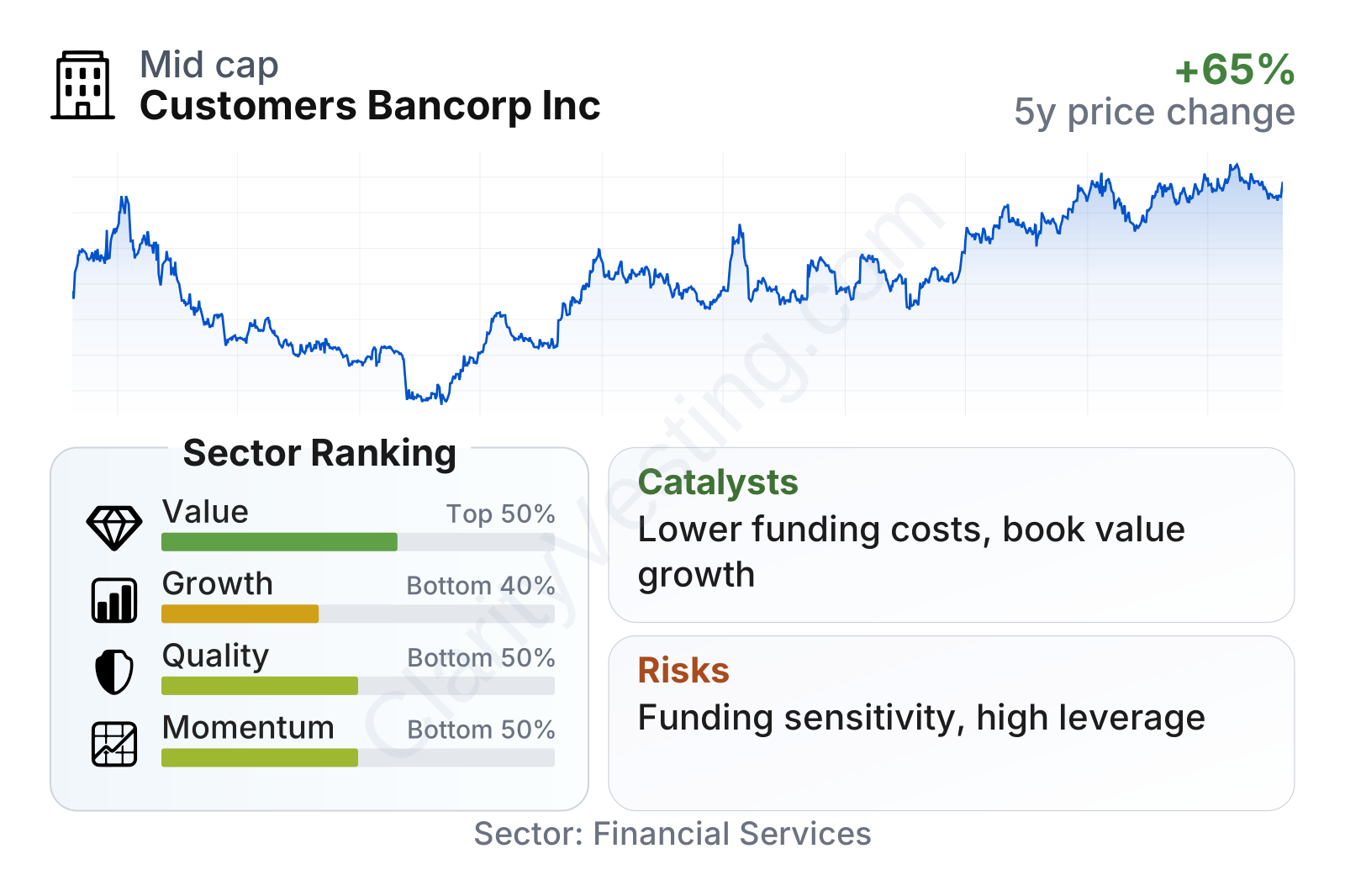
Customers Bancorp is a mid-sized regional bank with a stock that has been notably more volatile than the broader banking group, as reflected in its elevated beta and its sharp swings since 2023. On valuation, it screens somewhat cheaper than the sector on earnings and roughly in line on book value. Profitability is mixed: margins are strong, but return on assets is below the sector median and leverage is clearly higher than many peers. Growth is also mixed, with good book value expansion and decent revenue growth, but weaker earnings compounding over five years. Recent share-price momentum has improved over the longer term, though the shorter-term trend is less convincing than the median regional bank.
Growth
The company operates in a sector that is mature rather than fast-growing, so the growth case depends less on the banking industry expanding quickly and more on Customers Bancorp taking share in targeted niches. That is where its strategy matters. The bank has focused on specialized commercial businesses, digital banking capabilities, and operating efficiency instead of building a large physical branch network. For a smaller institution, that can be a sensible way to grow because it avoids the cost base of a traditional retail bank and allows management to concentrate on products where expertise can support pricing.
Its future growth path looks most tied to commercial lending niches, treasury management, and deposit gathering through technology-enabled channels. If the bank can keep attracting commercial clients while stabilizing deposit costs, earnings growth could improve even without a large jump in the balance sheet. That is especially relevant after the industry-wide stress that followed the 2023 regional banking disruption, when funding strength became just as important as loan growth.
Earnings per share show a business that is profitable but not smooth. Results were very strong in 2021, then compressed, rebounded, and remain below that earlier peak. For long-term analysis, that matters because it suggests the company can generate good profits in favorable conditions, but those profits are highly influenced by rate cycles and funding costs.
Book value per share has moved steadily upward over the last five years, and that is one of the more constructive indicators here. For banks, book value growth often provides a useful read on whether management is building underlying economic value over time. Customers Bancorp has outpaced the sector median on this measure, which supports the view that the franchise has been expanding its capital base even during a turbulent banking period.
A meaningful catalyst is the possibility of a more normal funding environment. If deposit competition eases and interest expense stops rising so aggressively, the company could keep more of what it earns on loans. Another catalyst is continued execution in specialized lending and payments-related banking services, where smaller banks can still carve out profitable positions. Recent company communications have also emphasized capital strength, liquidity, and a continued focus on relationship-based commercial banking rather than balance-sheet growth at any cost, which is the right posture for a bank trying to compound value after a volatile period for the sector.
Risks
This article is for informational purposes only and does not constitute financial advice. Some content is AI-generated. See Disclaimer


