Stock Analysis · CubeSmart (CUBE)
Overview
CubeSmart is a real estate investment trust, or REIT, focused on self-storage. In simple terms, it owns storage properties, rents units to people and businesses, and collects recurring monthly rent. The company also manages some storage locations for third-party owners, which adds fee income without requiring as much capital as buying new properties. Its portfolio is concentrated in major metropolitan areas, with a particularly meaningful presence in densely populated markets along the East Coast and in other large U.S. cities.
The business is relatively easy to understand: demand comes from life events and space constraints. Customers often need storage when moving, downsizing, getting divorced, inheriting items, running a small business, or living in high-cost urban areas with limited home space. That tends to make self-storage more resilient than many other property types, although results still move with housing activity, employment, and consumer budgets.
CubeSmart’s revenue mix is heavily centered on rental income from self-storage properties, while management and other ancillary services play a smaller role.
- Property rental revenue: approximately 94% to 97% of total revenue in recent years. This is the monthly rent paid by customers for storage units, plus related tenant charges.
- Management fees and other revenue: approximately 3% to 6%. This includes fees from managing stores for third-party owners and smaller ancillary income streams such as administrative and service-related charges.
Over the last several years, revenue has generally trended upward, and the business has maintained strong property-level profitability. Operating expenses have stayed comparatively controlled relative to revenue, which helps explain why margins remain solid for a storage REIT.
Key Figures
| Metric | Value | Sector ⓘ |
|---|---|---|
| Date | Oct 24, 2026 | |
| Context | ||
| Sector | Real Estate | |
| Industry | REIT - Industrial | |
| Market Cap ⓘ | $8.82B | |
| Beta ⓘ | 1.04 | |
Value (Cheapness) | ||
| P/E Ratio ⓘ | 26.68 | 17.85 |
| P/B Ratio ⓘ | 3.63 | 0.87 |
| FCF Yield ⓘ | 6.38% | 7.30% |
| Dividend Yield ⓘ | 5.36% | 4.83% |
| EBIT / EV ⓘ | 3.72% | 3.78% |
| PEG ⓘ | 5.33 | |
Growth (Business expansion) | ||
| Revenue Growth ⓘ | 1.50% | 5.35% |
| RPS Growth (5Y CAGR) ⓘ | 5.13% | 6.02% |
| EPS Growth (5Y CAGR) ⓘ | -7.57% | -10.65% |
| BVPS Growth (5Y CAGR) ⓘ | -4.46% | 0.43% |
| Margin Growth (5Y Trend) ⓘ | 11.60% | -0.69% |
| FCF Growth (5Y CAGR) ⓘ | 5.99% | 5.40% |
| DPS Growth (5Y CAGR) ⓘ | 11.69% | 5.07% |
Quality (Business durability) | ||
| ROIC (Latest) ⓘ | 6.17% | 5.69% |
| ROE (Latest) ⓘ | 12.77% | 7.37% |
| ROA (Latest) ⓘ | 5.01% | 2.85% |
| ROIC (5Y Median) ⓘ | 3.36% | 4.26% |
| ROE (5Y Median) ⓘ | 12.26% | 6.04% |
| ROA (5Y Median) ⓘ | 5.12% | 2.45% |
| Net Debt / EBIT (Latest) ⓘ | 7.78 | 7.55 |
| Net Debt / EBIT (5Y Median) ⓘ | 7.92 | 8.26 |
| Net Debt / EBITDA (Latest) ⓘ | 4.98 | 5.26 |
| Net Debt / Assets ⓘ | 53.57% | 37.45% |
| EBITDA / Interest ⓘ | 3.06 | 4.11 |
| Operating Margin (Latest) ⓘ | 39.92% | 33.86% |
| Operating Margin (5Y Median) ⓘ | 39.66% | 37.49% |
| Debt to Equity (Latest) ⓘ | 137.31% | 88.76% |
| Profit Margin (Latest) ⓘ | 29.33% | 18.94% |
| Free Cash Flow (Latest) ⓘ | $562.33M | |
Momentum (Price trend) | ||
| 3Y Return ⓘ | +33.15% | +36.33% |
| 12M Return (excl. last month) ⓘ | +1.74% | +4.32% |
| 6M Return ⓘ | +5.59% | -1.74% |
| Price vs. 200-Day MA ⓘ | +4.26% | -1.42% |
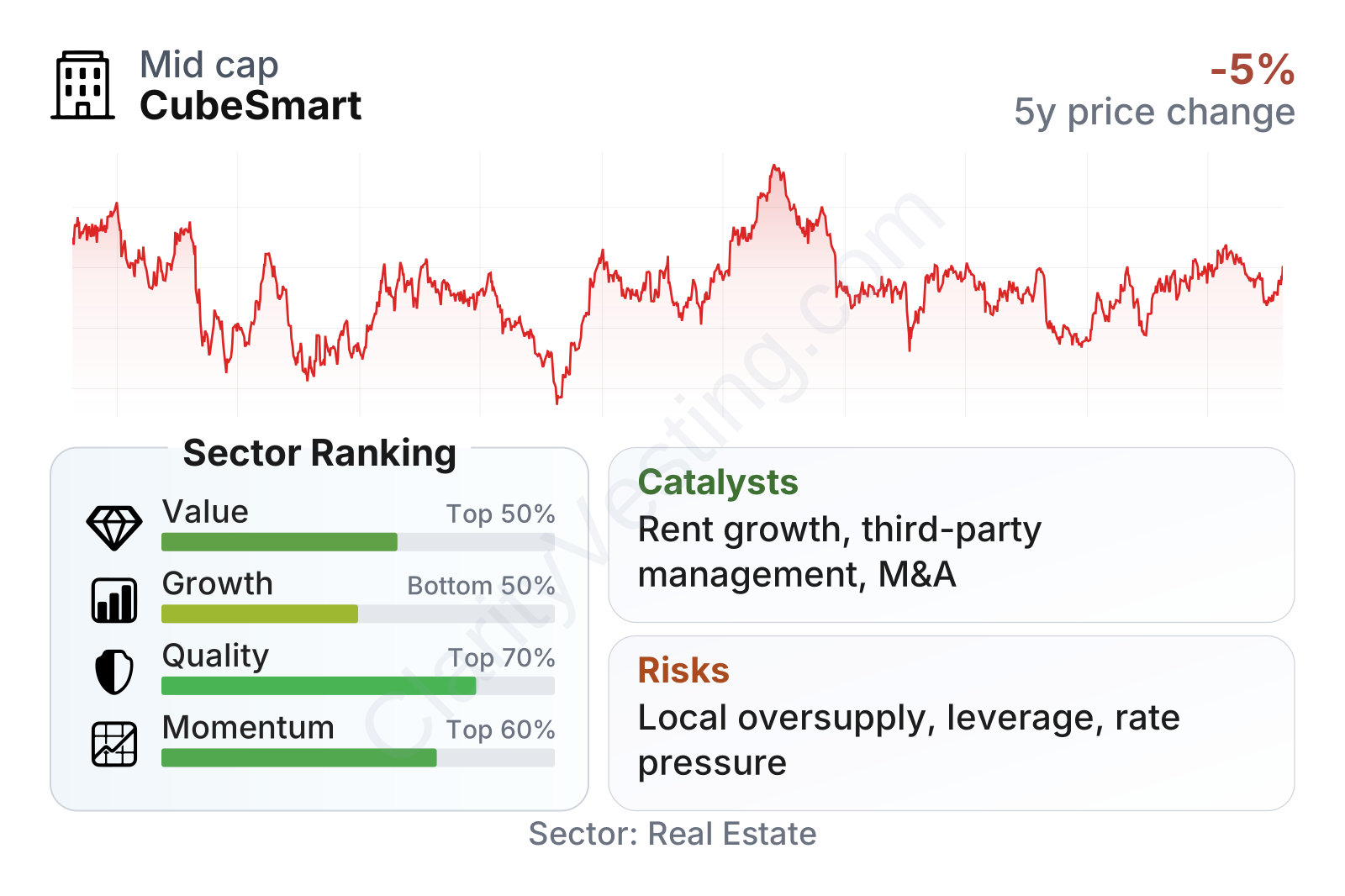
CubeSmart is a large publicly traded storage REIT with a market value in the multi-billion-dollar range and share-price volatility close to the broader market. The overall profile is mixed but understandable: quality metrics are stronger than much of the sector, while growth and recent share-price momentum look more modest. Profitability stands out, with returns on assets and equity above many peers and operating margins around 40%, which is strong for real estate. On valuation, the stock trades at a premium to sector medians on both earnings and book value, while the free-cash-flow yield and EV-based earnings yield are closer to the middle of the pack. The dividend yield is above the sector median, which partly offsets the slower recent growth profile.
Growth
Self-storage remains an attractive long-term niche within real estate because demand is supported by structural rather than purely cyclical forces. Population mobility, household formation, downsizing among older Americans, and the continued rise of small businesses and e-commerce side hustles all create storage needs. In addition, housing affordability pressures can indirectly support the sector: when people live in smaller homes or apartments, they often rent external space.
CubeSmart’s strategy also makes sense for future growth. The company combines owned properties with a third-party management platform, which can expand its operating footprint and local market knowledge without requiring the same amount of balance-sheet investment. That platform can also create acquisition opportunities over time if managed assets become available for purchase. For a storage REIT, this is a practical way to grow while staying disciplined on capital allocation.
Revenue per share has moved upward steadily over the past five years, showing that growth has not depended only on issuing more shares. The pace has been moderate rather than explosive, but consistency matters in a property business where compounding often comes from rent increases, occupancy management, redevelopment, and selective acquisitions.
Dividend per share has also climbed meaningfully over the last five years, with growth well above the sector median over that period. That does not guarantee future increases, but it does suggest that cash generation has been strong enough to support a rising shareholder payout while still funding operations and portfolio needs.
A near-term catalyst for CubeSmart is the operating environment for existing stores. If housing turnover improves and customer move-ins recover further, same-store revenue could strengthen. Another useful tailwind is the company’s urban and suburban market mix, where space constraints and higher housing costs can support demand. Recent company updates have also continued to emphasize a combination of revenue management, expense control, and external growth through acquisitions and third-party management relationships rather than relying on a single growth lever.
Risks
This article is for informational purposes only and does not constitute financial advice. Some content is AI-generated. See Disclaimer


