Stock Analysis · Ampol Ltd (CTXAY)
Overview
Ampol Ltd is an Australian fuel company operating across refining, fuel distribution, retail service stations, convenience sales, and commercial fuels. In simple terms, it buys crude oil and finished fuels, refines part of that supply, moves products through storage and logistics networks, and sells gasoline, diesel, jet fuel, lubricants, and shop items to drivers, businesses, airlines, miners, and industrial customers. The company also has an expanding presence in electric vehicle charging and energy transition infrastructure, although that remains small relative to its traditional fuel business.
Its business is mainly organized around two earnings engines: selling fuel in Australia and New Zealand, and supplying customers in international markets through trading and distribution. Revenue is heavily linked to fuel volumes and fuel prices, so sales can move sharply even when underlying demand changes much less.
The main revenue sources are broadly the following:
- Australian fuels and infrastructure: approximately 70% to 80% of group revenue. This includes retail fuel sold through branded service stations, convenience-related sales, wholesale fuel supply, aviation fuel, marine fuel, and commercial customers such as transport and mining.
- International operations and trading: approximately 20% to 30% of group revenue. This mainly covers fuel supply, trading, and distribution activities in overseas markets, especially through Ampol’s Singapore-based trading and regional channels.
- Convenience retail and newer energy services: a much smaller share of total revenue, but strategically important. This includes in-store purchases and early-stage EV charging and related mobility services. These activities can carry better margins than fuel, even if they are still modest in size.
Ampol’s economic model is typical of fuel refiners and marketers: very large revenue, but relatively thin margins. The business can therefore produce strong cash flow in favorable refining and marketing conditions, while profits can also fall quickly when margins narrow or input costs rise. Over the last several years, the company’s revenue stayed very large, but the share of revenue flowing through to operating profit and net income weakened materially after the stronger 2022-2023 period.
The flow between revenue, operating costs, interest expense, and net income shows a clear pattern: Ampol remains a high-volume business, but profitability has become much tighter. Revenue has stayed in the tens of billions of dollars, while operating income and net income have compressed sharply since 2022, highlighting how sensitive results are to refining margins, fuel market spreads, and financing costs.
Key Figures
| Metric | Value | Sector ⓘ |
|---|---|---|
| Date | Oct 03, 2026 | |
| Context | ||
| Sector | Energy | |
| Industry | Oil & Gas Refining & Marketing | |
| Market Cap ⓘ | $7.35B | |
| Beta ⓘ | 0.14 | |
Value (Cheapness) | ||
| P/E Ratio ⓘ | 7.41 | 14.47 |
| P/B Ratio ⓘ | 1.74 | 1.70 |
| FCF Yield ⓘ | 13.75% | 8.66% |
| Dividend Yield ⓘ | 5.60% | 3.77% |
| EBIT / EV ⓘ | N/A | 7.46% |
| PEG ⓘ | N/A | |
Growth (Business expansion) | ||
| Revenue Growth ⓘ | 33.40% | 27.35% |
| RPS Growth (5Y CAGR) ⓘ | 9.52% | 6.75% |
| EPS Growth (5Y CAGR) ⓘ | N/A | -15.45% |
| BVPS Growth (5Y CAGR) ⓘ | -4.48% | 5.85% |
| Margin Growth (5Y Trend) ⓘ | -3.11% | 0.75% |
| FCF Growth (5Y CAGR) ⓘ | N/A | 3.62% |
| DPS Growth (5Y CAGR) ⓘ | -17.12% | 16.85% |
Quality (Business durability) | ||
| ROIC (Latest) ⓘ | N/A | 11.33% |
| ROA (Latest) ⓘ | 9.25% | 6.03% |
| ROIC (5Y Median) ⓘ | 15.49% | 10.16% |
| ROA (5Y Median) ⓘ | 4.20% | 5.34% |
| Net Debt / EBIT (Latest) ⓘ | N/A | 1.62 |
| Net Debt / EBIT (5Y Median) ⓘ | 3.31 | 1.91 |
| Net Debt / EBITDA (Latest) ⓘ | N/A | 1.06 |
| Net Debt / Assets ⓘ | 31.86% | 17.29% |
| EBITDA / Interest ⓘ | 5.91 | 9.64 |
| Operating Margin (Latest) ⓘ | 3.73% | 16.32% |
| Operating Margin (5Y Median) ⓘ | 2.67% | 19.53% |
| Debt to Equity (Latest) ⓘ | 126.53% | 54.41% |
| Profit Margin (Latest) ⓘ | 4.03% | 8.79% |
| Free Cash Flow (Latest) ⓘ | $1.01B | |
Momentum (Price trend) | ||
| 3Y Return ⓘ | +57.23% | +62.93% |
| 12M Return (excl. last month) ⓘ | +65.57% | +44.83% |
| 6M Return ⓘ | +38.38% | -1.62% |
| Price vs. 200-Day MA ⓘ | +31.15% | +5.18% |
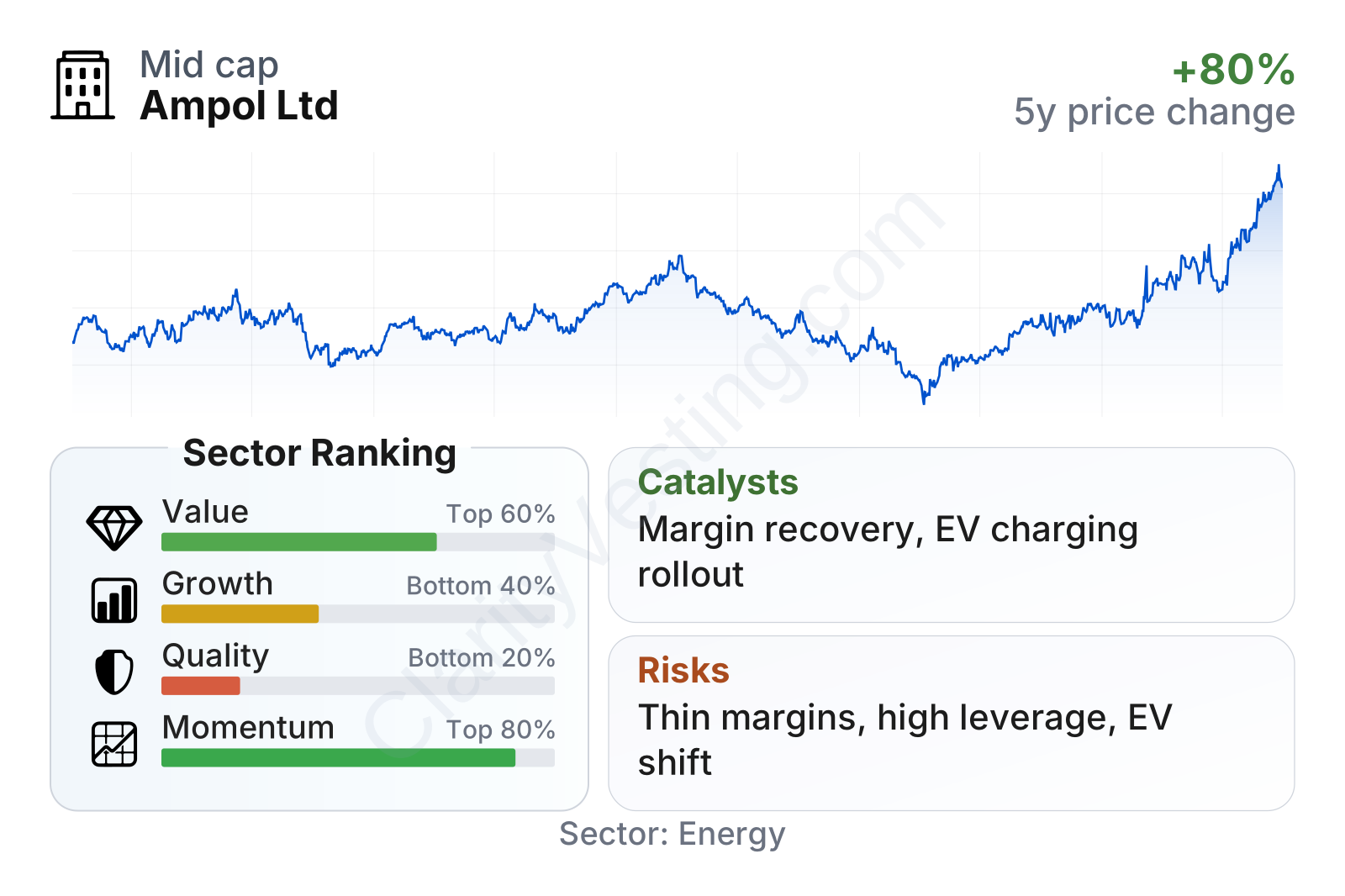
Ampol sits in the large-cap range for its niche and has shown unusually low share-price volatility for an energy stock, with a beta close to 0.14. On valuation, the stock screens inexpensive on earnings, with a P/E around 7.5 versus a sector median near 15, while free cash flow yield and dividend yield are both above sector medians. The more mixed message comes from operating quality: recent leverage is meaningfully above sector norms, margins are thinner than most peers, and sector-relative quality ranks near the lower end despite respectable asset returns in some periods. Price momentum has been strong over the last year, suggesting the market has recently become more constructive even though the underlying business still looks operationally uneven.
Growth
Ampol operates in a mature industry rather than a classic high-growth sector. Fuel demand in developed markets tends to grow slowly, and over very long periods electrification creates a structural challenge for gasoline demand. That said, the company still has several growth paths that are realistic. The first is not simply selling more fuel, but improving the mix toward convenience retail, premium fuels, commercial supply, and infrastructure services. The second is using its logistics network and import terminals to stay relevant even if domestic refining economics become less attractive over time. The third is building out EV charging and broader mobility services so the company can retain customer traffic as vehicle technology changes.
Ampol’s strategy makes industrial sense because it is built around assets that are difficult to replicate quickly: brand recognition, service-station locations, storage terminals, distribution infrastructure, and commercial customer relationships. These are useful whether the company is selling refined fuel, imported product, convenience items, or charging services. The challenge is that strategy execution needs to offset the natural maturity of the core market.
The revenue trend illustrates how cyclical this business is. Growth surged in 2022, helped by higher fuel prices and strong market conditions, then turned negative as price effects normalized and volumes alone were not enough to sustain that pace. That pattern suggests top-line swings should not be read as steady underlying expansion. For Ampol, future growth quality matters more than headline revenue growth: margin stability, network utilization, and higher-value customer mix are likely more important than simply increasing sales dollars.
Cash generation has been one of the more constructive features. Free cash flow has remained solid in absolute terms, showing that the business can still convert its scale into meaningful cash even when accounting profits are under pressure. That matters because fuel refining and distribution are capital-intensive activities, and long-term resilience depends heavily on maintaining cash flow after operating needs and capital spending.
A visible catalyst is the company’s ongoing effort to strengthen convenience retail and energy transition infrastructure around its retail network. Another is any improvement in refining margins or supply conditions, which can have an outsized effect on earnings because the underlying revenue base is so large. In addition, a favorable fuel demand backdrop in commercial and transport markets across Australia can support earnings even without dramatic structural growth.
Risks
This article is for informational purposes only and does not constitute financial advice. Some content is AI-generated. See Disclaimer