Stock Analysis · Ampol Limited (CTXAF)
Overview
Ampol Limited is an Australian downstream energy company focused on refining, importing, distributing, and selling transportation fuels and related products. In simple terms, it buys crude oil and finished fuels, processes part of that supply through its Lytton refinery in Queensland, moves products through storage and logistics infrastructure, and sells them through wholesale channels and a large retail network of service stations. The company also has a growing presence in electric vehicle charging through AmpCharge, which broadens its role beyond traditional liquid fuels.
Its business is still centered on road transport energy, especially gasoline, diesel, jet fuel, and convenience retail. Ampol also operates in New Zealand through channels tied to fuel supply and distribution, although Australia remains the core market. Because refining and fuel marketing are high-volume but low-margin activities, results can swing sharply with refining margins, oil prices, foreign exchange movements, inventory effects, and transport demand.
The company’s revenue mix is not disclosed in a simple single-line format for every stream, but public reporting supports the following broad picture of where sales come from:
- Fuel sales through retail and wholesale channels: approximately 80% to 90% of group revenue. This includes gasoline, diesel, aviation fuel, marine fuel, and sales to commercial, mining, agriculture, and transport customers.
- Refining-related product sales: a substantial share within the fuel business, tied to output from the Lytton refinery and imported products. Refining is economically important, but reported revenue is still mainly recognized through product sales rather than as a separate large stand-alone line.
- Convenience retail and shop income: likely in the low single-digit percentage range of group revenue, but more meaningful as a contributor to margin than to total sales dollars. This includes food, beverages, and everyday items sold at service stations.
- Other energy and services: a small share, including lubricants, card services, and early-stage EV charging activities.
A notable feature of Ampol is that it combines infrastructure ownership, refining capability, supply trading, wholesale relationships, and consumer-facing stations. That makes it more vertically integrated than a pure fuel retailer, but it also means results are exposed to more moving parts.
The long-term pattern shows how sensitive profitability is in this industry. Revenue expanded sharply in 2022 on higher fuel prices, then moderated. More importantly, operating income and net income fell much faster than revenue in 2024 and 2025, showing that margin pressure, higher operating costs, and interest expense can outweigh the benefit of large sales volumes.
Key Figures
| Metric | Value | Sector ⓘ |
|---|---|---|
| Date | Oct 03, 2026 | |
| Context | ||
| Sector | Energy | |
| Industry | Oil & Gas Refining & Marketing | |
| Market Cap ⓘ | $4.60B | |
| Beta ⓘ | 0.14 | |
Value (Cheapness) | ||
| P/E Ratio ⓘ | 4.58 | 14.47 |
| P/B Ratio ⓘ | 1.75 | 1.70 |
| FCF Yield ⓘ | 21.20% | 8.66% |
| Dividend Yield ⓘ | 15.03% | 3.77% |
| EBIT / EV ⓘ | N/A | 7.46% |
| PEG ⓘ | N/A | |
Growth (Business expansion) | ||
| Revenue Growth ⓘ | 33.40% | 27.35% |
| RPS Growth (5Y CAGR) ⓘ | 10.46% | 6.75% |
| EPS Growth (5Y CAGR) ⓘ | -34.60% | -15.45% |
| BVPS Growth (5Y CAGR) ⓘ | -4.46% | 5.85% |
| Margin Growth (5Y Trend) ⓘ | -3.11% | 0.75% |
| FCF Growth (5Y CAGR) ⓘ | N/A | 3.62% |
| DPS Growth (5Y CAGR) ⓘ | -16.41% | 16.85% |
Quality (Business durability) | ||
| ROIC (Latest) ⓘ | N/A | 11.33% |
| ROA (Latest) ⓘ | 9.13% | 6.03% |
| ROIC (5Y Median) ⓘ | 15.49% | 10.16% |
| ROA (5Y Median) ⓘ | 4.20% | 5.34% |
| Net Debt / EBIT (Latest) ⓘ | N/A | 1.62 |
| Net Debt / EBIT (5Y Median) ⓘ | 3.31 | 1.91 |
| Net Debt / EBITDA (Latest) ⓘ | N/A | 1.06 |
| Net Debt / Assets ⓘ | 31.86% | 17.29% |
| EBITDA / Interest ⓘ | 5.87 | 9.64 |
| Operating Margin (Latest) ⓘ | 3.70% | 16.32% |
| Operating Margin (5Y Median) ⓘ | 2.67% | 19.53% |
| Debt to Equity (Latest) ⓘ | 126.53% | 54.41% |
| Profit Margin (Latest) ⓘ | 4.03% | 8.79% |
| Free Cash Flow (Latest) ⓘ | $975.08M | |
Momentum (Price trend) | ||
| 3Y Return ⓘ | +72.32% | +62.93% |
| 12M Return (excl. last month) ⓘ | +72.90% | +44.83% |
| 6M Return ⓘ | +97.22% | -1.62% |
| Price vs. 200-Day MA ⓘ | +100.55% | +5.18% |
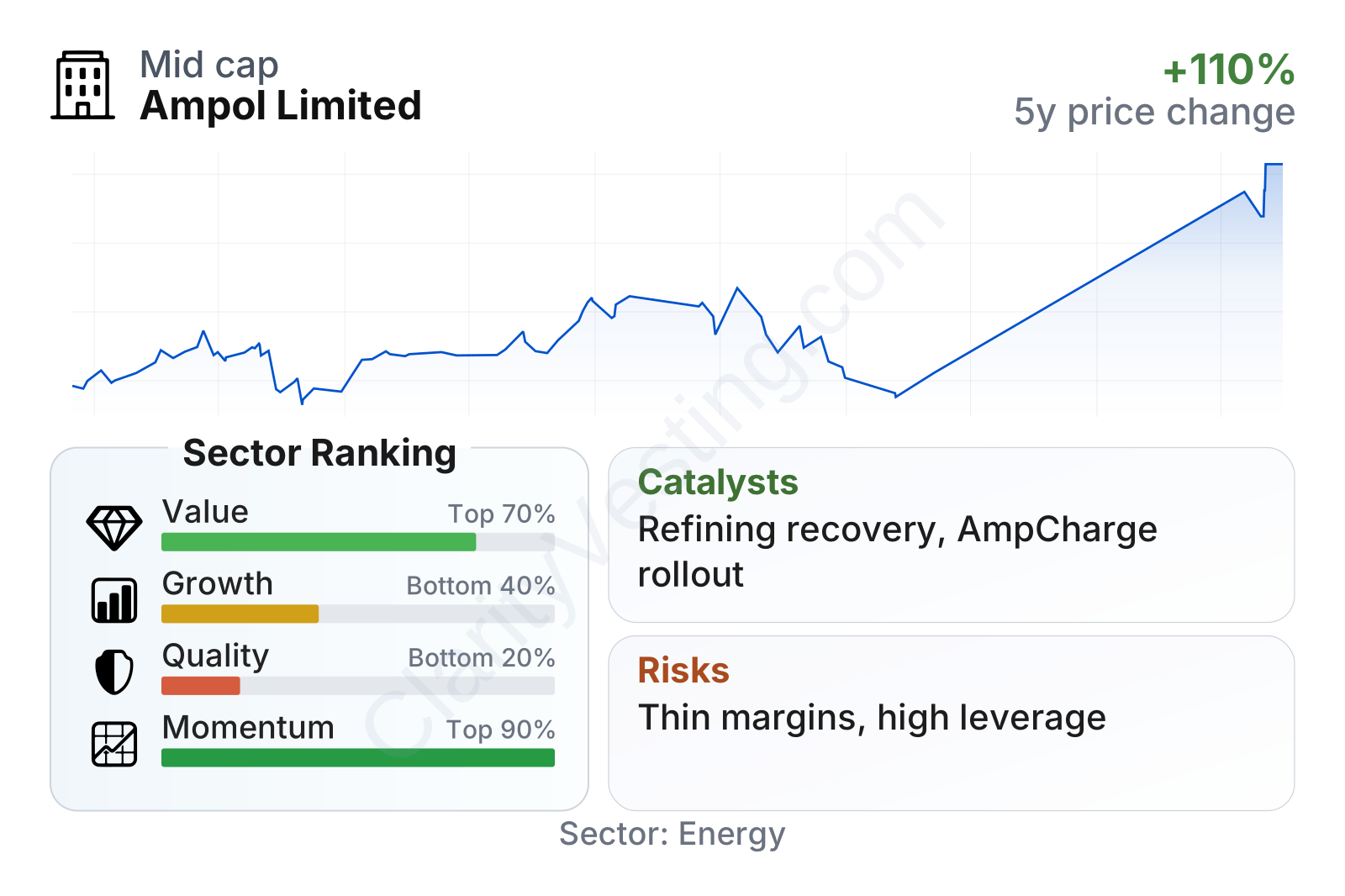
Ampol looks inexpensive on earnings and cash flow compared with much of the energy sector, with a very low P/E ratio, a free cash flow yield well above the sector median, and a high trailing dividend yield. Price momentum has also been unusually strong over the last 6 to 12 months and over three years.
That said, the quality and growth profile is much weaker than the valuation metrics suggest. Profitability is thin, operating margins are far below sector norms, leverage is elevated, and interest coverage is more limited than many peers. The picture is therefore mixed: the stock screens as cheap, but that discount lines up with a business whose earnings have been volatile and whose balance-sheet flexibility is not especially strong.
Growth
Ampol operates in a sector that is mature rather than structurally high-growth. Demand for liquid transport fuels does not usually grow at the pace seen in technology or healthcare, and over the very long run electrification creates a challenge for gasoline demand. Even so, the business can still grow through market share gains, stronger convenience sales, better supply-chain efficiency, and selective expansion in faster-growing niches such as commercial fuels, aviation, and EV charging.
The company’s strategy broadly makes industrial sense. Australia still depends heavily on transport fuels, and domestic refining capacity has become more limited over time. Ampol’s Lytton refinery, import terminals, storage assets, and station network form a useful logistics system in a market where supply reliability matters. This can support earnings when refining margins improve or when disciplined supply-chain management lowers costs.
Ampol also has a practical transition angle. Rather than trying to transform overnight, it is gradually adding EV charging infrastructure at selected sites while keeping its core fuel network productive. For a company with established roadside locations, that is a logical extension of existing assets. The opportunity is not large enough yet to reshape group earnings, but it can help preserve relevance as vehicle fleets evolve.
One near- to medium-term catalyst is any recovery in refining margins and retail fuel profitability after a weak earnings period. Another is execution on cost discipline after the sharp increase in selling and administrative expense seen in 2024. If margins normalize even modestly, earnings can rebound significantly because the company operates at very large revenue scale. In addition, Australia’s focus on fuel security gives strategic relevance to local refining and import infrastructure, which may remain supportive for operators such as Ampol.
Risks
This article is for informational purposes only and does not constitute financial advice. Some content is AI-generated. See Disclaimer


