Stock Analysis · Corteva Inc (CTVA)
Overview
Corteva is a global agriculture company focused on helping farmers raise crop yields and protect fields from weeds, insects, and disease. The business was created from the agriculture assets of DowDuPont and today operates mainly through two large activities: seeds and crop protection products. Its customers are farmers, distributors, and agricultural retailers across North America, Latin America, Europe, and Asia-Pacific.
The company’s revenue is mainly generated from the sale of proprietary seed genetics and branded crop chemicals. Based on recent annual reporting, the mix is dominated by seeds, with crop protection as the second pillar.
- Seed: approximately 56% of revenue. This includes corn, soybean, and other seed products, often paired with genetic traits designed for insect resistance or herbicide tolerance.
- Crop Protection: approximately 44% of revenue. This includes herbicides, insecticides, fungicides, and biological products used to protect crops and improve field productivity.
Corteva’s model is built around recurring demand from agriculture rather than one-time industrial projects. Farmers need new seed each planting season and continue using crop protection products every year, which gives the business a large installed customer base. At the same time, performance depends heavily on crop prices, farm economics, weather, and product innovation.
The cost structure also shows a business that spends heavily on commercial support and research. Selling, general, and administrative costs remain significant, while research and development has steadily moved higher over the last several years. That is important because new traits, chemicals, and biological solutions are central to maintaining pricing power and market share.
Over the past few years, revenue has stayed in a fairly narrow band while gross profit and operating income have recovered after a softer 2023. That suggests the company has recently made more progress through mix, pricing, and cost discipline than through simple top-line expansion alone.
Key Figures
| Metric | Value | Sector ⓘ |
|---|---|---|
| Date | Oct 17, 2026 | |
| Context | ||
| Sector | Basic Materials | |
| Industry | Agricultural Inputs | |
| Market Cap ⓘ | $8.91B | |
| Beta ⓘ | 0.58 | |
Value (Cheapness) | ||
| P/E Ratio ⓘ | 8.20 | 16.90 |
| P/B Ratio ⓘ | 0.36 | 1.65 |
| FCF Yield ⓘ | 7.06% | 5.76% |
| Dividend Yield ⓘ | 6.62% | 2.13% |
| EBIT / EV ⓘ | 3.56% | 6.30% |
| PEG ⓘ | 1.05 | |
Growth (Business expansion) | ||
| Revenue Growth ⓘ | -1.20% | 11.10% |
| RPS Growth (5Y CAGR) ⓘ | 4.88% | 4.49% |
| EPS Growth (5Y CAGR) ⓘ | 10.09% | -13.47% |
| BVPS Growth (5Y CAGR) ⓘ | 0.85% | 5.51% |
| Margin Growth (5Y Trend) ⓘ | -4.44% | -1.54% |
| FCF Growth (5Y CAGR) ⓘ | 6.92% | 0.37% |
| DPS Growth (5Y CAGR) ⓘ | 6.82% | 6.08% |
Quality (Business durability) | ||
| ROIC (Latest) ⓘ | N/A | 9.26% |
| ROA (Latest) ⓘ | 2.41% | 4.91% |
| ROIC (5Y Median) ⓘ | 4.83% | 7.70% |
| ROA (5Y Median) ⓘ | 2.62% | 3.86% |
| Net Debt / EBIT (Latest) ⓘ | 1.25 | 1.40 |
| Net Debt / EBIT (5Y Median) ⓘ | -1.04 | 1.70 |
| Net Debt / EBITDA (Latest) ⓘ | 0.77 | 0.95 |
| Net Debt / Assets ⓘ | 6.03% | 13.69% |
| EBITDA / Interest ⓘ | 18.53 | 12.34 |
| Operating Margin (Latest) ⓘ | 11.23% | 13.20% |
| Operating Margin (5Y Median) ⓘ | 8.92% | 11.80% |
| Debt to Equity (Latest) ⓘ | 19.38% | 40.56% |
| Profit Margin (Latest) ⓘ | 2.76% | 6.43% |
| Free Cash Flow (Latest) ⓘ | $629.00M | |
Momentum (Price trend) | ||
| 3Y Return ⓘ | +123.52% | +68.89% |
| 12M Return (excl. last month) ⓘ | +18.30% | +30.21% |
| 6M Return ⓘ | +10.92% | -4.16% |
| Price vs. 200-Day MA ⓘ | +14.53% | -1.27% |
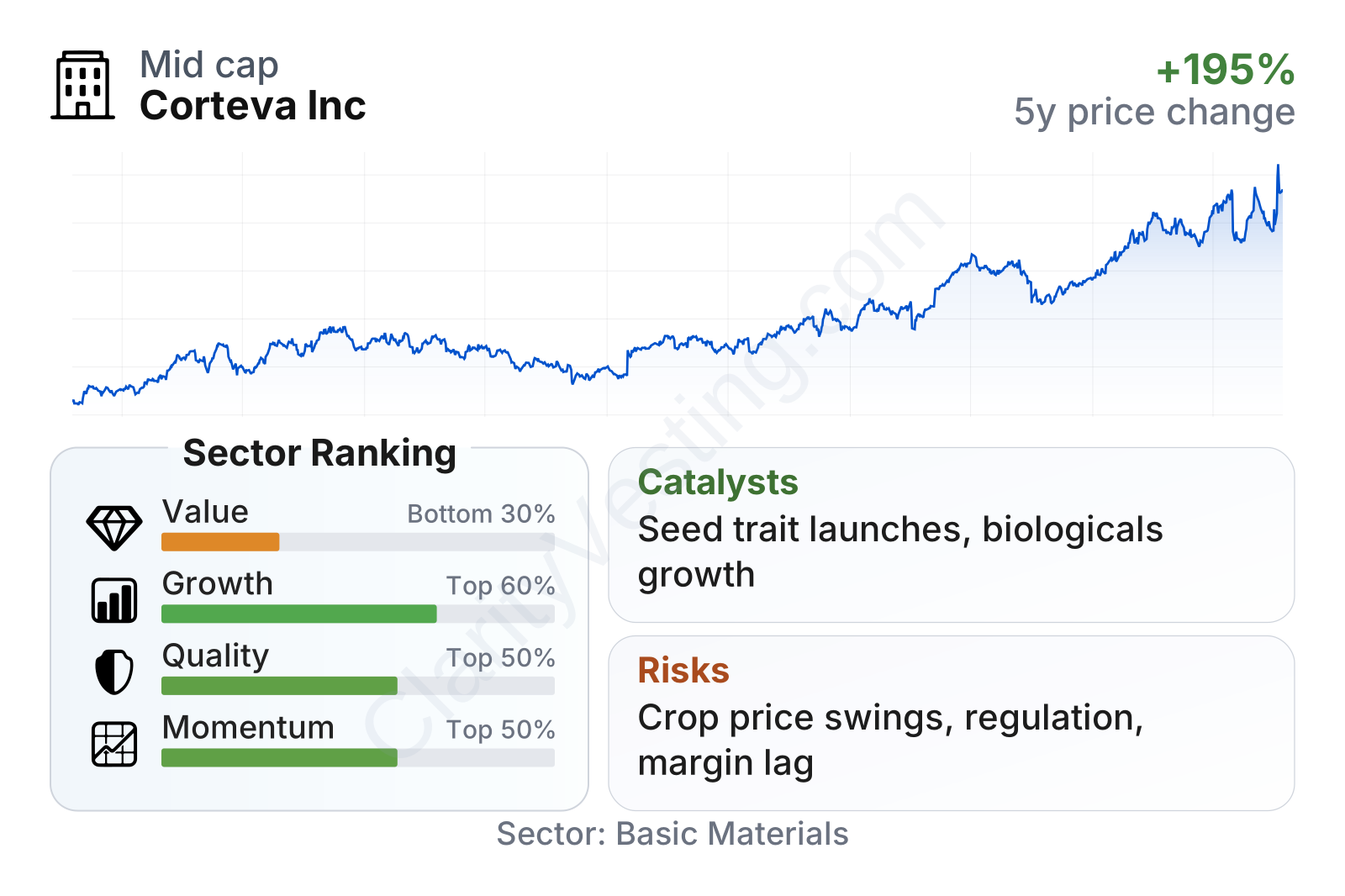
Corteva is a large agricultural inputs company with relatively low share-price volatility, as shown by a beta well below 1. On the balance sheet side, leverage is modest for the industry. The main weakness in the current snapshot is valuation: earnings and cash-flow multiples sit on the expensive side versus the sector, while quality metrics such as returns on assets and margins are more middle-of-the-pack to below-median rather than elite. Growth indicators are mixed: the recent year has been soft, but the five-year record for earnings, free cash flow, and dividends is notably better.
Growth
Agriculture remains a structurally important sector because the world needs more food from limited arable land. That supports long-term demand for higher-yield seeds, crop protection products, and technologies that improve farm productivity. Corteva is positioned in this theme through a portfolio that spans both genetics and chemicals, which gives it multiple ways to participate in grower spending.
The company’s strategy for future expansion is logical. Management has emphasized premium seed traits, new crop protection molecules, biologicals, and a more focused geographic portfolio. This matters because agriculture input markets do not grow smoothly every year; companies often create value by launching products with better performance or by taking price through differentiated technology. Corteva’s steady research spending supports that approach.
Recent revenue growth has been uneven. There was strong momentum in 2021 and 2022, followed by a period of declines and then a partial rebound. The latest reading is close to flat to slightly negative year over year, which shows the business is still moving through a cyclical patch rather than a clean acceleration. Even so, the five-year picture is better than the latest quarter alone would suggest, especially at the earnings-per-share level.
Cash generation has improved materially from the weak point in 2023. Free cash flow moved back into solid positive territory and has remained strong over the last two years, which is encouraging because it gives the company room to fund research, dividends, debt service, and share repurchases without relying heavily on borrowing.
One notable catalyst is Corteva’s push into biologicals and differentiated crop protection products. Biological solutions are still a smaller part of the industry than conventional chemicals, but they are attracting attention because farmers want tools that can work alongside existing programs and fit evolving regulatory expectations. The company has also continued to highlight new product launches and trait adoption in its seed portfolio, particularly in corn and soybean systems, which can support pricing and mix over time.
Another potential opportunity comes from normalization in the agricultural cycle. If farm economics improve after a period of caution, spending on premium inputs can recover. Corteva does not need a broad commodity boom to benefit, but better sentiment among growers would help volumes and reduce pressure on channel inventories.
Risks
This article is for informational purposes only and does not constitute financial advice. Some content is AI-generated. See Disclaimer


