Stock Analysis · Centuri Holdings Inc (CTRI)
Overview
Centuri Holdings Inc is a utility infrastructure services company. In simple terms, it helps build, replace, repair, and maintain the networks that deliver natural gas and electricity. Its crews work on pipelines, electric distribution systems, transmission-related projects, and other field services that utilities and infrastructure owners outsource. The company operates mainly in the United States and Canada and was separated from Southwest Gas Holdings through an initial public offering in 2024.
Centuri’s revenue comes primarily from contracted construction and maintenance work rather than from owning utility assets itself. Based on the company’s recent annual reporting, revenue is spread across a few main activity areas, although exact public breakouts can vary by filing and presentation.
- Gas utility infrastructure services: approximately 50% to 60% of revenue. This includes pipeline installation, replacement, integrity work, maintenance, and emergency response for natural gas distribution systems.
- Electric utility infrastructure services: approximately 30% to 40% of revenue. This includes work on overhead and underground electric distribution systems, grid hardening, storm restoration, and related field services.
- Other infrastructure services: approximately 5% to 15% of revenue. This can include broader utility and energy-related services depending on customer demand and project mix.
The broad economic logic is straightforward: utilities must keep their networks safe, compliant, and reliable, and much of that work is recurring. Centuri therefore sits in a part of the utility value chain that benefits from ongoing replacement cycles and capital spending by its customers. Over the last several years, revenue has generally moved upward, but profitability has been much less stable, showing that scale alone has not automatically translated into strong earnings.
The business mix shows a company with multi-billion-dollar revenue, very high direct project costs, and thin earnings. Revenue recovered in 2025 after a softer 2024, while operating income improved from prior losses. Even so, the overall picture remains one of a contractor with narrow margins, where execution and cost control matter as much as demand.
Key Figures
| Metric | Value | Sector ⓘ |
|---|---|---|
| Date | Oct 17, 2026 | |
| Context | ||
| Sector | Utilities | |
| Industry | Utilities - Regulated Gas | |
| Market Cap ⓘ | $2.10B | |
| Beta ⓘ | 1.01 | |
Value (Cheapness) | ||
| P/E Ratio ⓘ | 62.97 | 17.28 |
| P/B Ratio ⓘ | 2.33 | 1.51 |
| FCF Yield ⓘ | -0.73% | 0.65% |
| Dividend Yield ⓘ | N/A | 3.77% |
| EBIT / EV ⓘ | 3.17% | 5.01% |
| PEG ⓘ | 0.54 | |
Growth (Business expansion) | ||
| Revenue Growth ⓘ | 32.90% | 6.10% |
| RPS Growth (5Y CAGR) ⓘ | 6.99% | 3.87% |
| EPS Growth (5Y CAGR) ⓘ | 0.95% | -11.30% |
| BVPS Growth (5Y CAGR) ⓘ | 15.40% | 4.23% |
| Margin Growth (5Y Trend) ⓘ | -0.79% | 3.57% |
| FCF Growth (5Y CAGR) ⓘ | N/A | -8.84% |
| DPS Growth (5Y CAGR) ⓘ | N/A | 4.84% |
Quality (Business durability) | ||
| ROIC (Latest) ⓘ | 4.39% | 6.53% |
| ROA (Latest) ⓘ | 1.26% | 3.20% |
| ROIC (5Y Median) ⓘ | N/A | 5.95% |
| ROA (5Y Median) ⓘ | -3.51% | 2.75% |
| Net Debt / EBIT (Latest) ⓘ | 9.58 | 7.13 |
| Net Debt / EBIT (5Y Median) ⓘ | 11.01 | 7.23 |
| Net Debt / EBITDA (Latest) ⓘ | 3.50 | 4.31 |
| Net Debt / Assets ⓘ | 36.98% | 38.42% |
| EBITDA / Interest ⓘ | 3.80 | 4.58 |
| Operating Margin (Latest) ⓘ | 2.86% | 20.83% |
| Operating Margin (5Y Median) ⓘ | 3.22% | 20.08% |
| Debt to Equity (Latest) ⓘ | 106.94% | 137.69% |
| Profit Margin (Latest) ⓘ | 0.85% | 11.37% |
| Free Cash Flow (Latest) ⓘ | -$15.22M | |
Momentum (Price trend) | ||
| 3Y Return ⓘ | N/A | +52.37% |
| 12M Return (excl. last month) ⓘ | -14.99% | +8.84% |
| 6M Return ⓘ | -41.34% | -3.95% |
| Price vs. 200-Day MA ⓘ | -28.76% | -0.79% |
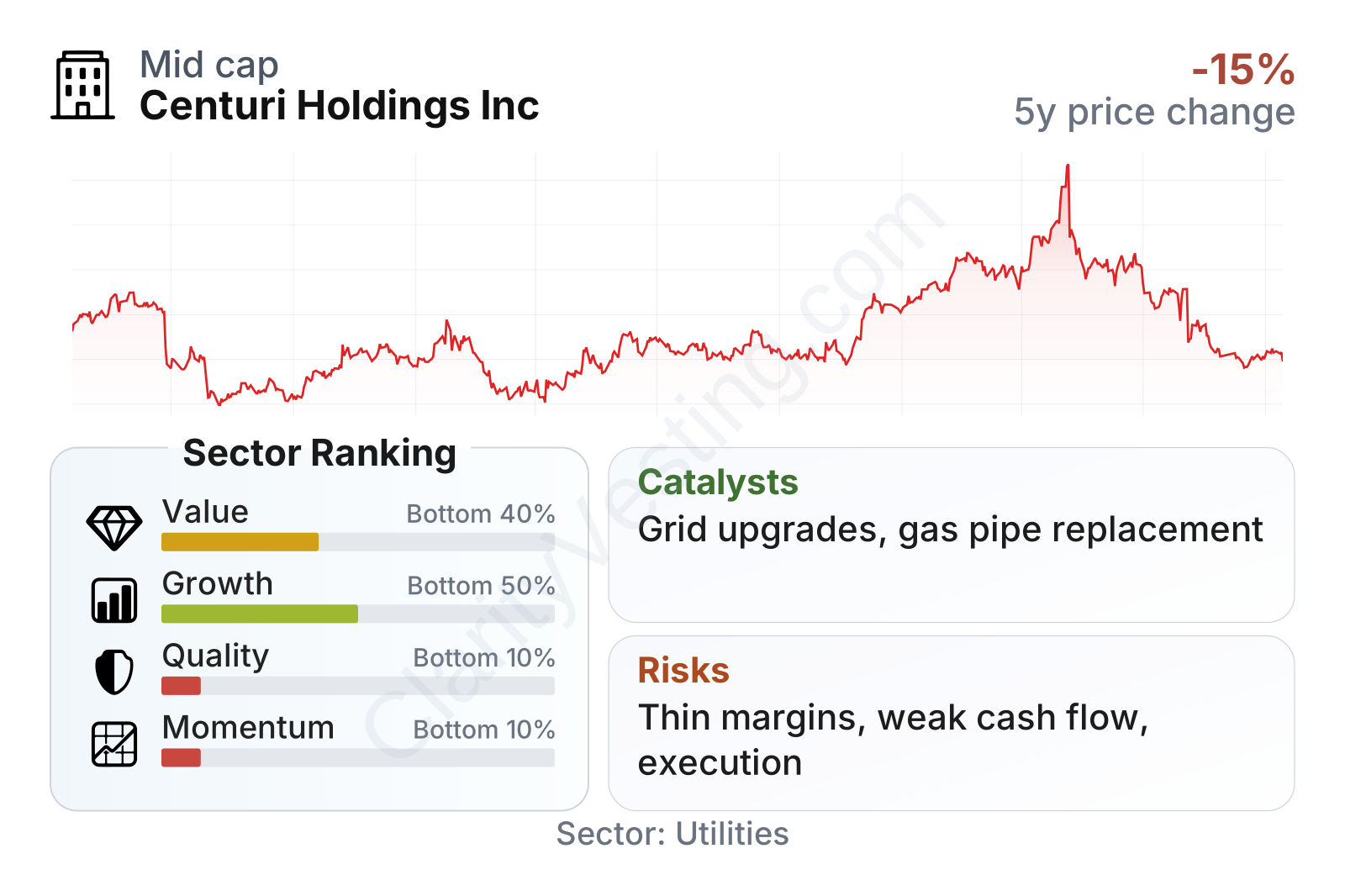
Centuri is a mid-sized listed infrastructure contractor with a share price history that has been volatile since listing. The factor table points to a mixed profile: growth metrics are better than many utility-sector peers, but quality, momentum, and valuation look weaker. In particular, profitability and returns on capital remain low for the amount of revenue the company generates, while the stock trades at a noticeably higher earnings multiple than the sector median.
The market behavior also reflects that tension. The stock has had periods of strong recovery, but recent momentum indicators remain weak relative to the broader utility group. That suggests the market is still debating whether Centuri’s improving operating performance is durable enough to support its valuation.
Growth
Centuri operates in a sector with real long-term demand drivers. North American gas and electric networks require constant maintenance, and many systems are aging. Utilities are also spending on safety upgrades, replacement of older pipe, electric reliability, undergrounding in some markets, grid modernization, and storm hardening. Those trends create a steady need for specialized field crews, equipment, and local operating footprints, which is exactly where Centuri is positioned.
The company’s strategy also makes industrial sense. Utilities often prefer outsourcing labor-intensive work to established contractors with safety credentials, regulatory familiarity, and regional scale. Centuri’s presence across gas and electric infrastructure can help it capture work from customers that want fewer service providers and broader capabilities. That is especially relevant as spending shifts from simple maintenance toward more complex system upgrades.
Revenue per share has trended upward over the last five years, with growth clearly stronger than the sector median. That supports the view that Centuri has been expanding its activity base, even if annual results have not moved in a straight line. The more difficult question is not demand, but how much of that revenue can be converted into durable profit.
Cash generation is a more uneven part of the growth case. Free cash flow was positive at points, then turned negative again on a trailing basis in 2026. For a project-based business, working capital swings can be significant, especially when revenue grows quickly. A return to steadier cash conversion would matter because it would give more confidence that growth is creating financial value rather than simply adding volume.
A notable recent opportunity is the continued buildout and refurbishment of utility infrastructure in North America. Public policy support for grid resilience, electrification-related upgrades, and replacement of older gas systems can expand the addressable market. Centuri does not need to win a single transformative contract to benefit; a broad increase in utility capital programs can support demand across many local markets.
Risks
This article is for informational purposes only and does not constitute financial advice. Some content is AI-generated. See Disclaimer


